Monday, 10 February 2014

Head to Head in the Midfield - Lamson Guru vs Loop Evotec


We're approaching that time of year again.  The Christmas credit card bill slamming our bank account is now in memory not prospect, and the green shoots of financial optimism are sprouting in step with the snowdrops.    The primroses will be out soon and the first swallows have already left Nigeria.  Just as the signs of spring emerge and the sun gives some warmth, the attraction of new equipment once again threatens to trump our 6 week old resolve.

The Market Context


As you will know from Reel Value, I've spent most of my life at the bargain end of the reel market.  Trusty old friends like the Vision Koma and the Loop CLW continue to give me excellent service.  But scanning the catalogues that are arriving on my doormat to coincide with the annual salmon-fisher spring madness, it's clear that there's a strong market in more expensive reels.  Certainly the manufacturers think so, as you can see from the table below which shows what's in the shops at the intermediate price point between bargain and exotic.


The first point that stands out is that every major manufacturer has a product in this range.  Second, the tight clustering in the £200-300 band recognises that buyers at this level still retain a degree of price sensitivity.  They've done well economically; can justify spending this order of money; want something good and aesthetically pleasing; but don't wish to go up to the exotic range (where the price band is 5 times wider).  That recognition drives competition to the benefit of the buyer, yielding an excellent engineering quality - price balance in very good looking packages.  If you exclude the idiosyncratic click-check Hardy Marquis (the 'singing reel'), there are great technical similarities across the range in terms of the specification and use of materials, machining processes and sub-assemblies.  There's lots of contrasting finishing, weight saving perforations and other eye-catching features that are more to do with product differentiation than any difference in function.

Manufacture


Many of them are made in South Korea.  The choice of location has nothing to do with cheap labour.  South Korea is one of the most advanced manufacturing economies in the world, competing on quality with the EU, US, UK and Japan.  The fishing reel business is all about design, limited volumes and flexible manufacturing.  The production runs are very short in engineering terms: once set up, a pair of multi-station CNC machines could make most of the frames and spools for a year's sales of one of these reels in little more than 72 hours.  Subsequent powder coating/enamelling, assembly and finishing would keep half a dozen people busy for a week on each phase.  As a result there is unlikely to be a single plant making uniquely Brand A and nothing else.  With a proven track record in making fishing reels, the factory will bid competitively for work from the big brands, re-tooling between each batch, in order to reach economic volumes.  Set-up and re-tooling represent significant costs, which in part explains why the brands re-use components across their ranges (e.g. drag assemblies).

The Contenders


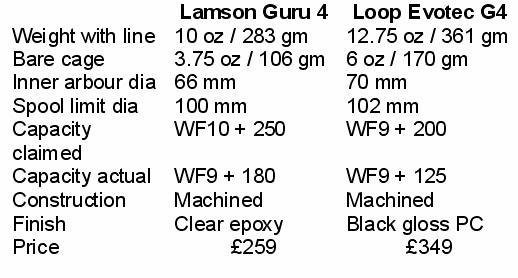
At various times over the past 5 years I've used about half of the reels in the table (6/13).  Some have been just for the odd day, whereas I've owned a Lamson Konic and a Guru for some years.  Last autumn I succumbed to the temptation of a Loop Evotec - it was in a discount sale at a lower price than a Multi (a first class reel) - and used it for 5-6 days at the back end of the season.  Based on that experience I thought there might be some merit in doing a detailed comparison of the Evotec with the Guru, because they straddle the price range and mark the opposite ends of the spectrum of design philosophies.


Respectable working clearances
You will immediately spot some differences in my measurements from the manufacturers' specifications.  These centre on the fact that normal anglers don't always wind the line on perfectly, especially when fighting a fish, and therefore need more clearance.  You don't want a jam between line and frame when you're bringing a 20 pounder into the critical last 6-8 yards.  This need for a realistic clearance as shown in the picture to the right reduces the capacity of both reels, but especially the Loop.  Bearing in mind that the Loop is sold as an #8/10, one wonders how much backing you'd have with a #10 line.


The first clue to the differing design philosophies is in the overall weight, and specifically of the bare cage: the Loop is 25% heavier overall; in the cage the margin's 60%. 


You can summarise the 2 approaches as 'Just Because' and 'Just in Case'.  Lamson is subsidiary of a design company (they do lots of other things) with a strong suit in material sciences.  They first came into reels via Sage. The elegant symmetry of the Guru's open frame design gives maximum strength with minimum metal to satisfy its design brief as a salmon and steelhead reel.  If you wish to go after bigger fish then you have to upgrade to the full-frame ARX at £450.  In contrast the Loop is a full-frame design with lots of extra metal, just in case you wish to mount the 9/13 spool and chase serious fish (like this).  That said, the asymmetric 'double L' strut is a bit of form over function, which isn't an efficient use of metal and so adds weight to achieve the required strength.


The Loop's 'just in case' mode is plainly visible in the drag (which you will also find in the Multi and CLW/Xact).  Not only will it stop serious fish (and the odd truck), it is capable of doing it with respectable frequency.  It is not, however, in the really big brake league alongside the classic 'flats' reels like the Tibor, Abel and their ilk.  Like the disc brakes on high performance cars it's all related to contact area.  With the 'centre contact' drag designs used in these 2 reels, that translates into the diameter of the spindle and its internal surface area.  Once I'd overcome the incorrect factory setting of the Evotec's drag (3 minutes with a supplied fine hex key) full happiness was restored.  With a selection of fish in various water states it was smooth and importantly, uniformly progressive in adjustment.


The Lamson's elegant and efficient theme extends into its drag system, which is based on pressing one metal cone into another (with all manner of clever coatings).  There are no fibre or ceramic washers.  However, its smaller contact area might be a limiting factor if you had to fight lots of very large salmon in heavy water.   For those who don't fish in Russia, the Guru will subdue 99% of what we're likely to encounter.  If we did hook the 1% monster of our dreams, the leader would give up long before the Guru.  I find it a nice fighting reel with a smooth drag progression.  Its open frame allows palming of the rim, which is handy in the closing stages when you don't want the drag too tight.  For me it's handled fish up to 19 lbs with ease and passed the stress test of a silver fresh 15 pounder in a confined space - rapids below, right angle bend and overhanging trees upstream, and a big sharp rock in the middle.

The design philosophy differences extend to the drag knobs, the Lamson's is scalloped and elegant, whereas the Loop's is a simple utilitarian knurled affair.  Actually, the Loop's works better with wet cold fingers and gloves.  You just slap your hand onto it and turn.  The Lamson requires you to place your fingers in the recesses - a mite too clever for me - and the beautifully polished stainless steel can be slippery.  The same applies to the handles: rubbery practicality on the Loop versus the Guru's polished metal.


Quality & Durability

Both reels are very well made.  The quality of machining is excellent and the surface finishing good.  The black gloss on the Loop is, however, vulnerable to 'gravel rash'.  I treat my kit with care, but after only 5 days' fishing the marks are clearly visible owing to the high contrast between the black surface and the underlying aluminium.  The Guru's clear epoxy coating is highly effective: where it has been breached the rash doesn't show up, even after 3 season's use.

Balance

The final issue to consider is balance.  The best reel in the world is no use if it doesn't sit well on your rod in a gentle horizontal balance with one hand on the cork and the other on the line.  If the reel's too heavy the rod tip keeps drifting upwards and you have to move your hand back.  More inconveniently, if it's too light the rod tip keeps catching the water, which requires hand movement and positive effort to correct.  If it's too pronounced you have no choice but to add weight to the reel or rod butt with lead tape.

I bought the Guru to go with a bespoke 13' #8/9 Charles Burns ('Ure Celebration') enabled by a bequest from an aunt.  By virtue of sound advice from the reel dealer and checking the balance in the shop, the overall balance is perfect.  But the Guru is not a happy union with any of the family's 14 footers: it's just too light.  With the Loop the position is completely reversed: it's too heavy at 13' and spot on at 14'.  It's an ideal match with the Cross S1 - they'd be daft if it wasn't - which leads me to suspect a connection with some of the  Evotec's additional mass.  I don't own a 15' rod, but it would be interesting to check its balance with the Evotec with the bigger #9/13 spool.

Conclusions

In summing up it's interesting to reflect that in their boxes these two reels have near identical headline specifications in terms of function, line capacity and arbour dimension.  They are both first class products, but when you take them apart you expose markedly different design philosophies that extend into every aspect of their construction and operation.  Those engineering differences have effects that become apparent once you reach the river.  I'm also very aware that at this price level it's not all about engineering:  aesthetics and personal taste are major factors in the purchase decision.  With that in mind, I offer the following thoughts:

  • The Lamson Guru 4 on a 13' #8/9 is a delightful combination for mid-size rivers.  The elegant design is pleasing and the finish excellent.  The minimal parts count bodes well for long term reliability.  My only minor gripes relate to the handle and drag knob.  It is too light to balance most rods of 14' or longer.
  • The Loop Evotec G4 belongs on 14' rods, and probably up to 15' with the larger #9-13 spool option.  Its design is workmanlike and sturdy but lacks the original aesthetics of Loop's early models.  It's smooth, capable, gripe-free and a pleasure to use in a very Volvo sort of way.
  • Both reels fall short of their declared line capacities when filled to practical rather than theoretical limits.  This is quite common with large arbour designs, something you should bear in mind, irrespective of what the retailer may say.  Remember that over-filling a reel with perfectly wound line is a recipe for losing fish late in the fight.
  • Try before you buy is as important with reels as anything else in fishing, and at this price level you want to be delighted.  Put it on the right rod to do an approximate balance check; explore the feel of handles and knobs; and check the drag progression because half a turn between free run and dead stop will cost you expensive fish.
  • And then there's the Yorkshire question.  Do these reels justify the extra cost above their value engineered cousins, the Konic and the Multi?  After all, they share the same vital organs of drag, bearings and spindles.  I suppose it all depends on what that extra money means to you in exchange for better finishing and looks.  It's a economic issue and even a Yorkshireman yields to temptation sometimes, especially if they're paying below the RRP of the lesser reels! 

Sunday, 19 January 2014

New Year Resolution - Salmon on a Dry Fly

My salmon fishing resolution for 2014 is simple: to catch a Yorkshire salmon on a dry fly. The resolution is simple but the execution will be much more demanding owing to the perversity of salmon.  The chances of success are probably on a par with a New Year resolution for someone else to lose weight on your behalf.

The idea came from Canada - Newfoundland and Labrador - where dry fly is one of the primary tactics.  It lodged in my mind after watching some of the films posted by local guides on YouTube of salmon taking a dry fly on the surface and then going mad on the far end of a single handed rod.  The take was exciting and nerve wracking - there are lots of near misses and you see it all happening.  But the the fight was something else.  Unconstrained by the drag of 40 yards of #9/10 line the salmon seemed to spend a large part of the affair doing aerobatics, demonstrating that their sea trout and steelhead cousins don't have a monopoly on adrenalin.

While the dry fly demonstrably works very well on Canada's east coast rivers, opinion is divided in the UK.  Some say it won't or can't work.  Others point to the success of riffle hitched light tubes and by extension think it might work.  A very few are determined adherents of the dry fly, but mostly they accept that the range of situations in which it's a viable technique is quite narrow.  Hugh Falkus wrote about taking fish on the surface, but he viewed it as an interesting but limited tactic to be exploited in specific conditions, which he illustrated with examples from rivers in the very north of Scotland.  Indeed, one very experienced friend who's used every tactic in the book over the past 40 years considers that this is a phenomenon of the high northern latitudes, working well in Newfoundland, Iceland, North Norway and northernmost Scotland (yes, he's fished them all), but less well elsewhere. 

With little or no clear evidence or guidance in the British literature, I sought the wisdom of Bill Bryden, a well known Canadian guide and proponent of the dry fly. What follows is his thinking, not mine, and I'm most grateful to him for his tolerance of my ignorant and persistent questions.  In parallel I tested some of the assumptions and guidance on one of the days at Tomatin last September.  I didn't catch anything but the experience gave me insights into some of the practical challenges I'll need to overcome.


The Parameters


White Bomber
Technique  The resolution is for a floating dry fly cast square and fished on the drift, probably a Bomber or something similar.  It excludes riffle hitched tubes, skimmers, muddlers and wake flies fished in the surface zone, even if they might offer a better chance of success.  Last September's experiments taught me that Roll or Spey casting a Bomber rapidly drowns the fly; and that a Bomber carries a lot of water.  This means short exposures with overhead delivery and false casts to dry the fly between presentation. 


Equipment  Much as I love my 12' #7 DH Vision, I will get the best delivery and easiest casting with a single hander and a normal (i.e. non-Spey) profile line, albeit at a substantially reduced range.  My middle-aged 9' 6" #7 Hardy Viscount will match the task rather better than my late father's positively geriatric #6 Daiwa Whisker Kevlar sea trout rod.   It took 40 minutes to subdue a 10 pounder 31 years ago and like me certainly hasn't got any firmer since then.  The standard Cortland #7 line projected the Bomber adequately in the September trial, but it's now old enough that I won't feel guilty replacing it if necessary (e.g. to achieve more range with a constrained back-cast).  The leader will need thought and some experiment, but my opening bid will be 10 lbs Seaguar Fluorocarbon to avoid the surface effects that arise with floating tippet materials.  Being denser than water fluorocarbon sits below the surface film, but at 10 lbs not so far below as to risk drowning the fly.  Once below the surface fluorocarbon has the same refractive index as the water, so it does not appear as a shadow line when viewed from below.

Close Range   Self evidently you have to get near enough to the salmon to spot its movement and inclination to take; cover it with a single handed rod; be able to see the take clearly in order to react effectively; and present the fly with the required accuracy and delicacy.  In Newfoundland they often use a boat to get close to the salmon, an option that isn't available here, which also improves your ability to see where the fish is lying.  You're standing on the water, not in it, so the look angle is more favourable.  This means I have a planning range of around 20 yards, which will decline rapidly if I have to wade to any depth. 


Dick Dub
Post spate, low and clear
Secondary holding lie area
Location  I need a holding pool with clearly defined lies within the 20 yard range; with the same clear space behind to allow square casting; and a moderate even flow (i.e. no back eddies to drag the fly).  Ideally the lies should be reachable without wading over everyone else's fish and making myself Public Enemy No1 of the trout fishing syndicate.  Given those factors, of the Thoresby beat pools the best option is probably the middle third of Dick Dub, provided I can overcome the back cast limitations.  The secondary lies are linear, well defined and within range.  Best of all it's not much fished and out of direct view. 


Flesh Dub is not viable because the lies are too far out.  There are some options in the tail of Frodle Dub that can be approached from the shallows below without disturbing fish further up, but this will involve casting upstream rather than the optimal square presentation. 

August Fish
Air 21C, Water >16C
but not on a dry fly!
Conditions  The advice is adamant that the water temperature should be at least 15C ( a figure only attained at Tomatin in our week during the drought and heat-wave years of 2002, 2003, 2005 and 2009).  However, that figure is reasonably common on the Ure in late summer.  The water must also be clear.  It remains to be seen whether these 2 criteria conflict with the size and persistence of water level rise required to pull fresh fish up from Goole and the 2-4 day freshness window.  Helpfully the Ure clears quickly after a spate and once settled is crystalline.  The air needs to be warm, still and overcast, in other words, classic olive fly hatch parameters, which can be commonplace on the Ure in August and September.


August Runner


Fish  The optimum targets are fresh newly arrived fish, not residents.  This presents me with something of a problem.  Whereas in Newfoundland they have bright silver fish and the requisite water and air temperature, in Yorkshire such coincidence is rare.  Last May we had silver fish in the Ure but snow on the tops.  If June and July are dry, then from August onwards we get fish that run the 73 miles up from the estuary at considerable speed and arrive with us in various shades of grey as a result of their extended sojourn in the Humber.  The August runners are much more numerous than their spring peers, which improves the odds, but it remains to
August Resident
be seen whether they are fresh and frisky enough to go for a dry fly. This criterion also sets a fairly brief window - perhaps 2-4 days - after each run-stimulating rise in water level before the salmon relapse into residence.


Inevitably a tremendous amount depends on the summer's weather.


The Plan


The analysis above suggests that the best chance of fulfilling my resolution will occur in August or September, within a 2-4 day window of opportunity after a run-stimulating spate.  There's no point block-booking a week because that will have dire repercussions for the weather (see The Countdown for an analysis of the meteorological effects of my eager anticipation).  Opportunism is the order of the day.  Work is quieter in August because everyone else is on holiday, and when they get back in September they need a full week to clear all the e-mails that accumulated in their absence and another week to process the work they requested other people to deliver by the first Monday (or others demanded of them).  This means I have a period of around 5-6 weeks in which I can snatch the odd day's leave without the need for a long lead time or coordinating with anyone else.


The Triggers


If the right conditions arise I'll have quite a good warning period because:
  • The weather system to bring the rain for the spate will show up on the forecast about 3 days ahead.
  • The rain should persist for 24-48 hours, long enough to generate a rise of about 1 - 1.5 metres.
  • Then the spate needs to run for long enough to pull fish through - generally 3 days.
  • The river will then need about 24-36 hours to fall to the optimum level and clear.  The Environment Agency levels are displayed on my phone and updated twice daily (yes, it's sad, I know).  Once the reading at Kilgram goes back down through +80cm the next 2 days will be just right.
  • And the average air temperature throughout needs to be between 16 and 21C, which Dales folk would regard as somewhat tropical.
Those parameters chime precisely with King William of Orange's description of an English summer: "three mild days followed by 2 of rain".  That will do me nicely Your Majesty.  Of course as a result of our Royal family being related to all the others in Europe our weather is anything but reliable in any direction.  In 2013 we had a Hanoverian summer with no rain;  in 2012, Swedish, all rain; but in 2011, classic English 3+2 mixture.  Who knows what 2014 holds?  Take your pick from Danish, Greek and Russian (courtesy of HRH The Duke of Edinburgh), but if I'm to crack the resolution, please pray for the full English.  Thank you.

Monday, 30 December 2013

Happy New Year - The Annual Miracle

With Christmas past our minds turn to the year ahead and the annual miracle of the salmon's migration.  It's been happening every year for at least the last 500,000, during which the salmon has survived and adapted to a great ice age and some lesser ones; several iterations of global warming and cooling cycles; and most recently, the effects of human actions on temperature and the environment.   The inescapable genetic imperative of survival drives the cycle of outward travel to the best feeding grounds and the return to breed.  The individual salmon has no choice in the matter: the entire process is pre-determined by the accumulated experience of the species embedded in its cells.


80 billion cubic km of water
How many salmon?
The salmon's life from birth to departure has been extensively studied, recorded and filmed.  But once the smolt leaves the estuary for the open sea it is beyond our intellectual reach until it returns as a mature fish.  Our knowledge of the Atlantic salmon in the ocean is fragmentary.  We know roughly where they go to feed, but their navigation, route and activities along the way are largely unknown.   In relation to the volume of ocean the numbers of salmon are minute, which makes them hard to find.  Nor do we currently have any practical or affordable tracking solutions.  As a result there are plenty of theories but precious little hard research evidence.

The purpose of this post is to provide something to ponder in the dog days of the close season.  To help fill the long dark evenings it is much longer than my normal offering, and anyway it's quite a complex subject.  There's no way I can make it shorter, so please be patient and stay with me.  That said, I make no claim on great scientific knowledge, nor am I a fish or cell biologist.  By training I am a mathematician and economist.  What follows are not answers but thoughts for discussion drawn from my studies: I shall be most grateful for your comments.  

The Broad Bean
Brain section - Pacific salmon
However, in thinking about salmon we must detach ourselves from human perceptions.  The salmon does not have our type of brain in terms of size, experiential learning and storage capacity, or processing.  One quarter of its volume is dedicated to processing olfactory/smell functions.  It lacks our trillions of neural connection permutations, and so is not equipped to conduct the recall, analysis and reasoning that determine our lives. The salmon has some remarkable capabilities; few of them are intellectual; most are embedded and reflexive.


Genetic Printing


(Photo - Seymour Salmon)
The journey that the smolts make in migration is unique because none have done it before and few if any of them will survive to repeat the experience.  Unlike juvenile swallows and geese there are no adults to lead them.  Even if there were any physical waypoints in the open ocean the smolt lacks the capacity to store and order them for re-use.  Therefore I suggest that instead it may be following an environmental map embedded in its genetic material as a result of the consecutive successes of its 100,000 preceding generations.  Indeed, each smolt only exists at all as a result of those successes.  Evolution ruthlessly culled the unsuccessful navigators.  The wondrous and sobering realisation is that the very existence of today's smolt depends, not on a majority of successful events, but on an unfailing absolute 100% success rate across all 100,000 generations of its predecessors.  Moreover, the surviving strains have sustained that success rate in the face of all the adaptations demanded by the challenges of the past 500,000 years.  The odds in play are mind boggling in their enormity: nature is indeed miraculous.

No strawberries please
How is this wonder achieved?  Recent research indicates that repeated intense experiences induce heritable genetic changes.  Repeated experiments gave a sample of mice a strong aversion to the smell of strawberries.  The resultant detectable changes in DNA and behaviour were replicated in subsequent generations of mice that displayed an unprompted dislike of strawberries without previous acquaintance.  Survival and its essential precursors (fear, food and reproduction - the 3 Fs) are especially intense stimulants that we may reasonably expect to impact DNA directly, and 100,00 generations is a lot of repetition.

The Monarch Butterfly


A much-researched North American species of butterfly provides some useful insights that may help our understanding of the salmon's migration and the possible role of genetic printing.  The Monarch is native to the north eastern states of the USA, where it thrives in the warmer months.  Like many insects it only has a lifespan of a few weeks, so successive generations are born and die during the course of a summer.  The winter temperatures in Vermont too low for the Monarch to survive, so well before the start of the ski season the fourth generation heads south west to Mexico, 2,800 miles away. The destination is not just Mexico (an enormous target) but a very precisely defined group of mountains only a few miles in extent, where countless millions of Monarchs congregate to breed and die before the cycle restarts and they return to Vermont in the spring.

The journey back to Vermont
(US Government)
Clearly there can be no conventional brain memory of the route taken by each 4th generation.  This is not an intellectual exercise: the salmon's brain may only be the size of a broad bean, but the Monarch's is smaller than the eye of a fine needle.  We may therefore surmise that a 'map' of what it must do and where it has to go in order to survive, is imprinted in its genetic material.


How it navigates to its destination is another issue.  It is reasonable to suspect that the sun provides its primary orientation, but a simple sun-following regime would cause it to follow a daily series of semi-circular tracks across the USA, with an average heading of south rather than south west.  And of course it needs to head away from the sun on the return journey.  There is something much more complex in play here - not least involving time and azimuth correction - that far exceeds the Monarch's brain capacity.  On that basis the navigational data must be stored elsewhere in its body.

Salmon and Spatial Awareness


When I was a boy my grandfather told me that the salmon found its way home to spawn by detecting the special smell of its parent river.  This was and remains a widely held theory.  However, despite the extraordinary power of the salmon's sense of smell, I observed that this theory suffered from a gaping hole in its logic, in that it covered only the return leg of migration whilst leaving the smell-free outward Atlantic journey wholly unexplained. I was indeed an insufferable 10 year old and over the years my curiosity has not waned.  More recently I examined some Norwegian research data from an experiment in which they disabled the noses of a sample of salmon, which nonetheless found their way home to spawn.  The theory of smell being the key to navigation just doesn't stand up to scrutiny.  Navigationally its importance appears to be in the final river stages of the return migration.  We therefore need a better theory that covers both legs of migration and works at an oceanic scale.

For the next step in the reasoning we return to North America and the migration of Pacific salmon.  Owing to the huge value of the commercial catch, the sea life of these species has been far more intensively researched than their Atlantic cousins.  Whilst perusing the scientific journals I came to the conclusion that the salmon may know where it is - what's described as spatial awareness.


The trigger for that thought was Vancouver Island.  It's 300 miles (500 Km) long and lies between migrating salmon and a very large number of spawning rivers.  There is no reasonable way that a salmon approaching from the Pacific Ocean can smell its parent river from the far side of such a big obstacle.  The river water is too diluted in the ocean to be detectable, and in any event the ocean currents flow southwards away from the salmon's direction of travel.  If the salmon makes the wrong choice between turning left or right when it meets Vancouver Island it could add  up to 500 miles (800 Km) to its migratory journey.  Bearing in mind that the main run of each species is extremely concentrated, the errant salmon risks missing the boat and hence the possible extinction of the DNA it strives to preserve.  However, the research published in the Journal of Current Biology in March 2013 indicated that the salmon made reliable decisions for getting around the Island, which suggests they have some degree of spatial awareness.  The researchers surmised that it might be based on a mixture of ocean currents and magnetic orientation.

What might be the foundations of any spatial awareness?  For an ocean going fish like the salmon we can rule out the use of physical features and landmarks employed by humans, primates and birds in their localised travels.  They just don't exist, and even where they do the salmon's range of vision is too short for this to be a viable navigational foundation: you can't navigate over hundreds of miles with a field of view of 30 feet.  The sun may be helpful but it's transient during the day and between seasons; unreliable, in that it can be obscured by clouds; and invisible underwater every night and for 3 months of the year at the northern latitudes of the salmon's feeding grounds.  There has to be something else that differs from place to place and so allows the differentiation of location.  Only 2 universal forces unaffected by water come to mind - magnetism and gravity.  The science of the latter challenges my brain and we don't know enough about its spatial characteristics (until the space survey reports in about 10 years' time) to make decent inferences that may be relevant to salmon.  Accordingly, I'll turn to magnetism, about which we now know a great deal more by courtesy of the MAGSAT project's mapping of the magnetism of the earth's surface crustal layer.

Magnetism


(Diagram - Morlands School)
There are 2 magnetic phenomena we need to consider.  At the largest scale our entire planet is magnetic owing to the iron content in its inner core.  The magnetic field it generates is one of our primary defences against harmful radiations emitted by the sun and other stars (the Northern Lights arise where they meet).  The field is similar to that created by a standard bar magnet - you may remember demonstrations in school science lessons with iron filings on sheets of paper displaying the field's patterns.  In fact our planet is a bit like a giant bar magnetic running vertically through the axis of rotation, albeit offset by about 10 degrees.  The regular pattern of force lines is disrupted by both large-scale and local anomalies.  The orientation of those lines is what provides us with the general indication of the direction of magnetic North as a navigational aid. 


However, we need a compass to give us that indication as we don't have a magnetic sensor system within our bodies.  There is, however, evidence to suggest that some species do have magnetic materials in their horizontally arranged spinal structures, which might arguably provide a means of orientation.  The most often quoted example is dairy cows, which when not grazing appear to orient themselves North-South, except when power lines influence the local magnetic conditions.  If this is correct then we may be observing natural orientation (direction), which is one essential component of spatial awareness.  But it doesn't meet the other component - location - which leads us to the second phenomenon, crustal magnetism.


Crustal magnetic map of the North Atlantic
There are all sorts of materials either on the earth's surface or in the shallow crustal layer that have magnetic characteristics.  Iron, cobalt and other elements are obvious examples, but the list is much longer.  For example, surface magnetism is especially strong in areas of historic areas of volcanic outflow (basalt etc) and where tectonic activity is a present or historic feature.  We now have detailed mapping of surface magnetic characteristics for  most of the globe.  What we observe is linear ridge-like features (often parallel over extended distances), shaped hot spots and edges. 


Linear magnetic phenomena near Iceland
The white gaps indicate polarity reversal
Note that the local magnetic field is offset
from the whole-earth field by about 75 degrees

When you look at the detailed maps there is a profusion of clearly identifiable local magnetic features distributed throughout the Atlantic salmon's range.  Indeed, there is a complete family of near parallel magnetic-tectonic lines in the area from the UK past Iceland to Greenland.  Their magnetic intensity declines with distance from the centre-line of the formation, and the polarity reverses between stripes.  The Reykjanes Ridge magnetic feature runs all the way from just south of Iceland to the feeding grounds where the Gulf Stream meets the Continental Shelf.  For the return journey, looking back towards the UK from Iceland you can observe unique local magnetic signatures and patterns, both coastal and inland.


GEE navigation 1943
How you found Berlin at night in a Lancaster bomber
If the salmon has the capacity to sense both local magnetic effects and the earth's magnetic field, and the relationship between them, then it would have the basis for locational spatial awareness.  The frequency, wavelength and wave forms of the 2 types are different.  Once upon a time, long before GPS, we used such dual-wave sensing for navigation.  The GEE and later DECCA systems employed radio transmissions of differing frequency and polarity, which allowed you to plot your location on maps showing the wave patterns. 


There has been ample consideration of the salmon's ability of otherwise to detect and respond to the earth's magnetic field, but this could only ever explain orientation.  The MAGSAT programme has now given us detailed imagery of local magnetic conditions, which could provide the basis for the salmon's embedded map, and thereby complete the spatial awareness riddle.   Certainly you can construct a logical hypothesis from the evidence that if salmon have magnetic sensitivity, then crustal features and the whole-earth field could give it the means of knowing where it is at sea, day or night.

Life's more problematic in the river because magnetism has very long wavelengths (about 2.5 Km for the whole earth field), which means it's not precise, give or take a few miles.  That's fine at sea when looking for Greenland, going around Vancouver Island or finding the meeting of the Gulf Stream and continental shelf, but even the Tweed is only 200 yards wide.  Of course you can use your nose for the closing stages.  But differential magnetism may good enough to lead you back towards where you spent the first part of your life, facing into the current 95+% of the time, with your horizontal spine recording the local magnetic map and adjusting your inherited DNA.  If, however, you were brought up in a hatchery and release pond with all sorts of metal in their construction, then it might just be that your magnetic map is less clear.  Could this be why reared salmon are less reliable navigators (one Tyne hatchery fish turned up in Canada and another in the Mersey)?  That's a debate for another article in the next close season.  Until then, I wish you a Happy New Year, in the hope that the 2014 season will bring a major improvement on 2013.

Afternote

I wrote this article in December 2013.  On 13th May 2020 the Times reported the outcome of Canadian research into the navigation of Chinook or King salmon, which confirms my central hypothesis.


Monday, 2 December 2013

MCX's Christmas Stocking

Life is tough when you're starting salmon fishing.  The fickle fish are hard to catch; your mind is a whirling mass of things to remember to do or not do; and the retailers confront you with an overwhelming array of goodies supported by advertising fit to tempt Ignatius that peaks at Christmas.  How do you know what's worth buying and what may end up on EBay?  What's good value?  The latter is a tricky question, because in salmon fishing as in life, you generally get what you pay for and false economies abound.  The challenge is telling which from which, and separating where spending more is advisable from the areas in which 'good enough' applies.  Of course, as a Yorkshireman value for money has a weight all of its own, so some of my judgements may be skewed towards economy.  But on the other hand I'm not writing this article for hedge fund managers and divorce barristers, or for the tackle fanatics whose spending patterns bear little resemblance to their incomes.

Let's consider a simple example, the humble wading stick.  The range runs from the basic type at around £40 up to bespoke cherry wood specials at £200.  No doubt the bespoke job is a thing of joy to own and I won't criticise those who buy them because customers create jobs.  But as its name implies, it's a stick that helps you to wade without falling over, and it doesn't do that any better than most other sticks at 1/5th of the price.  I use a Snowbee folding stick - the original version before they stuck on a fancy top and thereby weakened the lanyard attachment - that's given nearly 10 years' sterling service.  It's simple, robust, reliable, neat and indispensable, a triumph of good design.  I'll replace the elastic shock cord over the winter (£2.40), which should give it another 5 years' life.  Why pay more?

As I still believe in Father Christmas (or at least Mrs Christmas who lives with me), this post offers a range of items that:
  • Work well and add value on the river
  • Are cheap enough to consider putting in a Christmas stocking
  • Offer good quality and value for money
  • Can be purchased without technical knowledge by internet or phone
  • Fit in a large sock
I've tried to spread the hyper-links around the tackle dealers (the pictures are copied from their sites).  The fact that a couple of the items are Snowbee is not because I have shares in the company, but on account of their good quality/value balance (I also have their cheap and cheerful Gye net.  The frame's still going strong after nearly 10 years, but the mesh needs some repair).


Gloves

The Snowbee fingerless gloves have been my comfort and friend for years.  As you get older you tend to wear gloves more often, and up here in Yorkshire we view them as essentials.  At only £10, so I didn't expect them to last half as long as they have.  The elastic is getting sloppy and holes are appearing, so a new pair is definitely on this year's wish list.


If you're daft enough to go spring fishing in near Arctic conditions you need something more serious.  Last February I tested the market to find some gloves that provided the warmth to cope with a snowy day on the Tweed whilst preserving enough feel to allow sensible line control.  The Patagonia R1 met those criteria and I was delighted with them.  I fished for 6 hours at 0C and retained warm working fingers throughout.  Their only deficiency is that you have to be precise on the sizing (measure your hand width and length) to get the benefit of the snug fit.


Glue

The next 2 items are in my 'can't live without' category (and within your children's budgets).

Ever since losing an enormous trout to knot failure I have (obsessively) glued my knots.  As a result I have not lost a fish to that cause in the past 10 years.  After trying a range of formulas, Loon Knot Sense comes out top for salmon fishing.  It forms a nice clear blob that you can shape before exposing it to sunlight for near-instantaneous setting.  I still carry normal Super Glue in my tool pack for repair work, but no longer use it for knotting.

Finding a leak in your waders rates quite highly in the gloom stakes, so keep a fresh tube of Aquasure in your tackle box.   This year John was the beneficiary when boot foot and wader leg divorced.  For big repairs there's no substitute for Diver Dave, but this will cover most emergencies.


The Greatest Little Tube Fly Box

After several years' frustration with wandering tubes and ambushing trebles I happened upon a pocket sized gem from Snowbee.   It costs only £20, holds a dozen tubes and trebles securely and is about the size of a cigarette carton.  It's another triumph of value design, and I don't find its limited capacity any sort of handicap whilst fishing.  Even with only 12 to choose from there were 4 unused at the end of the season, and I don't need any more reasons for indecision.


Must Have Forceps

If you try to take a double or treble hook out of a salmon with cold wet fingers alone you stand a fair chance of hooking yourself equally firmly.  The salmon's jaw is tough and sinewy so strong 6" forceps are essential.  A locking facility allows you to do the job single handed (whilst restraining the fish with the other).  The basic John Norris branded product is only £4.99 and does the job as well for me as the specialised versions.


Casting DVD

There's no substitute for lessons with a good instructor, but within the criteria set for this post Jim Curry is far too large, and although Alan Maughan is more compact, he still won't fit into your stocking.  Nevertheless, instructional DVDs are very helpful and good value for money.

If you're just starting, then Michael Evans is the answer for the basic casts in the classic style.  The DVD contains everything you need, delivered in a clear simple style.  My wife gave it to me shortly after I started, and lots of my friends (and their children) have borrowed it over the years since to the entire benefit of their casting.  What's more, although it's introductory in pitch, you can keep on going back to it, year after year, which makes it very good value for money.


Once you've embedded the basics via some lessons and river experience, you will wish to expand your repertoire of casts.  If you've reached that point then Rio's Modern Spey Casting - led by Simon Gawesworth - is a good solution.  Please don't buy this as a first DVD, because the sheer volume of material (3 discs) and variety of casts will get you in a muddle.  On the other hand the volume of material does justify the price, the imagery is excellent and the 'bio-kinetic graphics are helpful.


My Own List

All of the above are things that I've either received or bought, and which have given me good service.  So what's on my stocking list this year? (posted in the hope that my wife and children may read this blog!)

  • Loon Knot Sense
  • Aquasure
  • Airflo polyleaders
  • 1" Cascade tubes
  • A small cheap Celsius water thermometer (my grandfather's is Fahrenheit)
  • A better fishing season in 2014

Happy Christmas!  I hope that your wishes are obliged.

Tuesday, 19 November 2013

Looking Back - 2013 Season

I apologise for the delay in finishing this post.  Work's got in the way (I'm currently in Abu Dhabi), although my wife will suggest that it's the combination of pheasants, visiting Doris the geriatric neighbour in hospital and just a little professional effort.

In retrospect it would be easy to write 2013 off as a very bad season and look ahead to 2014 with the usual optimism that keeps salmon fishermen going.  However, it's not in my nature to allow another year of my lengthy life to pass without hunting for some lessons that might help in the years to come.  Of course, in salmon fishing every season, day, hour, minute and fish is unique, so you have to be very careful not to over-extend.  Descartes is the father of our reasoning methods, but he didn't work underwater and as far as history relates, he wasn't a fisherman either.  This is important with fish, because you can reason all you like, but you just don't know whether your conclusions are correct.  On the other hand the perversity of salmon makes it very difficult to disprove anything, positive or negative.  This suggests Hegel's approach, which appears popular amongst fishermen: start with a hypothesis (choice of fly); subject it to analysis (cast and see what happens); and arrive at synthesis (it didn't work).  However, you can't be sure, because the conclusion might be right, but the salmon generally decline to participate in its proof, because fish, like humans, find Hegel's dialectic process complicated and boring.  The lesson here is simple: don't intellectualise nature.

For that reason I tend to avoid hypotheses for which a series of coincidences or outrageous luck might be the only foundation; and prefer those based on observation or experience.  Of course, even those may be flawed: a recent philosopher, rather fond of recreational substances and blondes, described life as a series of cock-ups connected by coincidence and sex.  The only certain fact is that having followed a different evolutionary branch of existence, salmon don't think like us, so anything I say is likely to be 50% wrong.  The challenge facing you is working out which half of what I write is complete rubbish, even if the fish won't help you to prove it (they're on my side).

Cold Comfort

In early March a generous trout-fishing friend very kindly treated me to a day on the Tweed at Rutherford near Kelso.  This is an exceptionally attractive beat of a breadth that makes my 14' rod a viable option.  I knew the weather would be bleak, so took all my specialist clothing and stayed overnight with friends near Corbridge to break the journey.  Early the next morning the car thermometer read -3C, there was a light dusting of snow and more was coming.  By the time I reached Otterburn there was 6-8 cm lying and I had seen only one car.  Getting to the top of Carter Bar was the easy bit: the descent to Jedburgh on standard tyres was something else.  When I reached Rutherford at the appointed hour the temperature had risen to zero and there were light flurries of sleety snow on the brisk easterly wind.  The river was low and clear but infused with a slight cloudiness (Michael the ghillie ascribed this to road salt run-off: I'll return to that theory in a later post).  Sadly we caught nothing and just before lunch I slipped on a smooth flat rock and fell in about mid-thigh depth water.  In the event very little water entered my waders and I remained warm enough to fish out the day for reasons described below.  So what did I learn from this bleak blank day?

  • Modern multi-layer synthetic under-wader clothing is massively superior to its conventional predecessors.  It continues to retain warmth even when wet, so don't wear cotton under your waders.
  • Its hydrophobic coating caused the small amount of water that actually got into my waders to run down to my feet, limiting the arctic changing operation to socks alone.  I only had to change them because they were cotton QED.
  • The kit I use isn't cheap but it's extremely comfortable in normal fishing and worth its weight in gold in extreme conditions.  Ask Mrs Christmas to develop a relationship with Mr Norris.
  • Keep your wader belt and jacket cuffs firmly done up and very little water gets in.  Better still, the buoyant air stays inside.
  • You're most likely to fall over in a seemingly easy bit as a result of not concentrating. Focus; always use a stick; and re-stud your wader boots in the close season.
  • If you want to fish and use your fingers for everything short of tying complex knots in such extreme conditions, get some thin, skin-fit neoprene gloves.  My normal Snowbee fingerless neoprenes, excellent down to 5C and great value, were well short of the thermal requirement, so I bought a pair of Patagonias.  I haven't tried the Simms specialist gloves, but £50 does cause a certain hesitation In Yorkshire.
  • Red wine can be warmed in a microwave and is better than the alternative.
  • My Fluorocarbon tippet purchased the previous September failed Michael's shock-snap test (a Tweed ghillie party trick): always start anew even if it means throwing away £5 worth twice a year.

Early Promise

Frodle Dub in sparkling sunshine
16th April 2013
Although the spring was exceptionally chilly (the coldest March since the big freeze of 1962-3, when I took my sledge out on Boxing Day and used it daily until 28th March), the portents were good.  We had plenty of water and salmon started running the Ure in numbers in April, certainly as far as Ripon.  The Ure Salmon Trust's imaging fish counter recorded more than a dozen exceeding 1.2m in length, which equates to about 35lbs/16Kg.  Filled with enthusiasm and optimism I had my first day on the 16th in near perfect conditions, missing a strong fish mid-morning.


Skagit - pretty, no; indispensable, yes.
The problem was the gale straight down the water.  Getting the line out wasn't the problem: getting it back to re-cast was, as you couldn't move the rod against the wind.  Then, during the return swing to form the D-loop, the loop blew straight downstream, rendering the forward stroke ineffective.  This is when a Skagit line comes into its own, combined with an ad hoc cast.  This comprised half of a left handed Snake Roll, which laid the line onto the water at about 45 degrees ahead; a low slow draw to form the D-loop; and up into to the vertical plane for the forward tap.


 In the event I faced identical conditions on my next outing on 13th May.  So what did I draw from the experience?

  • You have to be prepared to work in whatever conditions you encounter and adapt your technique and expectations accordingly.  In a strong wind you won't cover the whole water, so don't even try.
  • You can only do ad hoc casts if you're well grounded in the basics, so take casting lessons.
  • Develop the ability to cast with either hand off both shoulders.
  • Even a good spring run is unlikely to amount to more than 10% of the river's annual total, so it's not like fishing in September.  Resign yourself to long, cold days and don't get down if you catch nothing.

The Long Dry Summer

Yorkshire went dry from mid-May to October.  The Findhorn followed suit after a brief lift in early June.  Everywhere the spring fish settled down, switched off and became ever more comatose as the water temperature went up and its oxygen content down.  In the next 4 months I went up to the Ure just once (to do the evaluation of the Loop Cross 14').  Although there were fish in the river only an hour away from the office, I just couldn't bring myself to bother them.  It's a different matter if you've got a beat booked on a nice river and feel duty bound to try, although it was so bad this year that I heard of one person abandoning his week on the Middle Findhorn on the Wednesday.  

Heat-stressed stale fish
that wouldn't go away
Tomatin September 2005
I've posted before on fishing in low water (Reflections) but a prolonged drought is something else.  We've had several drought years in our time at Tomatin - 2002, 2003 (when the water temperatures were off the scale), 2005 & 2009 - in which catching poor brown fish was as unfortunate as it was dispiriting.  The memorable years in Yorkshire were 1976 (when the rain stopped in March), 1995 (when it was so hot I even tried swimming in the North Sea), and of course 2003.  In those conditions I have reservations about fishing, because there is a serious risk that the fish will not go away after the fight, like the one to the left.  I should have left it alone and not cast to it.

The Short Autumn

The rain came on Sunday 15th September as we went up to Tomatin, which meant that most of the little fishing I did this year was concentrated into just one month.  I recorded Tomatin in The Week, and the first two October days on the Ure in Autumn Glory.  I went back to Thoresby for another day on the 30th to make up for lost time and to close the season.  We arrived on the perfect water at 9.30 - remember, when our clocks go back, the salmon's don't - to experience a mad half hour.  My guest Simon took two good fish in Frodle Dub and I missed 3 takes in Flesh Dub downstream.  We thought we were in clover, until about 10.15 when it was like someone had turned a switch: the lights went out and the river went dead.  We didn't touch a fish in the next 6 hours, until Simon hooked and lost a very big fish just before we finished. It happens sometimes and seemingly there's nothing one can do beyond remaining philosophical when some other philosopher is pissing in the river upstream.

So what else did I learn this autumn?

  • When the sun is lower in the sky the sub-surface light level can change dramatically, from this.....


 to this.....in 2 minutes, so always keep an eye on the water and be prepared to change your fly and tactics quickly.


  • You need to get the fly down within the salmon's radius of action, but it will see a fly slightly above its sight line more readily in difficult light conditions.
  • If in doubt, fish smaller and slower.
  • Use a slow sink tip with smaller flies as the water clears and falls, especially if you have to get down through turbulence.
  • and finally, when you take your waders off for the last time of the season, check carefully for any signs of leaks, and note where the damp patches are located (for when you send them off for servicing in the spring.


Packing up for the winter

I'll close with a few broad winter pointers:

  • Clean and dry all rods and reels.  Do not put polish or anything else on the joints (they're precision machined to fit exactly).
  • Lightly lubricate reel spindles and slacken off the drag.
  • Ensure that reels are thoroughly dry internally (allow 3 days, somewhere other than the kitchen) before storing them in a warm, dry and dark place.
  • Wash your waders (and wading jacket) with Goretex re-proofer and hang up to dry inside out.  Do not use conventional detergent: it contains ultra-violet enhancers and reflectors to make your shirts look whiter that may make your legs visible for considerable distances underwater.
  • Store your waders in a mouse-free zone.
  • Throw away all tippet materials, even if unused (that hurts a Yorkshireman).
  • Check your fly boxes and cull any flies with bent or damaged hooks.
  • Download all the photos from your fishing camera and then back them up to a cloud application (e.g. Google+, MS SkyDrive).
  • Start your wish list for your stocking from Father Christmas - read my next post.

Make a note of the high points of your salmon fishing year, and give thanks for the glories of the beautiful places in which we are privileged to pursue this wonderful fish.

Smile, next year should be better.  Note that I don't use 'must', which would be tempting fate.