Thursday, 5 September 2019

Coul Fishing - Just One Week on the Conon

Coul Fishing
Upper Boat Pool

The River


At the end of last year, with no Findhorn week in prospect for 2019, Patrick started the search for an alternative location for Just One Week.  During his research he identified an opening on the Conon, a river about which we collectively knew absolutely nothing.  After a bit more work and some enquiries on various forums it became clear that the Conon was a very good option and well worth a try, so we went ahead and booked the last week in August.  This isn't usually available, but this year the owner - a Yorkshireman - was unable to take up his regular week, which created the opportunity.


River Conon (blue)
Coul Fishing (red)


The Conon isn't especially well known.  It's located about 20 minutes north of Inverness and flows into the head of the Cromarty Firth.  Like its neighbour the Beauly, the Conon is heavily exploited for hydro-electric power.  The main fishing section is below the final Achonachie dam, with the Coul fishing highlighted in red and amounting to approximately 2 miles/3 km of river.

Salmon that run up to the dam enter a fish lift that allows them to access the 10 miles of river between the Achonachie and Luichart dams.  However, there's no return route for kelts and smolts, other than taking their chances with the turbines.  Fortunately, significant numbers of fish spawn in the bottom section of the river.


It may not be well known, but it's certainly pretty and a classic fishing river about 50-60 yards across.

Robin's Run from the Gap
looking upstream and across to the north bank in low flow conditions


The Coul fishing is predominantly on the north bank on the opposite side to the road, a variety of lodges and the hut.  Access is by rowing boat from 3 points at the top, middle and bottom of the water.  There is no road access to the far side - the significance of that point will become apparent shortly.  We found that with 5 rods and a single ghillie, getting everyone over to the other side of the river each morning, back for lunch, the afternoon and at the end of the day involved all manner of time consuming faffing about.  However, by Wednesday the head ghillie was satisfied that my rowing skills justified independence, which made life easier all round.

SSE's Conon hydro operations are controlled by a computer in Perth, using all manner of clever algorithms to balance predicted demand, water availability and wind power inputs off the surrounding hills.  As a result there are 4 general water states:

  • Minimum sustainment, when they aren't generating and there isn't enough water in the reservoir (or rain in prospect) to allow greater release.  In this situation the gauge goes down to around 8-10" but the river never goes onto its bones.
  • Base flow, which obtains either when SSE are generating at a low level or are spilling some excess water, giving levels in the range 10-18", creation very pleasant fishing conditions.
  • Full generation, which lifts the level to anything between 18" and 2' 6", when you can have good fishing.
  • Full flow, which pertains when they are at full generating capacity and are spilling high levels of excess flow, taking the level to 3' and beyond and placing clear limits on fishing.
Changes of level are announced by the sounding of the 'Death Ray', a warbling siren at the dam, with a tone reminiscent of 1960s sci-fi films.  Whenever it sounds you half expect to meet Captain Scarlet in waders.  However, the changes in level - generally steps of 4" or so - are much less rapid and pronounced than those I have experienced on some spate rivers, most notably the Findhorn.  Nonetheless it does pay to keep a close eye on the gauges positioned near the 3 boat stations, because once it reaches 3' boating stops and you would be stuck on the far side without road access and have to walk 2 miles down the bank to the main road to get picked up.

It all sounds like a lot of bother but by the end of the week we'd all got used to the routine and the shortening of fishing time involved.  We also noted that the hydro operations had very little effect on water temperatures: at base flow the river generally ran at 16C, which only dropped a degree to 15C in full generation.  Nor did they seem to trouble the salmon much: we caught fish at every water level throughout the week, and they ran into the beat in all conditions except minimum flow.

The following pictures give some idea of the effects of different flows:


Upper Boat Pool
Low base, around 10"


Upper Boat Pool
Full generation, around 24"


Gallander's
Low flow on a gloomy morning


Gallander's
Full generation
2' 6"


Gallander's
In full spate 5' 6"
looking across to the north bank
Saturday lunchtime


The Fishing


Upper Boat Pool
Upstream view - Monday morning
My week began in Upper Boat pool with good water at around 16-18" in pleasant sunshine.  It was lovely to be back on the water with the prospect of a full week ahead.  On the MCX booze analogy scale the water was a light Amontillado shade but clear and running well at a delightful 15.5C, and the MCX score came in around 7.  The resulting solution was a slow sink tip, 13' of Seaguar leader and an MCX Dark #10.  With a swirling downstream wind you never knew what cast you would need next.  While that precluded establishing a steady rhythm it did at least keep me on my toes.  About 1/3 down as the line approached the dangle at the edge of the faster water I had a good grilse take, followed by some head shaking and surface splashing - never a good combination in my experience.  Fresh run grilse have very soft mouths and frequently take the fly end-on near the dangle.  The result is a weak hook hold near the front of the mouth and a consequently high loss rate, which is exactly what happened in this case.  I was mildly upset but for several reasons not unduly concerned: grilse are rarely singular; the presence of a fresh fish was a good sign; there were several showing; and my choice of tackled was vindicated.  


Upper Boat Pool
Low flow - Monday midday
As I fished down the pool the water level was falling steadily: by the time I went back up to the top to repeat it had gone down by 8-10", which called for a change of fly to a #12.  Apart from a half-hearted effort in the fast water things remained quiet until  lunchtime.


Gallander's Pool
looking upstream towards the dam
Low flow - Tuesday

In the afternoon I went upstream to Gallander's, directly below the dam.  The best holding lies are towards the head of the pool - a large boulder field in the mid-stream - and in the tail.  However, in the low flow conditions on Monday and Tuesday the tail lies were very difficult to fish without snagging.  Indeed, I hooked and lost a 2 ton rock salmon at the end of the afternoon.  My session was lightened by another grilse hooked and lost on the near edge of the flow.

At the end of the day I was in good spirits: there were fresh fish in the river and what I was doing was working, even if for the moment they weren't staying on the hook.  It was one of those "Keep calm and carry on" times.


New Pool
Rising water - lunchtime
On the Tuesday morning the water was still low.  I returned to Gallander's for the first session.  By the time I had fished down to New Pool the water had risen by 8-10" and was looking very nice indeed.  After clearing the water immediately around me at the head, I progressively lengthened the line before starting to move down.  After the third step and about 2 minutes after this photo, a nice fish took on the edge of the fast water in the centre of the view.  Again it was close to the dangle and came up to the surface, from which I judged it to be around 8lbs and nicely fresh.  As it turned to run downstream the hook came out, my third straight loss, which earned me a fair amount of good humoured ribbing over lunch.


Oystercatcher
Low flow - Tuesday afternoon
Unfortunately the water dropped again in the afternoon when I went down to Oystercatcher and Junction.  It was low enough to allow Philip and me to wade across from the boat station on the bend barely wetting our knees.  The whole way down this long sweep to Junction the lies are beyond the centre line and commonly close to the far bank.  Nevertheless throughout the week we saw grilse moving across most of the width.  To be frank it was rather dull work in low water.  True to form I hooked and lost yet another grilse near the head of the pool.


Overnight the water rose slightly to a nice fishing height.  This gave me a thoroughly pleasant morning in New Pool, where, as you might guess, I lost yet another grilse near the dangle.  While disappointed with the number of fish I'd lost (5) I wasn't at all despondent.  What I was doing was hooking fish, so if I kept on doing the same thing, eventually one would stick.  And in any event I was enjoying the company of my wife and close friends (despite their teasing) in delightful surroundings: apart from a fish, what more could you reasonably ask?


Robin's Run
from the Gap on the south bank
Low flow


By now the head ghillie Ian Menzies was taking pity on me and was utterly determined that I should catch.  In fact I reckon he was even more determined than me, a condition that it not often encountered.  He directed me to Robin's Run, where under his direction I worked the obvious lies in the centre of the picture to death, to no effect whatsoever.  There were probably fish in residence but they just weren't interested.  Ian was so determined that he rowed me over to the other side to attack the lies from the north, again to no effect.  Ironically, at the end of the session, as he was rowing me back to the hut and I was casting idly from the boat, I had a light grilse take that failed even to achieve a hooking.


Junction Flats looking down into Junction
Moderate flow - Thursday afternoon

By Thursday morning the river had risen back to a decent fishing height and continued to rise steadily after lunch.  Following a quiet morning I went down to the bottom.  After positioning David on Oystercatcher I started on Junction Flats before following an angler on the opposite bank (Lower Fairburn) down into Junction. At 3pm, as I approached the grassy point in the left of the picture fishing a 1" MCX Dark conehead, I had a strong take on the centre of the flow about 3/4 of the way across.  At last I had grounds for optimism that this one might stay on.


And it did!  It was a lovely fresh solid 8 pounder, a picture-perfect salmon fit to put me on Cloud 9 of elation.  Its inclination to run upstream repeatedly made my job easy. Provided a fish doesn't get too far away, let it go upstream and tire itself out against the current and the drag of the line.  The challenge in this case was the netting because the foreground was very shallow.  Once I got out far enough to bring the fish to the net I was dealing with quite a strong flow, against which it was hard work holding the net left handed.  Despite the flow the fish could not be persuaded to head downstream into the net: for it the only way was up.  Anyway, on the third attempt it came good and I took it into shallower water for unhooking and a quick photo.  It never left the water.  Once unhooked it was so full of beans that it tried to swim off with the net until I lifted its head over the rim to allow it to stage one of those splashy departures you see on YouTube videos.

Dinner that night was a happy affair: I'd broken my jinx and by now everyone else had caught fish.  John topped the leaderboard with a shining 15 pounder, closely followed by David's 14 pound tartan warrior resident.


Junction
Full generation flow - Friday morning

Friday morning saw me back on Junction after a long walk through the fields (the level was too high for Ian to let me use the boat at the lower station).  The river was in perfect shape at an ideal height of 2' and running clear at 15.5C.  I was feeling optimistic and as positive as ever on a lovely bit of water that screamed salmon.  The wind was onto my right shoulder, so I settled into a steady rhythm of the left handed double Spey - 2 loops in the right hand, lift, cross, sweep, lift, shoot - to put the MCX conehead as close to the far wall as possible.


3 lbs 12 oz


I'd progressed about 30 yards down from the photo when this nice fresh grilse took on the flow line.  After a brief and uneventful scrap it came cleanly to the net in a small area of slack water.  The Conon is a Category 1 river so C&R isn't compulsory.  However, the local agreement is that each rod may keep a fresh grilse, so I had no hesitation in banging this one on the head.  It will feed at least 6 people well, and be utterly delicious with Hollandaise sauce and a good Chilean chardonnay or white Burgundy.  My wife, who doesn't understand C&R at all, was utterly delighted.  As a Cordon Bleu trained cook she'd much prefer that I always fished Cat 1 rivers.


Gallander's (middle)
Full flow and rising from 2' 6"
Friday afternoon


Over lunch the river continued to rise, with the 'Death Ray' sounding at regular intervals.  I rowed 3 other rods across from the upper station in 2 trips in heavy water in a boat that is about as responsive to oars as a carnival raft before making my way up to the top of the fishing.  With no one on Upper Fairburn I could start at the very top and get the best possible angle on the premium lie in the mid-stream.  Its back edge is at the right margin of the photo.  With the steeply shelving bank it was only possible to wade safely out 4-5 feet to give just enough water for a minimal anchor (well trimmed banks are such a blessing).  With a 13' 6" rod I could only cover about 2/3 of the width, but that was enough to reach the best lies.


Gallander's (lower)

Spot on cue, as the MCX conehead passed over the premium lie, it was taken by what was unmistakably a very large fish.  The sheer weight of the first kick said it all.  I leant back to set the hook with the line at about 45 degrees to the current. To my surprise the fish responded by coming to the surface about 5-7 yards upstream of where I expected it to be, such was the drag of the increasingly heavy water on the line.  This allowed me to see the tail and rear half of a very big fresh salmon.  I've caught enough 20+ fish to know what they look like, and this was a fully paid up member of the heavyweight fighters' club.


Its first run was upstream, about 30-40 yards, to the far end of the running line and beyond, where it held briefly at an angle to the current.  This gave me the time to sort myself out, get out of the water onto the grass and prepare for a long struggle and no doubt some running.  The plan was simple: at all costs stop it going out of the bottom of Gallander's into the fast water above New Pool because I couldn't go past the trees in pursuit; try to keep as much of the line out of the water as possible; and pray for a good hook hold by the Loop #8 double.

The fish turned, came briefly towards me and then set off downstream at speed to the tree in the right of the photo, a distance of about 80 yards.  Palming a reel and running at the same time is not a good option, so I relied on tightening the Danielsson's formidable drag.  Warning David and Rachel with a bellow of "coming down" I lumbered along the bank in pursuit.  For whatever reason and by the grace of the Almighty the salmon decided against going further downstream, crashed about on the surface ("don't roll over the leader, please!), turned and went rapidly back up to its lie, where it showed again.  I duly followed.  The next run was back down to the tree with me following; then back up to the bench in the middle of the pool; and next down again for about 20 yards.  I reckoned that in the heavy water this was going to take an hour to finish.  Would the #8 double last the distance?  Would I?  At the end of 40 minutes with the Beast of Wensleydale I was seriously worn, and that was in easy water.  Here I was fighting 50% salmon and 50% a big and rapidly rising river.

Its next run was straight at me at about 30 degrees to the flow at high speed.  Reeling frantically and reversing up the bank I struggled to keep the line tight while watching an ominous bow developing in the line.  It came into the rocks under the near bank, paused, turned and headed for the middle.  At some point in the turn, for reasons unknown, the hook came out: I saw no point in speculating.  I was simultaneously sad and elated.  I'd lost a magnificent fish, but landing it in the conditions would have required a miracle.  It was gone, but I'd enjoyed 5-6 minutes of the most incredible fight I've ever had with a salmon.  My adrenaline and endorphin count was off the scale; my pulse rate was around 170 ( a zone I know well from cycling); and I felt tremendous.  I was incapable of feeling disappointed: the fish deserved to win.  It was an utterly magnificent note on which to end the week.


With the river in full spate we couldn't fish on Saturday.  In a comprehensive display of balance, in the morning I joined my wife and our friends for a walk up to Rogie Falls, getting well soaked in the downpour, and in the afternoon played bridge.  That evening we enjoyed a very cheerful final dinner and toasted our thanks to Patrick and Tricia for all their work in organising such a successful week, and each other for the great pleasure of the joys of friendship.

You can't measure the success of a week in fish alone.  We only caught 9 between 5 rods - about half our long-term average - but we had a tremendous week that left me happy and relaxed.  In refreshment nothing else comes close to a week on a good river in the company of our friends.




Saturday, 8 June 2019

Vision Tool 13' #8

This post follows directly from the review of the Vision Onki 13 footer, which saves me having to repeat all the background and contextual information.  If you haven't previously read the Onki 13 post you would find it useful to do so before starting.

Although the Tool and Onki share a common parentage in the original Vision Catapult, they are distinct in design intent and outcome.  Nevertheless there is overlap between them.  For example, while the Onki has a forgiving through action that is ideally suited to novices, less experienced anglers and ordinary casters, well established fishermen would enjoy using it.  Conversely, the Tool is sufficiently forgiving to allow less experienced anglers to use it with pleasure, although it will be less tolerant of their faults and limitations.  The Tool requires more casting proficiency than the Onki, especially if you are to get anywhere near the best out of it.

I can best explain what I mean by analogy.  Just about everybody will be familiar with the BMW 320 saloon car, which is widely acknowledged as the leader in its class.  It's very easy to drive, has excellent handling and its general behaviour flatters its users.  The M Sport version (not the full spec M3) looks very much the same to the untutored eye, and if you're just pottering about, feels much like the original.  However, once you push a bit harder the differences, especially in the 'feel' of the car, become apparent.  If you've added the right options there is an additional athleticism in the dynamics of the steering, suspension and response.  Of course there are thousands of people who pay an extra 20% to buy an M Sport variant for reasons other than the driving feel, and probably never explore its limits - which of course is difficult to do legally on British roads.  Moreover, in the hands of the average user under normal road conditions, the difference in time from A to B between the two models is unlikely to be significant.  But in any event the difference in feel is undeniable.

So it is with the Tool.  When you pick it up for the first time, it has a distinct 'feel' that is athletic and purposeful, which sets it apart from the relaxed and reassuring Onki.  Old time salmon fishermen might have expressed it in terms such as 'heft' or 'yar'.  The word heft has its roots in old Norse.  Not all axes are the same, ask a Norwegian: differences in head weight and shaft length and shape impact their character, usability and 'heft'.  My father explained to me as a child that 'heft' was an essential quality in all things that you used with your hands, which expressed the quality of their dynamic balance and fitness for purpose.  The same is true of salmon rods.  'Yar' is an American term (derived from Old English) used in relation to the handiness of sailing boats, well explained by Tracey in the musical High Society (showing my age again!) as responsive, quick to the helm and taut.  It applies equally to salmon rods.

The Vision Tool has long had an outstanding reputation as a formidable casting weapon, capable of delivering anything up to Admiralty anchor chain.  In this evaluation I did not set out to explore that aspect, not least because I lack the casting skill to explore its full envelope, but rather to assess its worth in practical fishing use in the hands of a moderate user.  Would it meet my notions of heft and yar?


Tool Overview

At £550 the Tool is squarely mid-field amongst premium salmon rods, in a -/+ £100 zone bounded by the Guideline LPXe below and the Hardy Jet above, that also contains the new Mackenzie NX1.  It's certainly a high quality product.


The Tool arrives in the same WAG styled triangular cordura tube as its little switch brother.  I've long since got used to the colour scheme and I do like the triangular section, which stops it rolling about in the car.  Inside the 4 sections are contained in a plain black cloth bag.


The aesthetics are understated, with unpainted blanks and modest counter-point whippings.  The rings are high quality, probably PacBay but not labelled as such.


The reel seat is a simple down-locking design that exposes the blank beneath.  The locking held secure throughout the 2 days, with only one check.

The cork is average for this price point and well finished with composite butt cap and endings to increase durability.  The grip thickness is somewhat larger than suits my small hands but it didn't cause me difficulty.


The balance test indicated an optimum reel weight in the range 220-240 grams.  The Rulla shown here is at the light end of that range, but produced acceptable balance for the purposes of the test.


Test Conditions


The conditions were exactly the same as those for the Onki: two days on the Tweed at Rutherford in very low water, with an awkward swirling downstream wind.  The need to stay out of the water, or at most restrict wading to ankle depth, had more effect on the Tool than the Onki, for reasons I shall explain later.  During the test I employed the full range of casts (inexpertly) from both shoulders.

I tried 3 different Rio Scandi heads - 34, 37 & 39 grams.  While the Tool handled the heavier heads with ease and the 37 gram produced excellent loading, for me the sweet spot was at 34 grams, which produced the ideal combination of loading, communication and aerial performance.  It was so nice and well suited to the conditions I didn't bother with the 50' head in the car box.


Tool Impressions


Tail of Lovers' Leap
Tweed at Rutherford


As I noted earlier, from the moment you first pick up the Tool you are struck by its 'feel' - athletic, purposeful and most definitely 'heft'.  Nonetheless I had a frustrating start, because on Friday afternoon Lovers' Leap was a pale shadow of its normal character: I'd been looking forward to opening my shoulders (left handed) but rather was faced with a series of streams between awkwardly located rocks.  It wasn't fun as I had to expend all my concentration on fishing the fly briefly in each runnel before rapidly extracting it to avoid snagging and to cover another.  In terms of fishing the conditions were hopeless.  It certainly wasn't fair on the rod.


Between the Caulds
Tweed at Rutherford
Day 2
What a difference: Day 2 was overcast and gloomy, which made even shallow water seem more fishy.  On Between the Caulds I was fishing the left bank, right handed for the Single Spey when the wind permitted, and left handed for the Double and Snake when it didn't.  However, the need to stay close to the bank brought the luxuriant grass behind me into play, thereby restricting the D loop for the left handed casts.  Although the water was very low, the fishing width was the same as that at higher levels, which meant that whenever the wind dropped enough to allow a Single or C Spey I could load up the Tool and let fly.  And fly it did.  Over the years that Tony has kindly hosted me at Rutherford I've fished this run several times at +12" with a variety of 14 footers (including the Loop Classic, Cross S1 and Hardy Marksman).  In broad terms the Tool 13' was covering the same acreage of water with no greater effort.

The communication and rod feel during casting was clear, albeit not amplified to the extent of the Onki.  In this respect the Tool is better suited to a more experienced angler.  It loads all the way down to your hands, even at 60-70% effort.  It most certainly is not some kind of tippy Scandinavian shooting head launcher, but rather a properly integrated through-action fishing rod with serious sinewy muscle - Lasse Viren comes to mind - that brings the energy of all 4 sections into the action.


Island in the sun
Friday
After lunch I moved up to Island, where I'd fished the day before in blazing sunshine.  On Saturday it was gloomy and rainy, with a rising wind.  These conditions darkened the water, made everything look fishy and increased my confidence and focus enormously.  The wind wasn't helping my casting with either hand but the Tool made short work of the challenges - point and shoot.  As my MCX Dark #10 swung into the V-seam holding area below the second croy a nice fish took and headed off downstream towards Kelso.  Having been dissuaded from that option by a good bend in the Tool, it then made a bid upstream for Peebles.  It wasn't large but it was certainly energetic, putting in some nice runs and a little aerobatics for good measure.  I was much more forceful than I had been with Friday's larger fish and so brought it to the net still full of beans.  Indeed, Michael had no sooner got the hook out and it was off between his legs and away like a rocket before I could get the camera switched on.  Michael Farr reckoned it was about 6 lbs and had been in the river 8-10 weeks.  The Tool had shown that it was an effective fish-fighting weapon, with enough flex in the top to absorb shocks and good power throughout its length to get the job done quickly.


We then dashed down to the Slap in a desperate bid to cash in on my lucky streak and catch a third fish before tea and the drive back to Yorkshire.  I had one firm tap about 6-8 feet downstream from where I caught the fish on Friday but didn't get a hook hold.  Casting left and right handed I explored all the water, sadly to no avail.  One point I took from the casting was that the Tool wasn't as easy as the Onki in rolling short lengths of line.  Another was from extracting line into the back cast of the Single Spey that had sunk in the back eddy, which the Tool managed in short order.  I concur with Alan Maughan's view that extracting a sunken line efficiently - especially sinking heads - is a real test of design coherence.  Through action rods do it best with least effort because all 4 sections are involved in the process.  Some years ago I had a very prestigious rod but only its top 2 sections took part in extraction: as a result it was a complete pig to use with sinking heads, which persuaded me to sell it.  Vision have certainly appear to have got this right with the Tool, and I should have loved to have given it a real workout in big water with an S3/S6 to confirm my views.

Summary

The Tool is not just a first class casting machine but also an excellent all round fishing rod.  It has a delightful athletic feel in your hands - near perfect 'heft'.  I really liked the way in which the action brings every inch of the blank to bear on every activity - extracting, casting and fighting a fish.  It matters little whether you call it full, through or whatever term the marketeers might coin, this type of action makes life easier for the user while exploiting to the full all the energy stored in the blank during casting.  As  Yorkshireman I have difficulty with the notion of paying for 4 sections of expensive carbon when only the top two do the business and the role of the bottom pair is limited to adding altitude to the top ring.  Putting all 4 to work feels like much better value for money, and for me it's certainly more pleasurable.

Two days with the Tool on the Tweed was a most enjoyable experience.  It's a great rod that I can recommend to any competent angler and caster.  You will be able to cover acres of water with minimal effort and without fatigue. However, if you're not confident in your casting, stick to the Onki, which will suit you better.  But if you fish for more than just one week a year, have the skills to match and are looking for a 13 footer, then the Tool is a 'must try' option.

It certainly has great 'heft' - someone did a first class design and development job to achieve this sort of feel.  But is it 'yar'?  Its 11' 6" little brother is certainly yar, but bearing in mind that the sailboat that Tracey was describing was named True Love, I must confess that at 13 feet, it's the MAG that's most yar.


Tuesday, 4 June 2019

Vision Onki 13' #8

Despite my new-found state of retirement, it was quite difficult to find the time to write this post.  That's largely owed to the leisured days I've devoted to the Rye's trout in order to enjoy the peak time of the season.  However, with strong, cool winds and low temperatures, the level of activity has been somewhat disappointing.  That said, I did have 3 very nice fish in a 2 hour session early on Friday evening, after spending the rest of the day babysitting one of my grandsons (recreational lawn mowing).  Now that daughter, son in law and their boys have returned to London, and the rain has driven me in from the garden, I've finally got some time to write.


13 Footers

On many rivers that I fish the 13 footer is my rod of choice.  Provided the river isn't too big (perhaps < 35-40 metres wide) or the water too high (thereby demanding large flies and sinking lines or tips), a good 13 footer will meet 90% of your requirements.  It's light, handy and so easy to cast that you can fish all day.  And with the right head you can cover ample water.

Back in 2014-15 I undertook a methodical selection exercise to find my perfect 13 footer, using a combination of catalogue searches, user opinions and practical testing.  While many people would find that approach boring and a denial of the pleasures of buying, I found it valuable, informative and interesting.  The salient points included:

  • Most of the sales promotion text written in catalogues and on retailers' websites about rods is completely unhelpful.  In the absence of a standard lexicon of terms, the words can mean whatever the reader chooses.  in the worst cases they are meaningless in relation to the rod, because they are purely designed to stimulate you to buy the product.
  • The advertised rod line ratings comprise a very broad church.  Across a sample of 8-10 rods nominally rated as #8, I found optimum head weights from a low of 28 to a high of 38 grams.  In simple terms they covered everything from #7 to the upper reaches of #9.
  • Most of the 13 footers I tried were nice to use.  Manufacturers seem to find it easier to get things right at this length than at 14 feet, where I've encountered rods that I really disliked.  Of course it's all a matter of personal preference, but I repeat the point I've made several times before - there is no absolute consistency between rods of different lengths in the same model or make.  You need to try before you buy.

At the end of my selection I had fallen for the Vision MAG 13, which 5 seasons later remains my No1 favourite salmon rod.  Unfortunately, I had no sooner recommended it to all and sundry, than Vision took it out of production.  My research and review thereby rapidly became a matter of historical record rather than useful information (although in 2017-18 several of my regular readers took advantage of Uttings' clearance sale to pick up MAG 13s for £200).  I was increasingly conscious of the lack of value of an obsolete post and wished to offer something more up to date.  With retirement looming I sensed an opportunity, and duly nagged my local Vision dealer to lend me a couple of 13 footers to evaluate and write up - the well known Tool and the new entry-level Onki.  An invitation from Tony the Master Netsman to spend 2 days with him at Rutherford on the Tweed at the end of May provided a welcome opportunity to fish with both rods. 


Test Conditions 


I must stress that this is not an exhaustive test by an expert with a creel full of AAPGAI casting qualifications, using a wide range of different lines.  It's my impressions based on 2 days' fishing with the line and leader most appropriate to the very low water conditions (gauge at 0"), in this case the Rio Scandi head, a plain 13 foot fluorocarbon leader and a #10-12 MCX Dark double fly.  The water was so low and clear that to avoid disturbing the fish I had to stay as far back as possible from the edge, which often curtailed the space available for a good D-loop.  A longer-headed line would  have been an encumbrance, while the shorter head of the Scandi allowed me to work the fly through a useful area of water.  This didn't matter too much as there were only a few places where I needed to cast any great distance.  On both days we had a swirling and often blustery south westerly wind, which required me to use every cast in the book from both shoulders.


Disclaimer

As I have previously stated, I have no connection with Vision.  Nor do they offer me any inducements or benefits that would in any way influence the opinions in this evaluation, which are entirely my own.

Onki Overview


With the demise of the Vipu range, the Onki is now Vision's entry level double handed rod.  However, with a price tag of £450 it's certainly not a budget item pitched to compete with the likes of Shakespeare, the  Airflo Delta and the basic Greys.  Its price puts it head-on against the market-leading Guideline LPXe (£499) and £100 below the Tool (and the old MAG).  This places it firmly in the premium £400-£800 bracket, in which the competition is intense and the quality generally high.  You don't get the very latest resins and carbon weaves, or the most up-market rings, reel seats and cork, but the trickle down of the previous generation's goodies does work to the customer's advantage.

I'm not privy to Vision's marketing strategy, but the evidence clearly indicates that they regard the Onki and Tool as very different products, with the choice between them determined by preference rather than price.  The launch of the £1,000 XO range marks a new development in their market positioning that appears consistent with a preference over price doctrine.  You can see where Vision has reduced costs to bring the Onki in £100 below the Tool - rings, reel seat and rod bag most visibly - but they haven't compromised in the areas that really matter.

The first thing that strikes you is the unusual colour.

Within an hour's use I ceased to notice the colour.  It's actually quite easy on the eye, and in a salmon fishing world with yellow rods, electric blue ones and all manner of distinctive shades, it's not that eccentric.

In this photo you can also see the single leg intermediate rings, which are neat and tidily whipped with translucent materials.


The reel seat is a plain workmanlike down locking design, with a slim lock-nut and a gunmetal finish.  At the end of 2 days' fishing it was as tight as when I started, and it required no attention whatsoever.  I'm not a fan of ornate reel seats - my favourite is the American ALPS - and I much prefer something simple and functional, so the Onki's (quite similar to the LPXe) got my vote.


The cork is about average for this price point.  The handle is a nice diameter - not as slim as the MAG, but still well within a comfortable range for my small hands.

The butt and ends of each section are of reinforced cork composite, which is nicely finished.


The balance test indicated an optimum reel weight in the range 220-240 grams.  On the test I used my old Lamson Guru 4, which by chance was a perfect match.


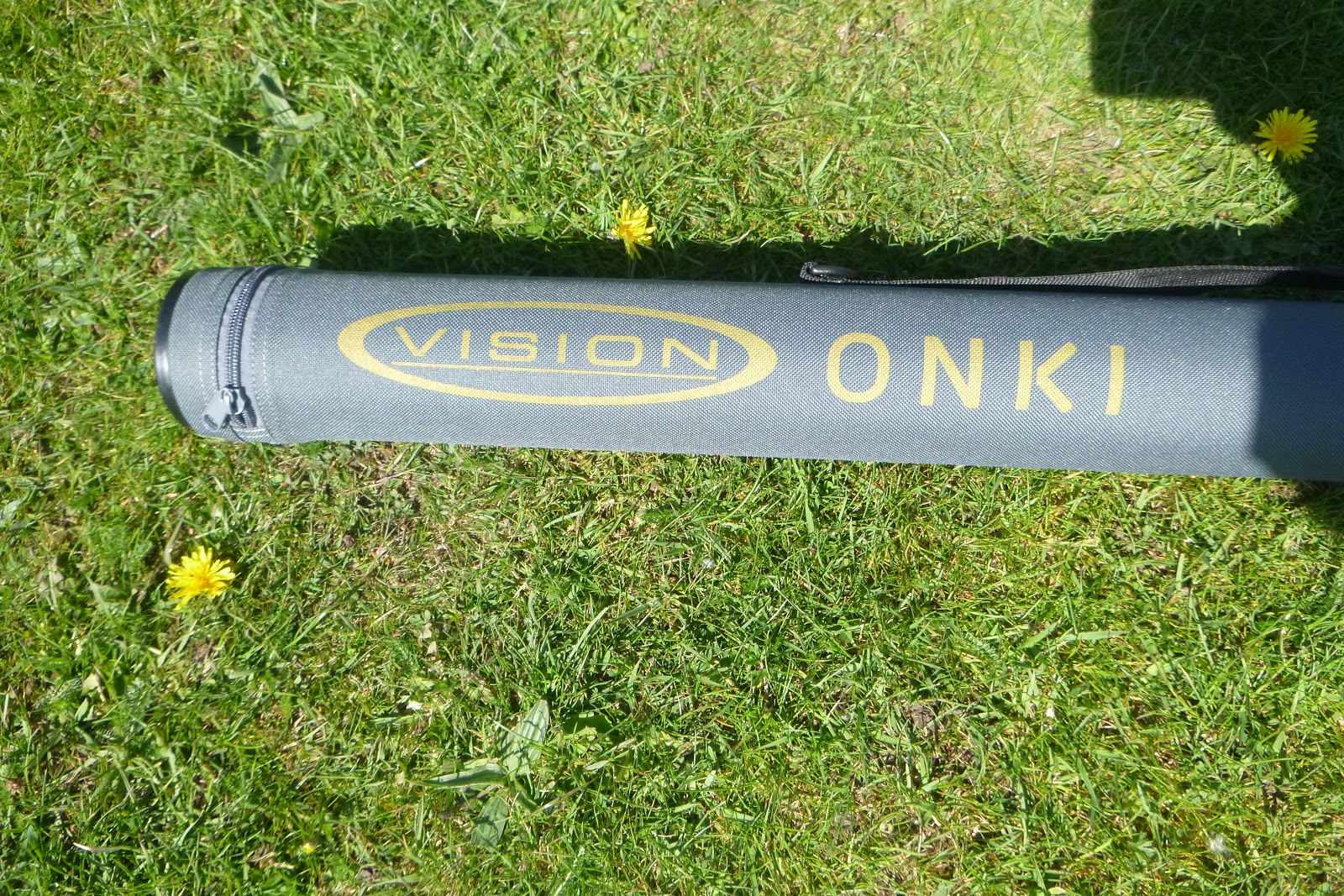
The Onki travels in an unusually modest (for Vision) light grey compartmented tube.


Onki Impressions


There's a certain cheerful eagerness about the Onki.  It's light and easy in the hand, and balanced with the right reel, does not have the inertia that influences the movement of longer rods.  Extending the line single handed was delightfully easy.

Vision describe the Onki as Medium-Fast and 'deep' actioned.  Both terms are unusually accurate.  The Rio 34 gram Scandi was absolutely on the sweet spot: it was so nice I didn't even try the 31 and 37 gram options.  With a full D loop deployed it loads progressively right down into the butt during both back and forward casts.  It tells you everything that's going on during the cast, which is exactly what novices and inexpert casters need (and I enjoy).  Over the years I've concluded that the best test of a rod's communication is the left handed single Spey: you don't have the same muscle memory as on the right side, so things are less automatic and require more thought.  The first pool I fished (The Slap) was right bank, left hand up.  There I was with a brand new and unfamiliar rod, on my first proper day's fishing of the 2019 season, casting rusty, and cack-handed to boot.  Good rod communication was of the essence if things were to get off to a decent start.  


The Slap
Tweed at Rutherford
The Onki made it delightfully easy.  I started on the rocks in the foreground with a series of left handed rolls to work the water closest to me, gradually extending the line before moving down the bank.  How a rod performs when lightly or under-loaded is quite informative, as it tells you how well it will perform in the short range scenarios that are common on small and medium sized rivers, and with the associated ad hoc casts.  You don't spend the whole time at maximum range shooting handfuls of line, so this flexibility is important.  Tip-biased shooting head or Scandi rods are less good in this domain.  In contrast the Onki was excellent.


Once I had extended the line I set off onto the pebble bank and down the pool.  When the wind permitted (downstream and slightly behind at 10-15 mph) I used either left handed single or C Spey, or right handed double Spey.  With the double the height of the pebble bank (about 5'/1.4 m), the impossibility of wading and the acute angle between the casting line and the shore together precluded the formation of a full D loop.  Nevertheless I could cover the full width of this pool, about 25 yards at the head, with ease.  As fish often run up the easier water beyond the centreline it was essential to cover the full width.  


12 lbs springer
estimated to have been in the river 8-10 weeks

Within 10 minutes I was fully settled with the Onki, happy, confident and casting respectably.  Then providence intervened: this nice solid fish, booked by Michael Farr at 12 lbs, took the little MCX Dark shortly after its arrival near the far side.  This gave me an unexpected opportunity to test the Onki's fish-fighting characteristics, which are entirely satisfactory.  As it was my first fish of the year and statistically significant for Rutherford, I didn't hurry the process.  But when the time came to bring it to the net there was plenty enough muscle to finish the job efficiently.


Island
Tweed at Rutherford
It's entirely possible that this stroke of luck - in brilliant sunshine and crystal clear low water - would influence my opinion of the Onki.  Well, so be it: you'll just have to estimate how much discount to apply to my opinion.  I then went on to fish Island, which in the bright sunlight was ultra-clear, which limited wading to no more than a couple of yards.  Here the wind was at 45 degrees downstream and into my face, and rather turbulent and variable, which made it difficult to settle into a single type of cast.  The requirement here was for a much more oblique presentation to maximise the time the fly spent in the narrow main flow-line, and hence a longer cast to cover the water.  It was, however, a far cry from the last time I fished this run in driving rain, near gale-force wind and high water, with a 14' Hardy Marksman, fast sink tip and a weighted tube fly!


Mill Stream (tail)
Tweed at Rutherford

The next morning the wind had dropped when we fished Mill Stream.  This gave me the opportunity to develop a full D loop and  cast a respectable distance with a right-handed single Spey.  The Onki responded enthusiastically, but even here I was nowhere near the limits of its capability.  Stripping in the running line allowed me to work the fly over a lot of water - there were fish in the pool - but sadly to no avail.

After a full session of fishing none of the untaped joints had moved, rotated or loosened.  A quick check of the 2 top sections showed good spinal alignment of the carbon cloths.


I din't try the Onki with a Skagit line, which would have been inappropriate in such low water conditions.  However, my impression of its full action suggests that it would perform very well with a Skagit, which Vision say was an essential part of their design brief.  They suggest a Skagit head of 580 grains, and noting that their recommended Scandi head weight of 34 grams proved to be absolutely spot-on, they're most likely to be correct.  Vision don't make a recommendation of weight for a conventional Spey line, and in the circumstances I didn't have an opportunity to test the 50' head in my car box.  I was so delighted with the 34 gram Scandi that frankly I felt no need to try anything else.


Summary


Doing an evaluation on your first day of the season when your casting is rusty is a stern test of a rod's user friendliness and communication.  The simple fact is that the Onki made the job not only easy but also a real pleasure.  Experienced casters could use this rod in their sleep because the feedback through your hands tells you everything you need to know during the progress of the cast.  The action is delightfully full, just the way I like it, with enough flex to reduce the effects of "the trout fishing top hand".  But it's most certainly not soft or sloppy: in essence the Vision designers seem to have taken the Cult action and just turned the firmness up by a couple of clicks.  The result is a delightful rod that I really enjoyed using and can recommend without reservation for a wide swathe of anglers.  In particular, if you're a novice who's now sufficiently committed to salmon fishing to want to graduate from an entry-level rod to something better; or someone who true to this blog's title, fishes just one week per year, is as a result a less than expert caster, and wants a rod that makes it easier; or like me are an OAP with the usual range of creaks and limitations who appreciates a really easy-casting rod, then the Onki will suit you admirably.


In my next post I shall be writing about the Tool 13', which in my view is different in design intent, and therefore optimised for more experienced and expert users.  There isn't a clear or wide dividing line between the Tool and the Onki at this length, rather a reassuring overlap, as I will explain in due course.


Of course all this begs the question of shall I be exchanging my MAG for the Onki?  The answer is no, because obsolescence notwithstanding, the MAG is still near the leading edge in design and materials, while at the personal level, after a 5 year love affair it's become an extension of my fishing hands.  But it's a telling comment on the Onki that at no point during the 2 days at Rutherford did I have the urge to take the MAG out of its tube in order to feed my soul.  For me at least the Onki was that good.