Monday, 11 April 2022

Maxcatch Skytouch Spey 15'


My experiment with Maxcatch was influenced by the needs of a week on the Spey (the next post).  For two reasons there was no point purchasing another rod in the 13 - 14 foot range: first I already have several; and second, it wouldn't add capability that was relevant to the Spey.  So the logical response was to buy their Skytouch 15 foot double hander and balance it with their Classic reel.  If I liked the combination it would be a bonus; if I didn't I wouldn't have lost anything.

I ordered the Skytouch 15 footer with the matching 55' head integrated Spey line and a spool of backing, selected the express delivery option, and the package arrived within 10 days with some added extras thrown in.


The rod comes in a solid fabric-covered polythene tube with an internal bag, an external carrying strap and the usual zip top.  The bag is light and not especially well made: the trimmings started to come away after the second opening.


The overall impression is of a respectable level of finish relative to its £100 price.  Mostly it's about on a par with the Shakespeare with some exceptions that I describe below.  The bottom 12" of the blank is gloss finished, with the remainder matt.


There are strippers on the lower section and standard snakes above.  The quality of the whippings is good and the epoxy finish smooth, sound and well finished at the edges.

The basic snake rings looked out of proportion to the rod - visually too small and I was concerned by whether this would impact line flow when casting.


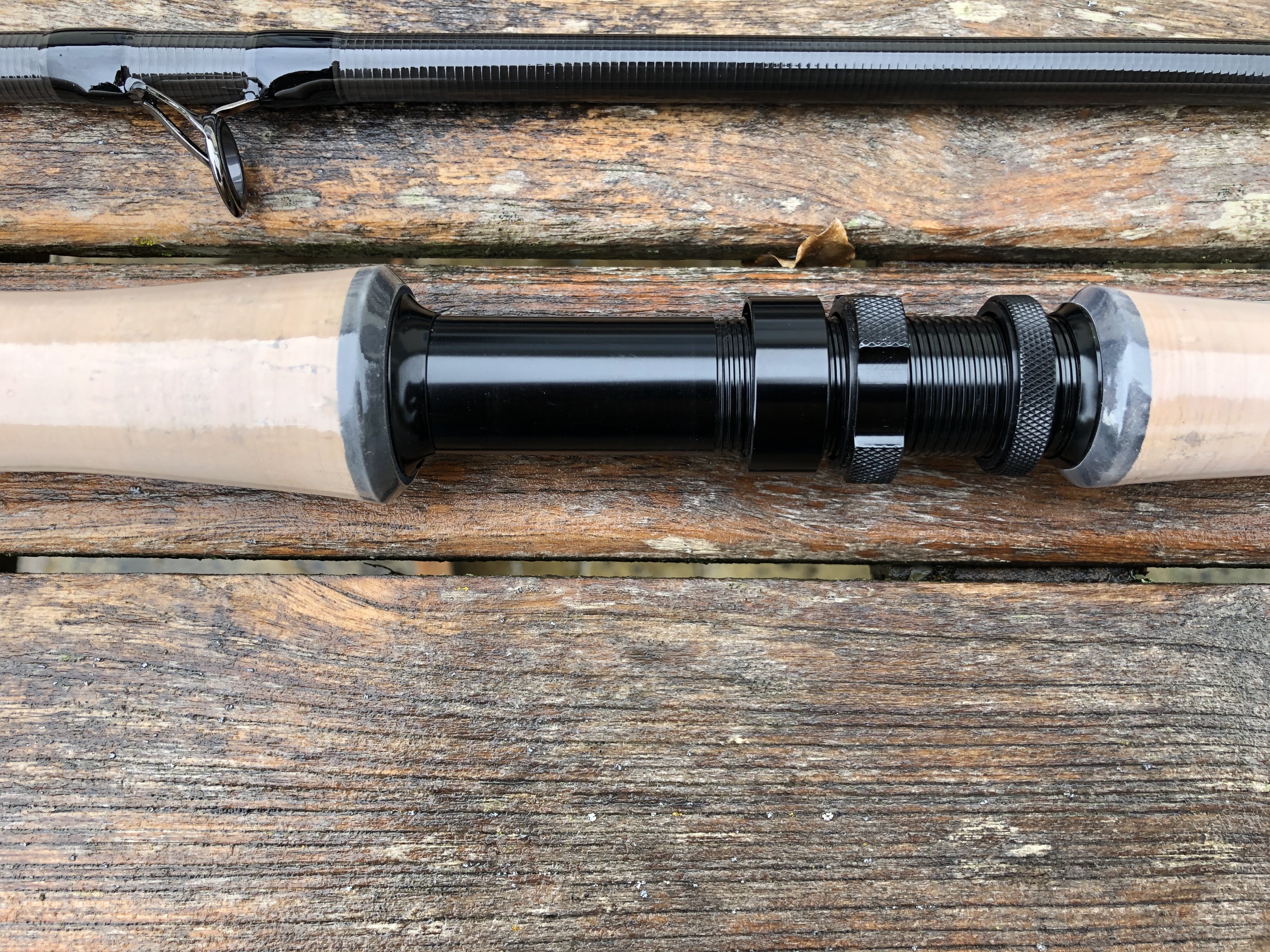
Similarly I considered the reel seat too small and light for a 15 foot rod.  It just didn't feel substantial.  You don't expect an ALPS at this price point, but it is reasonable to anticipate fittings that are consistent with the task and the size of reel employed.  The fittings are coated rather than anodised, which is a poor design choice: in the photograph you will observe the visible wear on the thread after just four cycles of fitting and removing a reel.  The seats did, however, keep the reel secure during the casting test.


Skytouch + Classic
Balance test


The Skytouch isn't light, tipping the scales at over 12oz/350gm, compared to a more normal 9oz/250gm at this length.  When you add 16oz/450gm of Classic reel the combination is close to 2lbs/900gm.  For reference that figure is more than double that of my Vision XO with a Danielsson reel, and you really do feel the difference.

But even with the hefty Classic attached, you will observe that the balance point is 2"/5cm above the cork.  The consequences of that would become very apparent on the casting test, but I was not prepared to add a further 1lb/440gm to an already substantial load to bring the balance point down to my hand position.


I took the opportunity of my pre-season casting coaching session on the Lord's Pool of the Ure with Brian Towers of Yorkshire Fly Casting to try the rod on water and get a second opinion.  Indeed, I asked him to try it first.  His first reaction was to the large overall weight and severe tip-heaviness.  Brian is a professional casting instructor who also does rod tests for Trout and Salmon, but he found the Skytouch a real struggle.  He just couldn't get it to respond, although he wasn't certain how much the line contributed to the challenge.  After 10 minutes he was delighted to hand it back to me.  After his departure - I din't want him to see me struggling and undoing all the good gained in the previous 90 minutes - I steeled myself for the attempt.  In the event I gave up after 20 minutes, while making the following very personal observations:

  • The combination of heavy overall weight and severe tip preponderance makes the Skytouch extremely hard work.  I could not fish this rod for more than 20-30 minutes at a stretch, whereas despite my age I can fish my own rods for hours at a stretch (or 19 hours in a day in Norway).  I was physically tired at the end of this test, in a way that I have never been with any rod in the past 20 years since parting with those I inherited from my father and grandfather.
  • I found it unresponsive in both back and forward cast.  There was something wrong at the tip, and the four sections weren't coherent and progressive.
  • There was no hand 'feel' whatsoever.  As a result I had to think through and watch every part of the cast.
  • Even when accustomed to the rod, my best casts were much shorter and less elegant than my efforts earlier in the afternoon with the 12' 8" XO.
I'm well aware that double handed rods are a deeply subjective area.  One angler's delight is another's poison: there is no universal objective scale of 'goodness'.  So this report is no more than my personal opinion.  There may be thousands of anglers around the world who love this rod and its combination with the Classic reel and 55' Spey line.  I am not one of them, and nor is Brian, whose experienced judgement speaks for itself.

I could not in all conscience sell this rod.  Accordingly, I gave it away with a health warning.  It never got to the Spey.


Tuesday, 1 March 2022

Maxcatch Classic #9/10 Reel

Two Classic reels
Back view

 It is said that "imitation is the sincerest form of flattery".  In that case Loop should be experiencing a warm glow of appreciation of Maxcatch's efforts.  However, I judge that unlikely, as Maxcatch doesn't seem to understand copyright law as evidenced by the comparison of the two sections of text below, drawn from the companies' websites:

Loop & Maxcatch - identical wording

"The Classic is completely corrosion resistant and benefits from a new ergonomic handle design with integrated leader retainer on the counterbalance. Available in specific left or right-hand wind, each reel is individually numbered and presented in a handcrafted leather case. With their timeless old world looks and ultra-modern braking power."

Leaving aside the blatant amateur copy-and-paste copyright breaches, the fact that Maxcatch don't number their reel or supply it in a leather case, and the very similar rear views, the front aspect of the two reels tells a different story that indicates more than cosmetic differences, despite the positioning of the 3 little rivets above the handle being identical.


Two Classic reels
Front view

It appears that Maxcatch have taken the name, look and feel of the Loop original, but adapted the design to arrive at a similar but different solution.  It's probably different enough to limit the risk of them being sued under WTO rules.

The front plate design and handle attachment is completely different.  Moreover, this includes an additional design feature shown in the photo below.


You will immediately spot the wide knurled external rim, which is optimised for palm control, and positioned on the same side as your winding hand. Given the width the knurling is probably superfluous, but overall, this is a very sensible enhancement, which compensates for one of the Classic's (of both breeds) design limitations.

This is the issue of arbor diameter.  As you can see in the photo, it's small in comparison to large arbor designs like the Loop, Lamson and Danielsson with similar line capacities.  The effect is apparent when you have a large fish running fast.  For every yard of running line taken the Classic rotates 6 times, whereas with the others it's fewer than 4.  By the time you reach the backing the ratio is 10:5. This isn't a knuckle friendly environment, so the Maxcatch palm control rim is an extremely sensible and worthwhile design response.The photo also shows the reel's substantial main frame.  The Classic is a chunky piece of kit: with a full load of line it tips the scale at 439 grams, or exactly a pound in old units.  For comparison that's about double the weight of the Vision Rulla and Lamson Guru 4.


Maxcatch Classic
spool inside view


The external finish is excellent, although it doesn't scale the heights of machining and polishing of the Loop.  There again, at £695 you are entitled to have high expectations of materials, engineering and finishing.  The acid test in such matters is an examination of the inside surfaces hidden from view.  In the event the internal finishes in the Maxcatch are very good, certainly far better than you might reasonably expect at £84.

Of course modern CNC machines produce excellent and consistent work, as evidenced by the quality of the hole drilling and finishing.  There was no evidence of any roughness: just a lower level of surface polishing.

Where you do notice a quality difference is in things like screws.  The plate screws on the Loop are objects of beauty, but correspondingly expensive.  Their counterparts on the Maxcatch are perfectly adequate, but smaller, less well finished and softer.  One of the cross head screws that hold the handles and front plate in place, concealed under the large central screw, lacked surface hardening and had me worried when removing it.  But that's what you get for £84.


Maxcatch Classic backplate
The greasy finger marks are mine
not the manufacturer's 
The sealed braking system is protected by three 'O' rings, two at the back of the spool (grey and black) and the other (orange) visible here.  I didn't feel equal to the task of taking the brake to pieces in the absence of any instructions.  It appears that the design is based on a disc stack pressing on a circular plate located beneath the cover.  The sales pitch doesn't elaborate on its construction or the friction materials employed, although stainless steel and carbon weave washers are a common solution.

Full application of the brake requires a couple of turns of the large handy knob.  The braking is progressive, smooth within the limits of my testing, and at maximum, rock solid.

The spool and component fit is excellent.  Everything lined up exactly when I reassembled the reel.  However, please note that the central shaft securing screw is in a recess under the large cover screw (which you undo with a 10p piece), and I found it impossible to align it without a magnetic screwdriver.  In all other respects dis- and assembly were perfectly straightforward.  Instructions are on the website: no paper leaflets or tools are supplied with the reel.


The line capacity is exactly as stated on the website.  Here you see the reel loaded with 150 yards of 30lbs Dacron backing and a #9/10 Spey line with a 55' head and integrated running line.  There's room for another 50-100 yards of backing if you choose to go to Norway.

Loading the reel proved that winding and rotation was smooth and regular.  No lateral movement or off-centre positioning of any component was detectable.  The spool sides were absolutely parallel, and tight enough to the frame to prevent any snagging of running line or backing.


Obviously I can't offer a final opinion on the reel's functioning until I've had it on the river for a couple of weeks.  But on the evidence before me in pieces and entire on the kitchen worktop, it looks like extraordinary value at £84.  In the UK that money barely buys you a die-cast reel with an unsealed brake, and you don't get a fully CNC-machined salmon reel for under £200.  Maxcatch have enough confidence in their work to give it a 10 year warranty, although I tend to be sceptical in a world where few companies seem to last that long.  Nevertheless, it is a statement of confidence, and there are more than 2,200 of these reels in use around the world, which suggests that while anglers may be daft, they're not stupid.

The Maxcatch Classic is going with me for a week on the lower Spey in early April, mounted on one of their SkyTouch 15' rods.  While the chances of me connecting with a unicorn-springer are exceedingly low, the week will give me the opportunity for some proper testing and evaluation.  Meanwhile the prospect of a week's fishing has excited me in ways I'd forgotten during the two blighted Covid years: Just One Week indeed!

I shall write on both subjects shortly, but I shall probably say little about my efforts to rediscover the long-forgotten art of casting a full length Spey line.  Until then, tight lines - short or long!

Sunday, 19 December 2021

2021 - Goodbye, I'm glad to see you go

I'm not someone given to complaining, being a life-long optimist who travels (and fishes) hopefully.  But I trust that you will forgive the title of this chapter, because by any standard,  it's been a bad year, for which the Covid-induced dullness of 2020 was a very poor preparation, and it got off to a very nasty start.  On Christmas Day, returning from church - virtue is apparently no insurance -  my wife slipped on ice and broke her wrist very badly.  We spent the rest of the day in A&E while three muscular registrars and a specialist heaved and pulled to achieve a decent setting.  Deprived of our children and grandchildren it wasn't a good Christmas.

A week later, I was caught out by black ice, went a purler, landed very heavily on my left shoulder and had to drive myself to A&E, where I was the 49th fall injury to arrive.  A very robust physiotherapist jerked my arm around, and presumably based on the volume of my screams, determined that I hadn't broken my arm.  I took that as a blessing and blithely assumed that a couple of weeks stiffness while the bruising came out, interspersed with nice hot baths, would see me back to full strength.  My optimism was completely unfounded and the pain most unpleasant: 6 weeks later my left arm still wasn't working.  I referred myself to the GP who instructed me to stop being brave and take Cocodamol, and referred me to the Practice Physio Team.  After 6 weeks' experience in 2017 (see Raring to Go) I hate Cocodamol's side effects, but at least it allowed me to sleep.  A physio called Kev called, a former corporal of the Yorkshire Light Infantry, with a wonderfully direct manner of telling people what to do.  He was explicit: "I'll send you a raft of YouTube links of enthusiastic and muscular ladies showing you the exercises  you must do at home.  As soon as you can move the arm, join a gym, get a trainer and start rebuilding your shoulders.  And, because you're old, build up your overall strength to help you through your older age, just. in case you reach it."  With the advice administered, Kev signed me off.  The ladies were scary but the exercises worked.  I joined a gym and hired a pleasant young man called Stuart with a master's degree in Physiology to sort me out, and  by July all was well again.  With Kev's words ringing in my ears I have, nevertheless, retained my gym membership.


Helmsdale 2018


The next injury was inflicted on me by wee Nicola Sturgeon, who decided to maintain an iron grip on Covid well after England had started to relax.  As a result, a week's fishing on the Helmsdale in May as the guest of Tony the Master Netsman went down the drain.  Helpful friends and acquaintances suggested all manner of wizard wheezes for bypassing the regulations, but based on my previous experience of the Helmsdale's climate I didn't much fancy wild camping in the snow at my age.  Needless to say, I was massively disappointed: such generous offers don't arrive frequently.


While Nicola was being hard in Scotland, the weather in Yorkshire was harder still.  April was the coldest I can ever remember, with many more mornings below 0C than January, bitter winds and almost no rain.  Everything in the garden stopped in its tracks for 3 weeks and the Ure dropped to MSL.  May remained cold,  but it just poured with rain: by its end we'd received more than double the average rainfall.  I couldn't get near a salmon or trout river for cold air and brown water, apart from one day early in the month on the Ure at Sleningford Mill, when I missed two salmon and caught a nice supper-sized sea trout and an (inedible) giant chub.  My one attempt at trout yielded hypothermia within 30 minutes and an early retreat.


By the time we got into June, the Rye and Ure and my garden were running about 3 weeks behind schedule.  The torrential rain of May stopped abruptly and we moved straight into drought.  For want of anything else to do I completed a long-overdue reconnaissance and review of the Jervaulx Abbey beat, but had no real expectation of catching.  With the Mayfly almost non-existent my morale followed the Ure down to MSL.  A year of Covid-induced dullness was really getting to me before two brief flashes of light pierced the gloom.


Tweed silver
Rutherford
27th May 2021
First, TTMN, feeling sorry for me, took me to Rutherford on the Tweed for a day as his guest.  I love Rutherford, and all the more since I broke my duck and started catching fish there.  The day was almost perfect, a mite bright but the water was an attractive +12".  Fishing Lovers' Leap just before lunch I hooked this sparkling 7lbs fish from the lie off the point on the near side.  Michael, who is always on hand 10 minutes before lunch, opined that it had reached Rutherford from Berwick, 37 miles as Tweed flows, in little more than 24 hours.  Having landed the fish, I took 3 paces upstream and covered the lie again: BANG! a similar fish came out of the water at 45 degrees with the small MCX Conehead in its mouth.  Sadly it came off shortly thereafter. Undeterred, I went back up 3 paces, and covered the lie for a third time.  A swirl 3 feet inshore from the lie told me that a fish had followed the fly and duly took.  Sadly that one too came off.  But three takes in three casts was a real lift.  The losses underlined the point that very fresh fish have soft mouths, so early in the season your loss rate may be higher.  The three takes reinforced the fact that salmon are schooling fish that run in company.  If you get one, cover the lie again straight away.  And the MCX was the only fly to catch that day!


Brae Water 4
looking down towards the hut
9th July 2021

Second, in late June a friend called to ask whether I would like to take his slot for 3 days on the Spey at Gordon Castle in prime time in early July.  There was only one question: "Do I have to walk barefoot or can I take the car?"  And so it was that I found myself fishing in the Premier League on the Brae Water.  Needless to say, with me, the man who blanked on the Gaula - twice - being on top class water at the peak time doesn't guarantee salmon.  And so it proved.  The water was low, but not so low as to preclude running, and a steady 10.5C.  Indeed, the bottom of Brae is within line of sight of the sea.  


The problem was that the fish were running too quickly.  It was a lottery: if you were lucky enough to be on a pool where a pod of salmon paused, you were in luck.  One member of our party had exactly that experience, arriving at a pool to find it boiling with fish, and directly caught a 14 pounder.  When the next rod turned up 15 minutes later, they were gone.  I don't recall covering so much superbly attractive 'fishy' water with such expectation and not getting a touch.


Piling at the top of Brae 3
When the touch came I blew the chance with a stupid careless error.  Iain the Head Ghillie instructed me to cast at a shallow angle and allow the line to come right in close to the rocks in the centre of the photo, and then with each cast extend the line to wrap around the corner.  The most likely take would be straight off or slightly behind the point, and so it proved.  After covering the first part of the rocks from where I took the photo, I advanced down to the bend in the piling for the next part.  Instead of tidying up the excess running line onto the reel I kept it loose.  On cue a good fish took at the exact spot.  Following the Spey dictum I gave it the two feet of slack under my hand, after which everything stopped.  To my horror I found that a loop of running line was fast around the handle of the reel, and in accordance with Murphy's Laws, the loose end was on the inside.  What followed was a couple of seconds of agony and cursing as I frantically tried to regain the slack needed to free the line, followed by more cursing when the salmon failed to cooperate and departed. I was mortified that I, the paragon of organisation and discipline, had been so careless.  There you have it, a full confession of crass incompetence.


Flesh Dub on the Ure
October 2021
beautiful but devoid of fish


Apart from a couple of grilse nibbles that was it, but the trip had been a wonderful elixir, an uplift from the pervasive gloom.  The downside was that it made me more keenly aware that we didn't have a Tomatin week this year, and as the summer progressed I became increasingly and irrationally low, totally contrary to my nature.  I was pining for salmon fishing and good company.  The state of the Ure didn't help.  The drought was just like 2014, except that the gauges went even lower.  The one at Bainbridge went off line because it hadn't been programmed to produced negative numbers.  All I could do was wait and pray for the weather to break, and hope for some decent fishing in October.  Meanwhile, all the fish that had run in March and May were hunkered down in whatever deep water they could find between York and Tanfield.  A barbel-fishing acquaintance remarked that the deep gravelly runs around Boroughbridge were full of comatose salmon.  I was aware that presented a serious problem, because once salmon hunker down, switch their systems to almost zero and go comatose, only the most serious and sustained spate will wake them from their slumber.  If we didn't get 6-8 feet of water for the better part of a week, the disaster of 2014 would truly repeat itself.  Despite my prayers, the serious rain never came, probably because in Yorkshire there are far more farmers than salmon fishermen.  It closed as one of my worst seasons ever.


Standing on fish & ruining a pool


I only drew one lesson from the Ure this year, which is clearly shown in this photo, of the gentleman - a charming chap - fishing below me.  For whatever reason he was desperate to cast to my bank, without looking at the water in front of him.  You can see quite clearly the lie through which he has just waded, one of the most productive on the whole of the river, and in this pool the running line comes up the right side.  If there are very few fish about, it helps not to stand on them.  On average there are as many fish on your side of the river as the other, and most salmon are hooked within 15 yards range.


Amber & Purdy
Then, to. complete my happiness, Murphy's 2nd law struck again: when you think it can't get worse, it will.  After my last day's fishing I went to stay with my friend the Brigadier who had invited me to shoot partridges the next day.  After arrival and a cup of tea I needed to switch fishing and shooting kit between my wife's car and my own.  As I was going about it, there was a multi-dog riot with my new Pup Amber getting hugely over-excited.  In the darkness and confusion as I was lifting the dog box out of my wife's car, bent at the waist, a dog hit me at full speed, knocking me sideways.  My back immediately told me this was not good news.  Over the next 3 weeks the pain caused by the trapping of the femoral nerve between two degraded vertebrae - which is in the right leg, not the back itself - got progressively worse,  until by the end of the month it was 2017 all over again, unable to walk properly, lying face down on the floor with a bag of frozen peas for company, in an opiate haze of Cocodamol.  Only shooting was capable of persuading me into an upright position, although narcotics and marksmanship don't coincide.   Fortunately, by early December the pain had eased, so I set about weaning myself off the painkillers with all the joys of withdrawal symptoms of nausea, giddiness and a few unmentionable side effects.  One that I didn't anticipate was a runny nose, which I dismissed as a light cold.  My wife, who is unfailingly right in such things, said: "You never, ever get a cold.  Take a lateral flow test."  It was positive, so. was the PCR.  Murphy had struck again, and somewhere, somehow, I had caught Covid.  Now I am serving the penitence of domestic self-isolation at the top of the house, due to emerge the night before Christmas Eve and hoping fervently that after a dreadful year Murphy will give me a break.  The trouble is, he doesn't, and there's no sunset clause in his 2nd Law.

As you might imagine, I'm not feeling especially cheerful.  The whole family is due for Christmas, which would be wonderful after 2 years, but with all the talk of 'circuit breakers' and 'mini-lockdowns' I'm fearful that it won't happen.  Moreover, it's challenging to write cheerfully about salmon fishing if at the end of a season you have only one salmon to show for your efforts.  It's not exactly the hallmark of an expert, and the impact on my self-esteem and the credibility of this blog as  a source of information defies description.  In fact there is a good case for abandoning this blog altogether, because since I started writing at the end of the 2012 season only one year has offered halfway decent fishing.  Over the past decade we've had one wet season (2017), one about average (2013) and eight droughts with rivers on their bones for months on end.  Indeed, when I embarked on this literary journey I pondered whether such hubris risked creating an inevitable nemesis.  Perhaps I was even more correct than I feared.  However, if I turned the tables on Murphy and surprised him by stopping writing, might the weather and my catches of salmon return to some kind of normality?

It would be very easy to give up.  I did much of my best writing while filling the spare time on business trips to the Gulf, but as a result of Covid there haven't been any of those for almost 2 years, and there's no prospect of any before late 2022.  It's much harder to find the time and focus when you're at home.  There's always something else that needs doing, endless distractions and a wifely disbelief that writing is anything other than a frivolous pleasure.  And it's doubly difficult if you've had a rubbish season, you've got nothing useful or original to say and it's been ages since you last wrote.  I apologise to everyone who may have missed the end of season round-up and MCX's Christmas Stocking, which failed to appear for those reasons.  To be honest, I've written this not as a result of any inspiration but rather as an act of defiance in the face of the urge not to bother amidst the dullness, gloom and darkness of the Covid suppressed world.

I'm still here, and a quarter of a million page views of Just One Week tell me to keep going.  Thank you for your support and encouragement, and have the best possible Christmas in the circumstances.  Let us hope and pray for a return to normality of life and salmon fishing.  I don't wish to be importunate, but at my age it's getting a bit urgent, so Happy New Year.

Having got all that misery and self-pity off my chest I feel much better.  Rest assured I will be back, fishing and writing in 2022!


Tuesday, 1 June 2021

ABBEY BEAT - River Ure


The ruins of Jervaulx Abbey
The spiritual home of Wensleydale cheese

The Abbey Beat comprises almost 2 miles of single bank fishing within the boundaries of the Jervaulx estate on the south side of the River Ure.  It is bookable through FishPal.  If you wish to have a ghillie, please contact Brian Towers directly on 07850727132.  He is also an AAPGAI double-handed casting instructor, which allows you to combine fishing and learning.  Some may find that especially useful, as the beat is right bank with a downstream prevailing wind, which places a lot on emphasis on your skill with left hand uppermost.

The main part of the beat is easily accessible by vehicle, including 2WD with good ground clearance: 4WD is only essential when the conditions are wet.  You enter the park at the gate opposite the Tea Room car park and continue along the estate road until you reach the first track to the left, which leads to the entrance gate to the fishery.  The track from there to the river bank across the meadow is clearly visible.

Note that the Jervaulx Fly Fishers have the trout and primary rights on this beat.  Their members will be most active in the summer and at lower water levels.  On a cool and windy May Day I saw no one else during the afternoon I fished.

The surroundings are delightful, with the Abbey and park full of mature trees providing a beautiful backdrop for your sport.

Harker Beck

The top of the beat is at the junction of the Ure and Harker Beck.  This little stream has a special significance for Ure salmon fishing, because it was here in the 1990s that a very large dead spent cock salmon was found, weighing 36lbs post-spawning.  The length and girth suggested that its clean weight in the spring might have been close to 50lbs.  It was the first hard evidence of the rebirth of the Ure as a salmon river.


Abbey Beat
Pool and run numbering cross-reference to photos & paragraphs below
(c) Ordnance Survey 2021

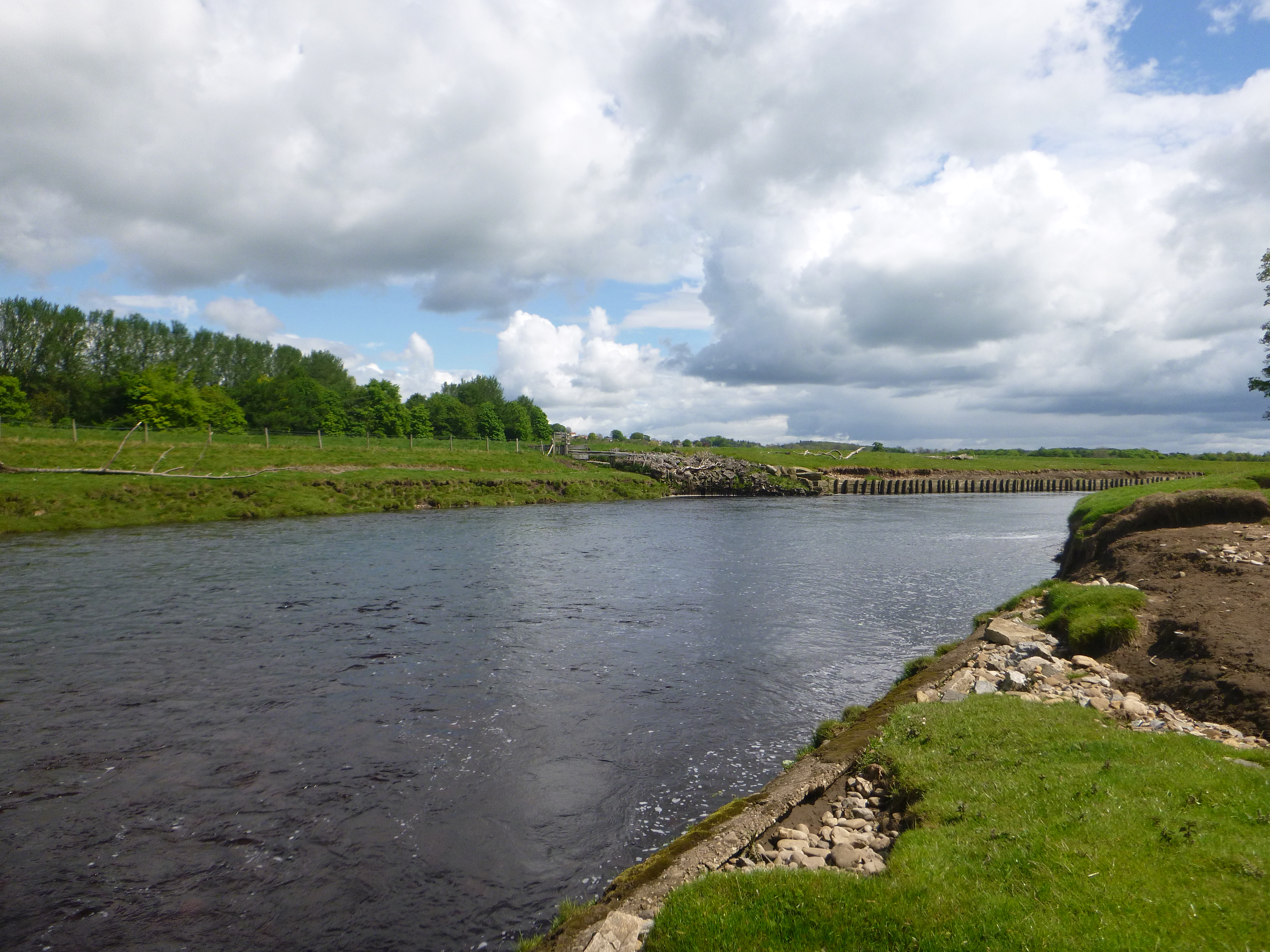
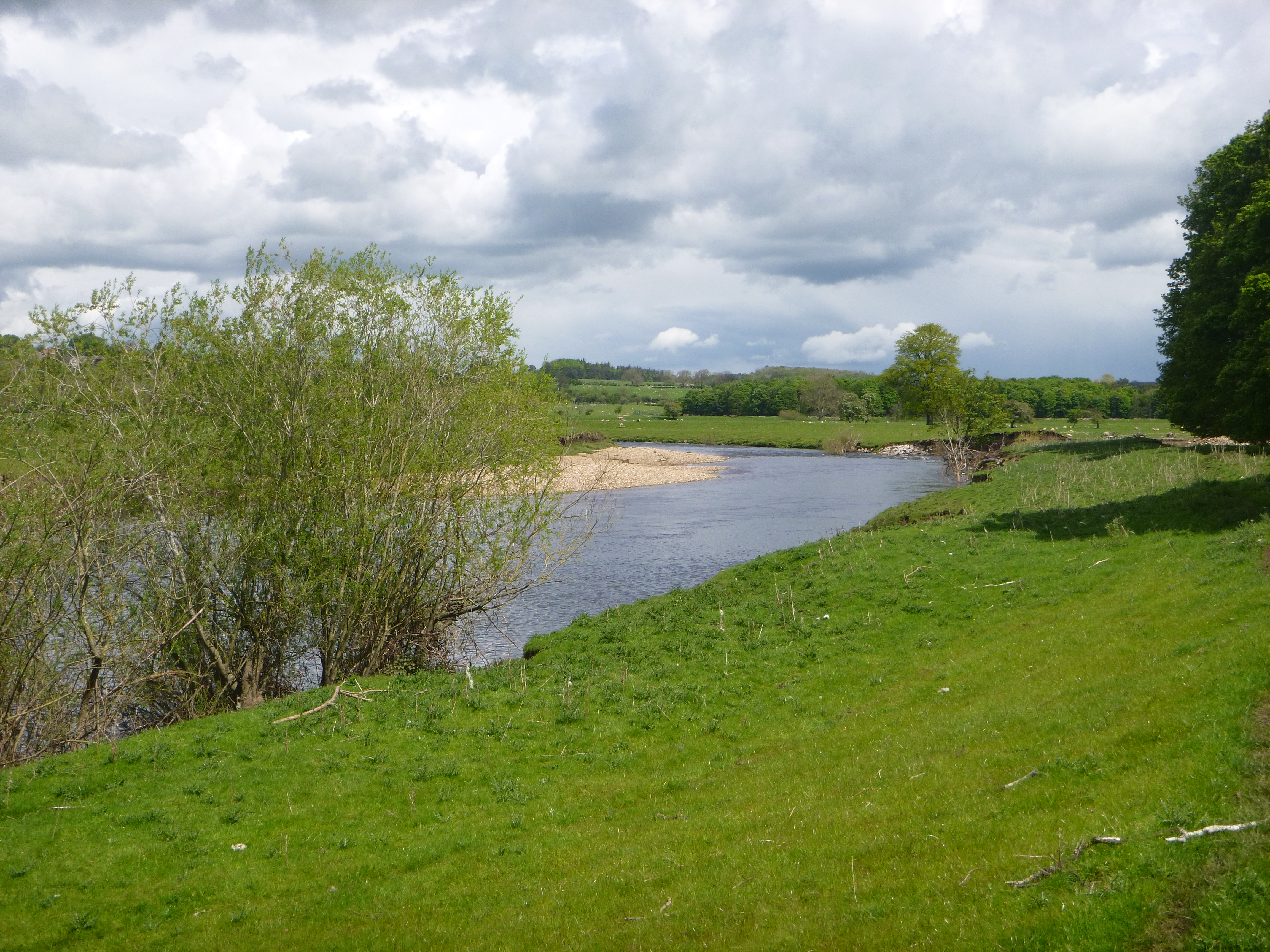
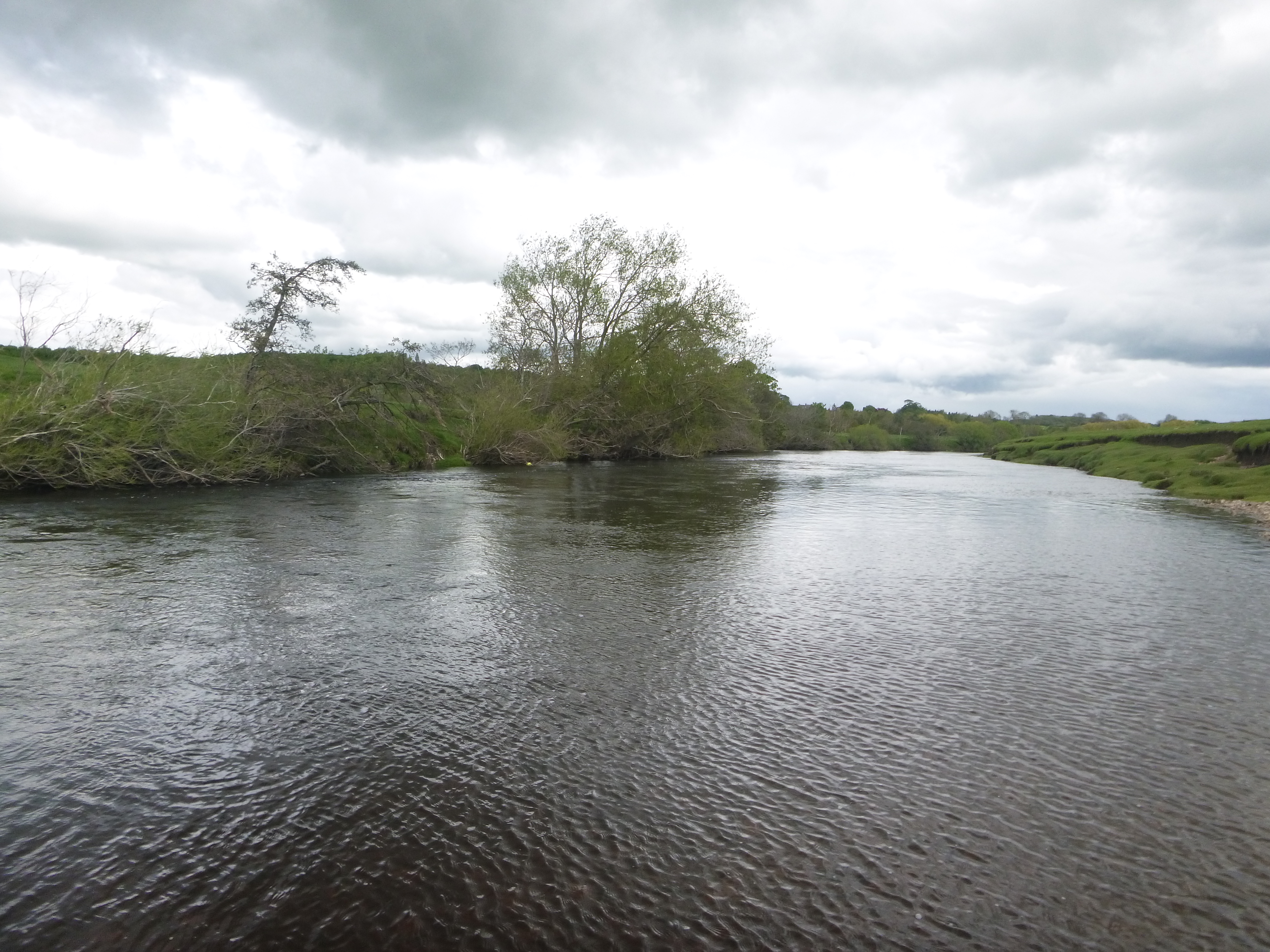
All the photos in this guide were taken at a water height of 80cm at Kilgram, falling following a 2 metre spate, which usually offers ideal fishing conditions on most beats between Thoresby and Ripon.  With 3 limited exceptions the wading is the easiest I've ever encountered on the Ure, with long stretches of gravel.

At this height the water is easy to cover: I was using a 12' 6" #7 which did everything I needed.  On most of the runs you are fishing directly beneath your feet, and the longest cast you need on the pools is about 25-28 yards.  With a higher river and using sink tips and a heavier fly you might need a 13' or 13' 6".


1 - Top

1 Is a straight run over a rough bottom that starts at the very top of the beat, and extends for about 150 metres down to the head of. Pool 2.  At the far end it's too shallow to be productive (see photo 3).

The main running line is directly adjacent to the near bank, and the rough bottom provides an ample supply of. short-halt resting lies for running fish.  There's no need to wade: indeed, it would be downright daft to try.


1 - Middle


1 - Tail and entry to Pool 2


2 - Head

2 is a long right-hand sweep with deep water and the main flow on the far side against the wooden piling.  It's a delightful pool to fish and later in the season will undoubtedly hold good numbers of fish.  The running line exits on the far side before shifting across to the near side for the journey up Run 1.  The wading is very easy, but it's best to keep as far back as possible: covering the water isn't difficult and there's no point scaring fish in quiet water that clearly transmits the crunch of your footsteps.


2 - Middle


2 - Tail


Run 3 - start

3 comprises a series of runs under the near bank of a long sweeping left-hand curve.  Again, there's no need to wade and quite a lot of its length has a rough bottom.


Run 3 - middle


4 - Head

4 is a medium-sized pool at the bottom of Run 3 that bends right into a straight quiet stretch.


4 - Exit


5 comprises a long section of runs split by gravel bars, with some very interesting pots and holding areas.  it has a very 'fishy' feel and could well be productive when there are more fish in the river.


5 - Lower end
Fishing from 8 feet above the water
Keep back and kneel down to avoid sky lining


5 - Lower, looking back upstream


6 - Head

6 is a pleasant pool formed on a right-hand bend with plenty of holding capacity and a good flow.


6 - Middle & Tail


7 - Middle

7 is a large pool formed on a right-hand bend which looks like a good holding area.  It's easy to cover, and although the wading is somewhat stony near the head there's no point going out more than you need for a good D-loop.


8 - Head
8 is a deep channel created by the intrusion of a large bank of gravel on the near bank.  I felt that I had a significant chance of a fish here, so fished it thoroughly.  In the event that yielded 2 large brown trout, but I would fancy my chances here come September.  


8 - Looking down from middle to tail


Below 8 - the end of the easy fishing
Once you reach the end of 8 the banks become heavily treed with overhanging willows.  A quick scan of Google Earth shows that there are only a few open spaces between here and the bottom of the beat at Kilgram Bridge.  In any even going beyond here probably involves driving back to the estate road in the park as I couldn't see a gateway through the hedge-line that runs from the right side of this view.


Thursday, 13 May 2021

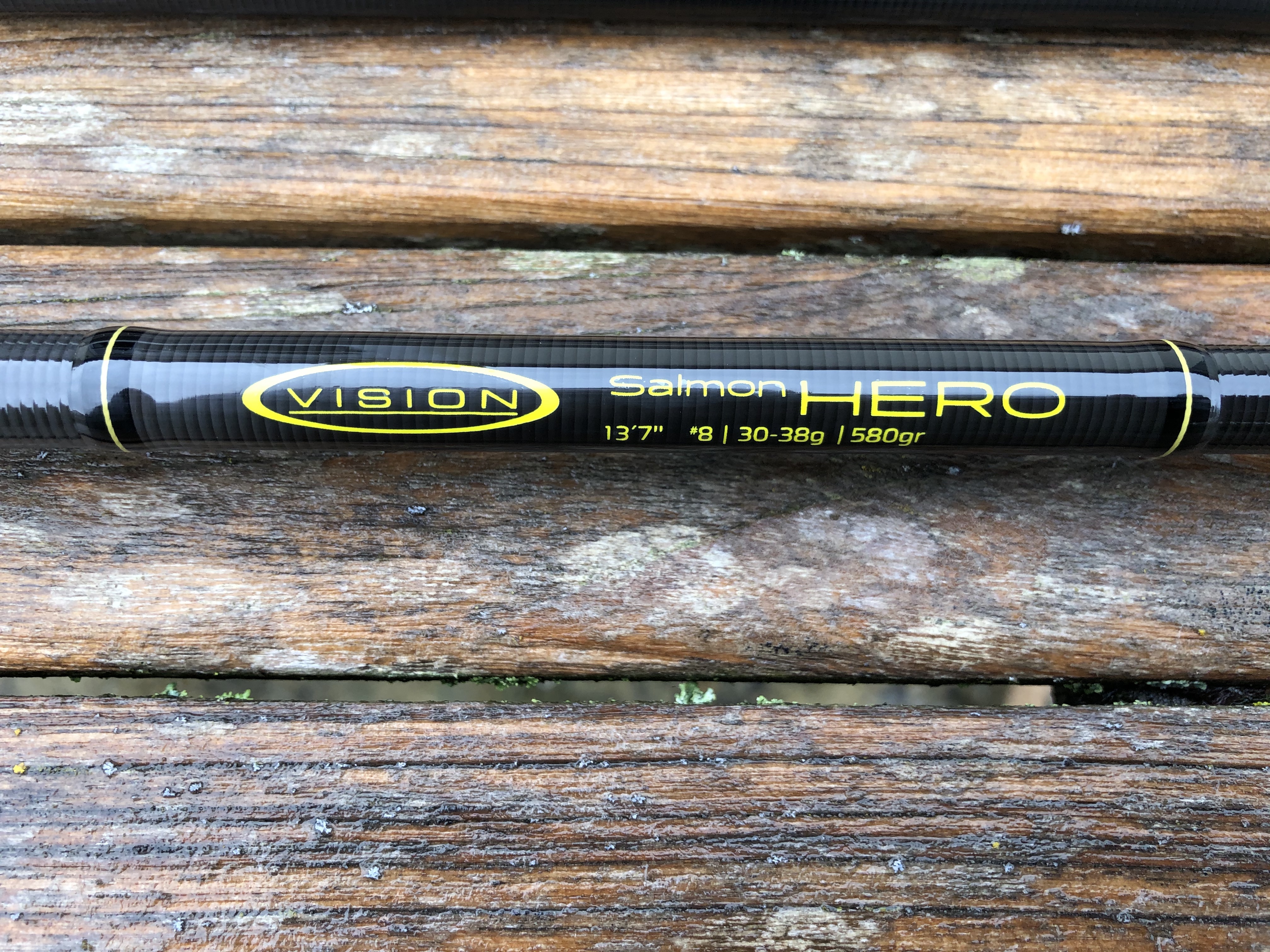
Vision Salmon Hero


Moving Targets

 Looking back over the past decade or so of Just One Week, it always seems to be the case that no sooner have I tested and reviewed a Vision rod than it becomes obsolete and is withdrawn from sale.  I've got used to it now and it hasn't put me off trying new rods and writing about them.  In the 2021 product cycle there are some real surprises.  Over the past year Vision has completely changed its range of double-handed rods:

  • The premium XO has been succeeded by the XO Graphene, with the same name, style, finish and performance
  • The long-serving Tool has finally been retired
  • The entry level Onki range has been reduced to single-handed only, pending stock run-down
  • The six-piece Sisu Siks remains, but will probably end shortly
The price-point positioning and range below the XO has been shifted and dramatically focused:
  • The Custom series, pitched at £700 - £850, comprises 4 general purpose salmon rods at 13, 14, 15 and 16 feet; and two specialist Skagit rods of around 13' 6".  The Custom range hasn't yet arrived in UK, but is scheduled for delivery in late May.  In that respect it's worth noting that Vision are not alone in having supply timing issues - presumably owed to the effects of Covid on supply chains - as Sage's new entry level double handers won't be available until after the season has ended.
  • The Hero is now their entry-level range, comprising just two rods, an 11' 2" #7 switch at £399, and a 13' 7" #8 general purpose at £449.  Both are now available in UK, and as soon as I could I got hold of a 13' 7" to try out.
After last week's left-handed session at Sleningford I was keen to blow the cobwebs out of my right handed casting, so I booked a lesson with Brian Towers and the rest of the day on Thoresby, which would allow me to achieve the double purpose of practice and trying the Hero.

Hero - First Impressions


Continuing Vision's long established tradition of eccentric presentation, the Hero comes in a cheerful primrose yellow tube with internal sub-dividers.  You're not likely to leave it behind!  Nevertheless, the cheerful colour is entirely in keeping with the Hero's happy demeanour and what it does for the user's morale.


The down-locking reel seat is a value engineered version of the design found on the XO.  The main nut is easy to screw down tightly on the coated thread, and the locking nut does its job simply and efficiently.  The combination provides a bullet proof hold on the reel: there wasn't even a hint of movement at the end of a day's casting.
The coated thread is silent and smooth in operation.  Altogether it amounts to an outstanding reel seat that approaches the Alps in quality and function.
The cork is at the standard you would expect at this price point - neat, well finished and with a moderate amount of filler.


The appearance is understated in every respect. The blank is semi-translucent black, and like the XO, has an un-machined surface.  The effect at distance is gloss black.  The whippings are neat and well finished with epoxy.  There are two stripper rings and the remainder are chrome snakes.
The rod balances nicely with a reel in the range 230-260 grams: during the day I used a variety - Lamson Guru 4, Vision Rulla and Danielsson L5W #8/12 - all of which were in the ideal weight span.


it's interesting to bear in mind that 13' 7" has a long pedigree as a Vision idiosyncracy, featuring in the Nite and Cult predecessors.  The profile of the Hero's blank bears a close resemblance to the Cult 13' 7".  Certainly the ferrules match (I had my Cult in the car).  However, the blank walls are substantially thinner, at least 10-15% and possibly more, which shows how there has been progressive trickle-down of the new resins from the premium ranges.  As a result the Hero is much lighter in the hand than the Cult, and feels correspondingly more lively.


On the Water

I tried a wide variety of lines with roll, single Spey, Snap T, Snake Roll and Double Spey casts, albeit I encountered some serious problems with my injured left shoulder in the Double Spey:
  • Scandi.  The rod has a wide weight window of 30 - 38 grams.  In the event the middle figure of 34 grams proved absolutely delightful, loading the rod fully and responding nicely with every cast, from short range rolls to full distance Single Spey.  I was able to cover the entire fishing width of the tail section of Frodle Dub without any wading.  Performance with a 38 gram line was competent but dull in comparison with the joys of the 34 gram.
  • Skagit.  The Hero was in its element with the Skagit, loading down to its boots before sending 10 feet of T11 and a brass tube the full width of Frodle Dub with minimal effort.  It also performed very well in extracting the sunken head from a slack back-eddy.  I didn't have the specified 580 grain line, but it was equally competent with both 550 and 600 grain lines.
  • Sinking Head.  Alan Maughan always held that extracting a sinking head was one of the most searching tests of a rod, in which strongly tip-biased actions were often found wanting.  The test line was an over-weight #9/10 Guideline 3D S3 with a 2" copper conehead tube.  The Hero rolled it up neatly before despatching a good single Spey.  I suspect that the Hero could have done a direct extract and cast with an on-weight #8 line. 
  • 55' Spey.  As I had a Unispey in the box I thought I'd give it a go.  However, its #9/10 weight seriously overmatched the Hero (and my ability).  I suspect that it would be happy with a #7/8, but there again, I only fish a full line once in a blue moon, and it's so much fun with a Scandi, why bother?

Observations

In total I spent nearly 5 hours casting and fishing with this rod.  Unfortunately, unlike my test of the Onki and Tool, I failed to catch a salmon.  Nevertheless, I ended a long day with a broad smile on my face.  Quite simply, the Hero is an absolutely delightful rod, which combines forgiveness for novices and inexpert casters with entertainment for the more skilled.  I don't like bling on rods, so the Hero's modest appearance appeals strongly to me.  The icing on the cake is the superb reel seat, which is as good as anything on the market.

The through action is exceptionally well-judged for an entry-level rod.  It clearly communicates everything that's going on in the cast.  The sensation under load during the delivery stroke is amongst the best I've encountered, and certainly far superior to many other rods at this price point that I've tested.  Its performance with a 34g Scandi is pure joy.  The action design also makes the Hero a superb Skagit rod: I would happily have spent longer fooling around dredging the deep head of Frodle with all manner of ironmongery on super-fast tips, but there were other lines to try for the purposes of this article.  I was similarly impressed by its ability to roll up and deliver the over-weight Guideline 3D sinking head, a task that regularly defeated my old Cross S1.

If I didn't already own the utterly divine 'Yar' 13' 6" XO (double the money), I would certainly buy the Hero.  Indeed, of all the rods I've tried in this length range over the past 5 years, the XO is the only one that I like better than the Hero.  That is praise indeed.