Thursday, 17 April 2014

Sinking Feeling

Through the extraordinary generosity of Michael at AM Angling I took two sinking shooting heads to test on the Dee last week.  Venturing into the submarine world of sinking lines was a new experience for me, as followers of Just One Week will have spotted that I've got by until now by adding a variety of sinking polyleaders or tips to floating lines.  Without the challenges of especially deep or heavy water I hadn't felt the need to acquire a sinking line.  However, with the Dee running at +18", it was an ideal opportunity to do some learning and testing.  You will note the order of those words: this post is as much about me learning how to get the best out of a sinking line as it is an evaluation of the two lines that Michael had kindly provided.

The Contenders

Guideline is the ubiquitous brand in sinking shooting heads and possibly the market leader.  You don't achieve that status with bad products, so the PT Scandi would provide a reliable reference baseline for the evaluation.

When you take it out of the box for the first time you are immediately aware of the design and production quality.  It just looks right.  There are several features that are clearly born of long experience and intended to make life easy, and these imbue a certain confidence from the outset.


Loop introduced their Graduated Density lines last year, when I did an evaluation of the Low-Float, a thoroughly good piece of kit, but markedly different from the Rio AFS.  The GDC concept really applies to the sinking lines, in that the transition from S1 to S2 is spread over 5 feet rather than just a couple of inches as was previously the case with many multi-rate sinking lines.  The theory is that this causes the line to extend in a single continuum rather than a series of steps.  The physics is certainly true, but I didn't look underwater on this test to verify the effect.

When I first took the line out of the box my reaction was entirely different to the Guideline, in that I was irrationally irked by the fact the GDC is all one colour - olive green - with no simple indication of which end is which once you've removed the tags.  This required quick action with a permanent black marker pen - you can't trust to memory at my age.

Spot the difference!
Which end is which?
You can see the difference here.  Perhaps I'm idle and old, but it's nice to be able to find the right end of a shooting head without having to think too hard.  Another advantage of the Guideline's colour scheme is that even I can see the orange end coming during the retrieve and coordinate its arrival with the management of the running line.

You will also note the use of handy garden plant ties to secure the coils: simple and very effective.


On the Lawn


Profile at 10 feet
The next step was to lay the 2 lines out on the lawn to compare their profiles.  Because the first section of the Guideline is Intermediate it is correspondingly thicker than the Loop at S1, which is visible here.


Profile at 25 feet
However, as you progress onwards through 20 feet to 25, where the Guideline transitions into S2, you'l note that it is still (counter-intuitively) fractionally thicker than the Loop at S1 (normally faster sinking lines are thinner).  I didn't use a micrometer, just eye and image zooming, but started to form the view that Loop had managed something a bit technically novel here.


Profile at 35 feet
At 35 feet you are approaching the end of the Loop: the Guideline is 4 feet longer.  At this point the Loop is S2 and the Guideline is S3.  Again, and equally counter-intuitively, the diameters are similar.


In sum, the Guideline follows an entirely predictable taper pattern, with each stage clearly visible.  There's something different about the Loop.  After a bit of head scratching and reviewing of the Low Float pictures, I concluded that Loop might have done something remarkable.  Instead of achieving higher density by reducing the line's diameter, they appear to have achieved the effect by changing the density of the material.  I may be wrong, but the consequences of this innovation (if it be so) will become apparent shortly.

On the River

Upper Kirk at +18"
The main part of the evaluation took place on the Upper Kirk pool which is usefully concealed from public view.  On Waterside,with a road running along its entire length, you tend to attract spectators, including those with cameras, liable to record your embarrassing efforts whilst learning the intricacies of working with sinking lines.  I had some difficulty persuading the charming tourist from Nigeria with a £2000 Canon EOS 5 and a 300mm lens that I really wasn't a good examplar of Scottish salmon fishing technique.

Beyond privacy, Upper Kirk had everything - cold water, weight of flow, depth and breadth. From the left bank you are working to maximum range from thigh deep wading; from the right you're managing narrow angles from a limited roll-casting space off the grass.  The wind was around 15 mph downstream oblique, rising to 20 mph later in the day, turbulent and gusty.  As a result the majority of the casts were waterborne anchor: Single Spey was out of the question on safety grounds.

The rod was a Loop Cross S1 14' #9.  The running line was a well worn Rio standard.  At the business end I employed a 5' slow sink polyleader (equivalent to S2), 7' of fluorocarbon, and a choice of 1" weighted tubes and #6 doubles.

When reading what comes next, please bear in mind that my name is not Alan Maughan and that I'm not a great caster.

Guideline

The Guideline was first up to establish the baseline.  As you might expect, the Guideline does exactly 'what it says on the tin', although some helpful hints on the box would have been handy during the first 10-15 minutes of getting the hang of its behaviour.

Like all heavy sinking objects it goes out like a rocket; slices through the wind and turbulence; and picks tubes up out of the water with ease.  The turnover is good.  Above all, it's very forgiving of limitations in casting.  If it can get out there, it will.  The arrival may not be pretty, but the Guideline will have done everything in its power to help.

It's nice to fish with and for the first time I could appreciate the virtue of a sinking line cutting down through the speed and turbulence of the surface flow into the smoother water below. Contact with the fly was direct and continuous.  The brightly coloured Intermediate section helped both visual management and retrieval.

Perversely, that otherwise most useful and helpful orange Intermediate section was the source of my one gripe with this otherwise excellent line.  I was surprised by the effort needed to extract this comparatively short head into the back cast.  There were occasions, especially if the dangle was in slower water, when getting it out was a real chore.  The Intermediate bit just seemed to hug the water in a way that real sinkers do not (based on experience with my old Loop Multi-Tip line which has very long front sections).  Even employing my newly learned Modern Spey lift and swing technique, this limitation got to be very boring after the first half hour, especially with my age and dodgy back.  It was most reluctant to respond to a Snake Roll, so I didn't invest much time in trying to apply that approach to the problem.  Of course, 'rolling up' made life much easier, but that's a bit of a chore and yet more wasted fishing time added to that expended on stripping in the running line.

Perhaps I may have missed something; more probably my technique is rubbish and slick floating lines have made me a softie, but for me the limitation of the back cast took away too much of the joy of the Guideline's excellent delivery.

Loop

When I stopped to change the lines over, my morale was not great.  I was a mite tired, a little cold (the water was at 6.5C) and filled with trepidation at the prospect of another 3 hours of demanding back casts.  I was irritated by Loop's all green line.  After a short break; a stiff self-lecture to get a grip and man-up; and some morale boosting chocolate (my weakness), I re-entered the water.

And so,  I fed out the line, rolled it around into a shallow angle and stripped out some running line whilst waiting for it to reach the dangle.  Then lift the rod, push the bottom hand under and out and turn the torso in a movement calibrated an honed and hardened over the previous 3 hours.  Swish! An all-green 36 foot snake with a black blob on its tail shot past me heading directly into the wind.  Splash!  It landed straight upstream, but I failed to observe the turnover.  After a certain amount of self-cursing, thrashing (aka roll casting) and sorting out, I got the snake back to the dangle.  Try again with a bit less effort.  This led to the anchor being about 15 feet upwind.  Unashamedly mixing my animal metaphors, the green snake came out of the water like a jack rabbit set to turbo: certainly more Green Mamba than Green Python.

Once I'd got the hang of the back cast the forward bit was easy.  Like all sinkers the GDC is fundamentally heavy and makes short work of difficult winds.  If it had been more across or frontal I would have increased the length and weight of the polyleader and shortened the fluorocarbon.  The turnover was good and the design continuity with the Low Float I use in windy conditions was self-evident.  In delivery it equalled the excellent Guideline across the board. The GDC had the same directness of contact with the fly, but the near invisibility of the back end of the head was a significant bugbear.

By the end of the day's fishing I hadn't caught a fish, but I'd started to develop a real liking for the green snake and sinking line fishing, which is really surprising for someone with a lifetime aversion to snakes.

Summary

So what came out of the day:
  • A sinking line is probably essential if you are going to fish big fast-flowing pools like Kirk and Waterside in spring with cold water.  After this experience I wouldn't wish to be without one for future spring fishing.
  • The Guideline is an excellent product, with outstanding design features and perfect finish, that offers very good forward cast delivery.  But for whatever reason - possibly the Intermediate section or my poor technique - I found the back cast uncomfortably difficult.
  • Michael of AM Angling will need a crowbar to get the Loop Green Snake out of my tackle box: it's great.  Obviously lots of Swedes agree with me, because I'm told it's in short supply.
  • But if you do buy the snake, it will work best when used with a brightly coloured running line, which coincidentally is the subject of my next post.

Thanks

I close by reiterating my gratitude to Michael of AM Angling for his generous support to this evaluation, and for his help and advice in a multitude of other matters; thank you.  A company of this quality is worthy of anyone's custom, so please use the links or side-tag to pay them a visit.

Tuesday, 15 April 2014

Spring on the Dee

Evening view of the Dee upstream from Waterside

It's been a while since I last wrote a post, simply because I didn't have anything especially interesting to say in advance of actually doing some fishing.  Then the postponement of the day on the Tweed in March meant waiting until April and our trip to the Dee.

Of course, as usual, my anticipation rose steadily as departure day approached.  Business didn't get in the way: from hotel rooms in Arabia you can track the Braemar weather forecast, SEPA river levels and the Dee's daily catches (or not) on FishPal with the same ease as from home.  The luxury may be greater, but the dearth of a refreshing beer after working in 30 degree warmth is a serious downside.  On the other hand, it was so cold when I was fishing last spring that we had to use the microwave to defrost the lunchtime drink (microwave? that's Tweed fishing hut luxury for you).

My anticipation and excitement was tempered by a degree of trepidation.  I'd not fished on Royal Deeside before, so sought advice from Patrick who has been an annual pilgrim to this salmon Mecca for a decade and more.  Would I have to wear a tie whilst fishing? (No).  Would my Simms thermal ninja pyjamas be acceptable? (Yes, provided I didn't wear them for dinner at the hotel).  Would I have to dress for dinner (aka black tie)? (No, but at your age do check that your trousers are on and done up properly).  Will the ghillie laugh at my rubbish casting finely honed on smaller rivers? (No, he's seen far, far worse.  Anyway he likes a tip, and therefore will even laugh at your awful jokes).  

Patrick's responses moderated my concerns, although the size of the water caused me to sneak off to the Tyne for a casting lesson with Alan Maughan.  He's an excellent instructor who's put immense thought into teaching methods and effective communication.  The challenge I gave him was to sort out my Single Spey, which is the cast I've used least in the 12 years since I started with a double-handed rod.  Think about it: if you fish rivers that flow generally east into the North Sea (Findhorn, Ure, Tyne etc) and the prevailing wind is westerly, then upstream winds are abnormal.  More often than not you've got a downstream wind, which makes you a dab hand at the Double Spey and the Snake Roll (in my case usually left handed because most of my fishing is left bank).  Finally, although its 'Single' title implies a certain simplicity, the Single Spey is undoubtedly the hardest cast to do well.  To make matters worse, it has the smallest margin of error in terms of anchor placement: joy and gloom are separated by a razor blade.  You can get away with all manner of sins with a waterborne anchor, but the airborne anchor of the Single can drive you to distraction.  Thus, with the aim of getting a decade's worth of embedded bad habits out and a sound technique in, I spent several hours in the wintry Tyne focused on getting the anchor placement right.  Persistence is a virtue, and I'll go back shortly for another session to polish the delivery.  That said, for 3 days on the Dee we had strong downstream winds, culminating in a near gale on the Saturday, so the new Single only featured for about 5% of my casting effort.

Fully prepared, armed, trained and reassured I set off on the Wednesday morning, via a brief stop at John Norris to buy a new lifejacket to replace the faithful item seized and destroyed by Royal Mail when I sent it off for servicing.  I'd failed to note the change in their postal policy last autumn - CO2 cylinders, however small are now totally forbidden.  Mine showed up on scanning and was then sent under guard to Barnsley to be blown up.  They rejected all entreaties for mercy and offers to collect - boom!  Be warned: no doubt MCX is now in MI5's files as a potential postal bomber.

As it was mid-week, far too early for tourists and caravans and there was little snow on the Cairngorms, I took the route from Perth to Braemar over the Glenshee Pass.  It's amazing what the Scots will grade as an A-road, but that does give you more time to admire the stunning scenery.  And as you descend from Glenshee you observe an ever-expanding snow melt stream sparkling beside the road, hurling itself exuberantly off the mountains, liberally accumulating the oxygen essential to all life and the Dee's quality as a salmon river.  By the time I reached Dinnet and the Loch Kinnord Hotel I fully understood what had so inspired the Victorians.

Waterside Pool - sparkling in the spring sunshine
Day 1 - +18"
We were on the Waterside and Ferrar beat of the Upper Dee on the Glen Tanar Estate.  It comprises some 4 miles of double bank fishing with 14 named pools.  It is an exceptionally attractive beat owing to the variety of water and setting that every pool offers, with each posing the angler a different challenge.  It's the epitome of classic salmon fishing - the idealised vision of the tackle catalogue and the box of shortbread - with well tended banks, nice benches indicating the best lies, and huts with pot-bellied stoves.  I loved it.


Upper Kirk viewed from the wading line
The running line is up the right side
On Day 1 we had perfect water at +18", a real morale booster.  It was a frigid 6.5C, but with no obvious temperature barriers between us and Aberdeen this wouldn't stop the fish coming (if they so wished!).

Using the MCX Scoring System Upper Kirk pool where I began Day 1 scored 2 for level, 3 for speed, 3 for temperature, but only 1 for clarity.  Indeed on the gin scale the clarity scored about 70 Proof (or 37% ABV for the younger reader).  With a point knocked off for the brilliant sunshine I arrived at an aggregate of 8 points, which suggested a lightly weighted 1" black and yellow Dee tube and a 10' sink tip.  The system isn't designed to be precise, but rather to lead you to a logical and sensible choice that isn't likely to be far wrong. Indeed, about an hour later Davie the ghillie appeared and endorsed my judgement.  Over the 3 days the air temperature remained above the water's throughout, from a morning low of 7C to a tropical 16C on the afternoon of Day 1.

Upper Kirk - knee depth, mid-morning light
After years wading the burgundy shades of the Findhorn I was amazed by the clarity of the water.  Standing on the bank you could see the bottom across nearly one third of the width.  The sunlight penetration was accelerating the growth of the green weed and algae on the rocks in the shallows.

This extreme clarity caused a wobble of confidence in my choice of fly.  Having never been to Iceland or Norway to fish snow-melt fed rivers, this was beyond my experience. So too was the counter-intuitive paradox of rising air temperatures raising the river level. Nevertheless I stuck with the Dee tube for most of the first day: I'm not much convinced by frequent changes of fly, which seems to do more for the fisherman than the fish.

Waterside Pool - thigh depth
This shot gives another view of the clarity: there's at least 15'/5m of unusually good horizontal visibility in the normally opaque Window 1.  The sunlight penetration is striking.  The green/yellow tinge is caused by 2 factors.  First, water absorbs more of the red part of the spectrum, thus emphasizing the remainder.  Second, the strong green tone near the bottom is owed to the vegetable growth stimulated by the sunlight, which is not evident when viewed from above the surface.  It was this evidence that caused me to change to a smaller fly - initially a 3/4" Monkey and then to a conventional #8 double.  Lesson learned: if in doubt take the underwater photo to confirm the real sub-surface light level and visibility.

Bank Pool - Day 2 - +15"
At the top of the beat is Bank Pool, which swings to the right in a long arc of 90 degrees. The running line is near the far bank (left) and the conventional wisdom is that it is best fished from that side.  While that may be easier, it does deprive you of half the pool's length once you reach the visible cliff of its name.  Moreover, as the right side is very shallow, an easy wade to knee depth puts you within 25-30 yard casting range of the far bank, even in a blustery down and across wind.  Anyway, it's much more fun doing a full cast than a series of modified rolls off the bank into a narrow angle.  It was a different matter by Saturday, when it was blowing a full Force 5, but both right-handed Double Spey and Snake Roll kept the fly safely downwind whilst meeting 90% of the range requirement.

Duguid's Pool looking down towards Upper Kirk
Day 3 - +12"
Next down is Duguid's, where again the running line is on the left, easily approach via shallow wading from the right when allocated that side.  Located directly above the fast water leading down to Upper Kirk, Duguid's looked like a classic 'tail' pool.  Armed with appropriate optimism I fished it thoroughly - sadly without result.  Even on the running line it's not very deep, so I was using 10' of slow sink polyleader and a #8 double Cascade (also endorsed by Davie).


Upper Rhunavella looking down towards Waterside
Day 3 - +12"
You then make your way down through the three Kirks pictured above to Upper and Lower Rhunavella.  As Jones' sawmill occupies the right bank here,the Rhunavellas are fished from the left.  The photo doesn't do justice to either the speed and weight of the water, or the wind - by late morning on Day 3 standing up was becoming a more pressing challenge than the casting.  That said, the running line here converges from left of centre down into a narrow neck at the base of the large tree at the mouth of the small burn down on the left, which made it easy to cover.  Indeed, the neck is an ideal 'ambush' site for later in the season.  It's much less good for that purpose in April as you have to wait rather a long time for a fish to turn up!  None did on the Saturday.

Waterside Pool
End of fishing Day 3 - +10"
Finally you reach Waterside, which is fished from both banks and very long.  From the left it takes well over an hour to do it justice.  The running line is just to the right of the main flow in the foreground.  It's eminently reachable from the left bank provided the water is below +18".  Above that mark the wading becomes too demanding - it's much steeper and deeper on the far side than it looks.  The higher level also makes a good case for a sinking head, something with which I experimented on this trip for the first time.


Thus my Dee trip ended without a fish, which puts me in good company with lots of other people this year.  With the unusual warmth the salmon appear to have run straight through the Lower Dee (which normally fishes very well) but then came to a halt just above Banchory, to the delight of those fishing at Ballogie.  In the Upper river pickings have been very thin.  The beat above us caught one fish (a nice 20 pounder) whilst we were there, and a Swedish rod took a single fish on our beat in the previous period.  Otherwise the ghillies have been in a general state of gloom, lightened only by my dreadful jokes (thanks Davie, your laughter was good for my morale!).

Lessons

So what did I learn from the experience?

  • Wading in cold water and casting in strong winds on a bigger river is tiring work.  Take regular breaks to warm up (important at my age) and rest your casting.  If you fish on relentlessly your casting will get progressively worse, deprive you of much pleasure and ultimately depress your morale.
  • Unless you're a seal, don't even think of wading the right side of Kirk - it's lethal.
  • Use the MCX Scoring System as a guide, but a waterproof camera provides a very useful cross-bearing on sub-surface visibility.
  • Bright spring sunshine makes the green slippery stuff grow very quickly, so never go into the water without a wading stick (I never do).  It's most slippery in the shallows.
  • As I noted in last year's spring post after fishing on the Ure, putting out a good line in strong winds depends on sound basic techniques, which you can only acquire through proper instruction, so take a pre-season lesson.  I'm not a good caster, but I could cover all the water required on all 3 days.
  • Be realistic about your chances.  With a 5 year average around 16 fish in April between 4 rods over 20 days' fishing, in a good year your catch probability is about 25-30%, and in a bad one as low as 3-5% (i.e. like 2013 and where 2014 is headed).  So don't fuss and fiddle, forever changing flies: just keep on doing the right thing and wait for the dice to roll your way.
  • There's more to fishing than just catching fish!  We had a thoroughly good week and we're already looking forward to next year, provided my wife discharges me from the secure psychiatric unit.


And Next

My next post, which will follow shortly, reports on the new kit that I tried on this expedition.  This included:

  • A comparative test of Guideline Scandi and Loop GDC sinking shooting heads
  • An evaluation of the new Rio Connect Core running line, with its thickened grip section


Friday, 7 March 2014

Loading Up

We're having a lovely fine end to an unusually warm winter, with sharp night frosts followed by clear skies and increasingly warm sunshine.  You can feel the onset of spring but the memories of last March's snow are still fresh enough to temper the optimism that bubbles in all anglers.  Nevertheless, when you combine the effects of the weather with a day on the Tweed at the weekend; reports of the first springers in the Ure; the approaching trip to the Dee; and good water in most places, the bubbles are pretty lively at the moment.


Let's face it, screens like these do make you feel better.  That said, it's an unusual spring run in some places, with fish running strongly and further upstream than normal.  On the other hand, every spring is different - think back a few years to the succession of cold dry springs with very low water levels and correspondingly reduced runs.  Indeed, the run nowadays is such a small proportion of the annual total, that it's perhaps unwise to proclaim patterns and deviations. 


 The simple fact is that spring fishing is even more of a lottery than the summer and autumn.  There are many fewer fish; the cold water can make them torpid and resistant to stimulation; and the fishing days are still short.  But despite - or perhaps owing to - the adverse odds, the pursuit of the perfect silver fish has an attraction all of its own.  My father and grandfather were both devotees.  Indeed my grandfather, a stern and determined Yorkshireman we addressed as "Sir", braved the spring elements annually until he suffered a stroke on the Exe in his 80s.  Sadly he fell backwards onto the bank rather than forwards into the water to be carried away in a manner he would have have far preferred to the subsequent degrading slow decline to death.


With rising morale comes the outload.  In my last post I showed off the Great Fishing Chest and with it my orderly traits (no it's conditioning not a condition).  Now the time has come to disturb that elegant order and transfer the contents to the pockets of my wading jacket and the car boxes.  We originally bought a collection of stacking polythene boxes to store the children's toys.  They've grown up into serious professionals and their most precious childhood toys are in those boxes in the loft, waiting for the next generation to wake them from their hibernation.  But there were two boxes left over that were natural candidates for fishing.


One takes wading boots, folding staff and waders.  The other takes the serious stuff, although you may be surprised by the small volume.  I removed the tube fly and polyleader boxes to give a clearer view of the reels (Koma + Skagit, CLW + GDC; Guru AFS #8, Evotec + AFS #9, Konic #7), one CLW spare spool (full length Spey line), shooting heads, tippet spools and the small tool box (another item purloined from the children).


It's a compact Aladdin's Cave: clockwise from the top right, WD40 and Vaseline; utility tools; spare shock cord; pliers, knife & Ketchum Release (sea trout); hook sharpening stone; spare wading stick ferrule; treble and double hooks (you don't want them coming open in the main box); super glue; wader studs & key; reel spares (& a Koma circlip); and the wader repair kit of Aquasure and patches.  There's everything I need to cover the reasonable worst-case scenarios I might encounter in a week's fishing.  I find it much simpler just to pack the kit and keep it in the car box for both day trips and longer excursions.  Then it's always there and you don't have to remember whether or not you've packed it.  If the boxes are in the car, you're ready to go.


Finally there's my jacket.  It's nothing special - the basic Snowbee with the minimum array of packets.  On the left side are a fly box (outside), polyleaders (intermediate, slow, fast, very fast) and tippet spool (inside).  On the right, the waterproof camera (inside), tube fly mini-box, soft tape measure, knot glue, water thermometer and priest.  In the centre, spectacles, sun glasses, forceps and scissors.


Here you see the car loaded with 3 rods (14', 13' & 12'), with the jacket folded into the tackle box at rear and the wader box in the foreground.  The landing net goes in the back seat foot-well.  You will note that my orderly traits don't extend to my car, which shows the effects of 4 months of muddy dog and boots, and has yet to undergo its end of shooting season annual clean.  It's a good thing that the bossy German Frau who lives in the dashboard can't see what's behind me.


At last!  Oh joy!  In my next post I shall be able to write about fishing.  Let's hope I don't fall in.  If all goes well and the water level is suitable.........(written on Wednesday)


But on Friday, Murphy strikes back at excessive optimism.  You will recall my vulnerability to the vagaries of meteorology from last September's posts.  Now you see it again: here is the SEPA Tweed chart on Friday, showing a wall of water making its way downstream.  My host rang at 11 this morning to tell me there was no point travelling up - the river was big, brown and rising at 4 inches per hour.

Having built up my anticipation to fever pitch, I now have the prospect of spending tomorrow in the garden, or worst of all, doing something about the inside of my car (or both).  I quite enjoy gardening, but nowhere near as much as fishing.  Moreover, I suspect that you would sooner be reading about fishing than my domestic organisation.  Looking ahead:


  • I had planned to use the Tweed trip to carry out a comparative evaluation of 2 sinking shooting heads - the Guideline Scandi Power Taper 1-2-3  and the Loop GDC 2-3 - kindly supplied by Michael at AM Angling.  This will now have to wait until the Dee trip in early April.  Their headline specifications are identical, but having laid them out on the lawn and photographed with the macro lens there are visible differences in weight distribution, profile and taper that suggest that the practical test on the water will be very interesting.  Also, having not previously had a requirement for sinkers, I hope to be able to give you a view on whether they might be a useful addition to your armoury.
  • At the end of March I'm having a casting coaching session with Alan Maughan (Modern Spey Casting) on the Tyne.  I remain a firm believer in the value of such sessions: eliminating bad habits and embedding good casting technique leads to more pleasurable and productive fishing, and fewer aches and pains at the end of a long day. There are few people who have given as much thought as Alan to the science of casting and its effective communication to the student. There's little point spending lots of money on good kit if you can't get the best out of it, so why not take some coaching?
  • And no doubt I shall find something to write about in the interim.

If you're lucky enough to get onto the water, tight lines.


Sunday, 23 February 2014

It's Here! A New Season

I've been fishing a very long time.  Incredibly, when I caught my first trout, Winston Churchill was Prime Minister - yes, that long ago.  Even after all those years I still have the same boyish enthusiasm.  My excitement greets each new season, new day and new cast, whilst being tolerated, humoured and teased by my wife and family in equal measure.  Yet after Christmas I lulled myself into believing that the new season was a long way away.  After all, we don't start on the Ure until April, even if there might be the odd springer above Redmire Falls before then.  As a result my fishing brain had lapsed into uncharacteristic hibernation, postponing all manner of tasks until the trip to the Dee in mid-April with John and Patrick came over the time-horizon.  As they say, "today's greatest labour saving device is tomorrow", and it was still 8 weeks until the Dee trip (with its attendant call on John Norris to break the journey).

Then, last week, out of the blue, a friend rang up to invite me for a day on the Tweed in early March.  Despite less than fond memories of last year's snow, freezing easterly wind and falling in, I accepted with alacrity verging on indecent haste, supported by appropriate gratitude. Once I'd got over the excitement the reality set in.  With 3 weeks to go - one of those lost to a business trip to the Gulf; the other 2 obstructed by more routine work; and a major backlog of weekend gardening - I needed to get my fishing brain back up to its normal pace and sort myself out.  As I'm an orderly person, sorting out my kit is fairly straightforward.  Rods and wading kit are all together at one end of the loft.  Everything else is in the Great Fishing Chest that lives at the top of the stairs. 


The Great Fishing Chest
I inherited this wonderful piece of furniture from my late father who had acquired it during a business trip to Denmark in the 1960s.  I have no idea what inspired him to buy it, but like me he loved things that were well made, and the GFC is beautifully constructed in rosewood.  I distinctly recall my mother's horror when the GFC was delivered: "where do you propose to put that monstrosity?"  Having grown up in a fishing family my wife has much more relaxed views on such things: anyway, the flat top provides her with a convenient parking place for things like clothes and books that go up and down stairs, and others that can't make up their mind where they wish to be.


GFC with 3 layers in view
Trout reels and flies above, salmon below
Internally it's a thing of beauty and joy, perfectly built and massively capacious with sliding shelves.  You can see the wonderful colour and grain of the rosewood.  The GFC swallows everything and permits eye-pleasing display of the contents.  Of course this wondrous order, so carefully established last November, is about to be disturbed by the outloading of gear into the car transit box and my wading jacket, where it will remain for the next 8 months.


GFC - Bottom Layer


GFC - Middle Left Layer
The sliding shelves lift out to allow full access to the salmon reels in the bottom layer.  The black enamelled box at top left is my grandfather's Hardy oddments box, fitted for weights, Devon hooks and swivels, probably of pre- World War 1 vintage.


This shelf contains the entirety of my business-end salmon kit - flies, tubes, polyleaders and tippet material.  The blue box is labelled 'Low' (water), the red 'High': it's that simple.  The big clear tube box lives in the car pack and feeds the Snowbee mini-box as necessary.  Four patterns of tubes predominate: Black & Yellow (early season); Cascade; Shrimp; and Sunray Shadow.


This week's immediate challenges lie in checking, purchasing and delivery.  Identifying the small gaps in the inventory and producing the shopping list is quick and pleasurable.  John Norris is very efficient, but there's a lead time to delivery.  Then there's stuff that needs fixing.  Fortunately the list isn't extensive and in January I'd sent my waders off to Diver Dave for their annual service and re-proof (£35 very well spent); and re-proofed the wading jacket with its shooting cousin's end of season wash (Nikwax Goretex Wash & Re-Proofer).  Nevertheless I still need to:


  • Get the life jacket off for servicing (Diver Dave again)(done).
  • Replace the studs the wading boots shed in September and October.  That will have to wait until I get back from UAE.  There are 2 things to bear in mind.  The ultra-hard and more expensive studs are good, but unless your boots have specific studding points, screw-in studs tend to fall out before they wear out, so I just buy standard items.  US manufactured studs are 1/4 inch, whereas European are 6 mm, which handily fit the hex-drive socket in my electric drill.  This reduces re-studding time to 5 minutes with the wading boot clamped in the Workmate.
  • Replace the worn laces in the wading boots before they break on the first day of the season.  I'd bought a pair and a spare, only to find that I'd  picked up the wrong length.  With all the eyes wading boots generally need a 64-72 inch lace (yes, I know that sounds enormous).  I always keep a spare pair in the transit box - which I needed on the last day of last season) and so has to be replaced.
  • Buy new fluorocarbon tippet material: Seaguar 19 lbs for springers and 15 lbs for the rest of the season.  It's expensive but safer to ditch last year's spools, especially if you don't wish to be ridiculed by a Tweed ghillie doing his party trick of snapping your tippet with disdainful ease (which tempts me to pop a spool of pike wire into the box to catch him out).
  • Check my stock of polyleaders (I've used Airflo for years and found them as good as any) and order replacements as necessary.
  • Go through the fly boxes to ascertain the gaps.  The bent, broken and worn out went in the bin at the end of the season.  Now I need to fill the gaps, mostly larger Cascade doubles and a couple of black and yellow tubes.  The reasoning behind black and yellow as an early season fly is given in last year's  Here's Looking at You post.
  • Replace the mesh on my trusty old Gye net with the new one obtained last month by phone from Snowbee in Plymouth (£14).
  • Check and if necessary replace the magic elastic that operates my folding wading stick.  It's been working for years, albeit getting a bit softer with each passing season (bit like its owner), but it won't last for ever, and I'd sooner fix it in the workshop than have to do some kind of bodge-fix on the riverbank.
  • Wash and polish the lines (see The Countdown for method)
  • Check the reels to make sure nothing got stuck during the winter stowage (despite the end of season servicing).  The unreeling and re-winding of the line cleaning process takes care of this.


When you get to my age you start to rely on methodical lists like this, otherwise you risk arriving on the river minus one wader boot.  But I shan't need my waders next week in sunny Abu Dhabi where it's 20 degrees warmer than Yorkshire and they don't have salmon - yet!  That said, I should sooner be chilling my nether parts in a cool river in pursuit of a silver springer, however challenging the odds, which will be the subject of my next post.


Monday, 10 February 2014

Head to Head in the Midfield - Lamson Guru vs Loop Evotec


We're approaching that time of year again.  The Christmas credit card bill slamming our bank account is now in memory not prospect, and the green shoots of financial optimism are sprouting in step with the snowdrops.    The primroses will be out soon and the first swallows have already left Nigeria.  Just as the signs of spring emerge and the sun gives some warmth, the attraction of new equipment once again threatens to trump our 6 week old resolve.

The Market Context


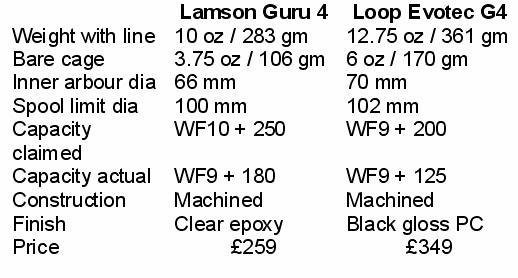
As you will know from Reel Value, I've spent most of my life at the bargain end of the reel market.  Trusty old friends like the Vision Koma and the Loop CLW continue to give me excellent service.  But scanning the catalogues that are arriving on my doormat to coincide with the annual salmon-fisher spring madness, it's clear that there's a strong market in more expensive reels.  Certainly the manufacturers think so, as you can see from the table below which shows what's in the shops at the intermediate price point between bargain and exotic.


The first point that stands out is that every major manufacturer has a product in this range.  Second, the tight clustering in the £200-300 band recognises that buyers at this level still retain a degree of price sensitivity.  They've done well economically; can justify spending this order of money; want something good and aesthetically pleasing; but don't wish to go up to the exotic range (where the price band is 5 times wider).  That recognition drives competition to the benefit of the buyer, yielding an excellent engineering quality - price balance in very good looking packages.  If you exclude the idiosyncratic click-check Hardy Marquis (the 'singing reel'), there are great technical similarities across the range in terms of the specification and use of materials, machining processes and sub-assemblies.  There's lots of contrasting finishing, weight saving perforations and other eye-catching features that are more to do with product differentiation than any difference in function.

Manufacture


Many of them are made in South Korea.  The choice of location has nothing to do with cheap labour.  South Korea is one of the most advanced manufacturing economies in the world, competing on quality with the EU, US, UK and Japan.  The fishing reel business is all about design, limited volumes and flexible manufacturing.  The production runs are very short in engineering terms: once set up, a pair of multi-station CNC machines could make most of the frames and spools for a year's sales of one of these reels in little more than 72 hours.  Subsequent powder coating/enamelling, assembly and finishing would keep half a dozen people busy for a week on each phase.  As a result there is unlikely to be a single plant making uniquely Brand A and nothing else.  With a proven track record in making fishing reels, the factory will bid competitively for work from the big brands, re-tooling between each batch, in order to reach economic volumes.  Set-up and re-tooling represent significant costs, which in part explains why the brands re-use components across their ranges (e.g. drag assemblies).

The Contenders


At various times over the past 5 years I've used about half of the reels in the table (6/13).  Some have been just for the odd day, whereas I've owned a Lamson Konic and a Guru for some years.  Last autumn I succumbed to the temptation of a Loop Evotec - it was in a discount sale at a lower price than a Multi (a first class reel) - and used it for 5-6 days at the back end of the season.  Based on that experience I thought there might be some merit in doing a detailed comparison of the Evotec with the Guru, because they straddle the price range and mark the opposite ends of the spectrum of design philosophies.


Respectable working clearances
You will immediately spot some differences in my measurements from the manufacturers' specifications.  These centre on the fact that normal anglers don't always wind the line on perfectly, especially when fighting a fish, and therefore need more clearance.  You don't want a jam between line and frame when you're bringing a 20 pounder into the critical last 6-8 yards.  This need for a realistic clearance as shown in the picture to the right reduces the capacity of both reels, but especially the Loop.  Bearing in mind that the Loop is sold as an #8/10, one wonders how much backing you'd have with a #10 line.


The first clue to the differing design philosophies is in the overall weight, and specifically of the bare cage: the Loop is 25% heavier overall; in the cage the margin's 60%. 


You can summarise the 2 approaches as 'Just Because' and 'Just in Case'.  Lamson is subsidiary of a design company (they do lots of other things) with a strong suit in material sciences.  They first came into reels via Sage. The elegant symmetry of the Guru's open frame design gives maximum strength with minimum metal to satisfy its design brief as a salmon and steelhead reel.  If you wish to go after bigger fish then you have to upgrade to the full-frame ARX at £450.  In contrast the Loop is a full-frame design with lots of extra metal, just in case you wish to mount the 9/13 spool and chase serious fish (like this).  That said, the asymmetric 'double L' strut is a bit of form over function, which isn't an efficient use of metal and so adds weight to achieve the required strength.


The Loop's 'just in case' mode is plainly visible in the drag (which you will also find in the Multi and CLW/Xact).  Not only will it stop serious fish (and the odd truck), it is capable of doing it with respectable frequency.  It is not, however, in the really big brake league alongside the classic 'flats' reels like the Tibor, Abel and their ilk.  Like the disc brakes on high performance cars it's all related to contact area.  With the 'centre contact' drag designs used in these 2 reels, that translates into the diameter of the spindle and its internal surface area.  Once I'd overcome the incorrect factory setting of the Evotec's drag (3 minutes with a supplied fine hex key) full happiness was restored.  With a selection of fish in various water states it was smooth and importantly, uniformly progressive in adjustment.


The Lamson's elegant and efficient theme extends into its drag system, which is based on pressing one metal cone into another (with all manner of clever coatings).  There are no fibre or ceramic washers.  However, its smaller contact area might be a limiting factor if you had to fight lots of very large salmon in heavy water.   For those who don't fish in Russia, the Guru will subdue 99% of what we're likely to encounter.  If we did hook the 1% monster of our dreams, the leader would give up long before the Guru.  I find it a nice fighting reel with a smooth drag progression.  Its open frame allows palming of the rim, which is handy in the closing stages when you don't want the drag too tight.  For me it's handled fish up to 19 lbs with ease and passed the stress test of a silver fresh 15 pounder in a confined space - rapids below, right angle bend and overhanging trees upstream, and a big sharp rock in the middle.

The design philosophy differences extend to the drag knobs, the Lamson's is scalloped and elegant, whereas the Loop's is a simple utilitarian knurled affair.  Actually, the Loop's works better with wet cold fingers and gloves.  You just slap your hand onto it and turn.  The Lamson requires you to place your fingers in the recesses - a mite too clever for me - and the beautifully polished stainless steel can be slippery.  The same applies to the handles: rubbery practicality on the Loop versus the Guru's polished metal.


Quality & Durability

Both reels are very well made.  The quality of machining is excellent and the surface finishing good.  The black gloss on the Loop is, however, vulnerable to 'gravel rash'.  I treat my kit with care, but after only 5 days' fishing the marks are clearly visible owing to the high contrast between the black surface and the underlying aluminium.  The Guru's clear epoxy coating is highly effective: where it has been breached the rash doesn't show up, even after 3 season's use.

Balance

The final issue to consider is balance.  The best reel in the world is no use if it doesn't sit well on your rod in a gentle horizontal balance with one hand on the cork and the other on the line.  If the reel's too heavy the rod tip keeps drifting upwards and you have to move your hand back.  More inconveniently, if it's too light the rod tip keeps catching the water, which requires hand movement and positive effort to correct.  If it's too pronounced you have no choice but to add weight to the reel or rod butt with lead tape.

I bought the Guru to go with a bespoke 13' #8/9 Charles Burns ('Ure Celebration') enabled by a bequest from an aunt.  By virtue of sound advice from the reel dealer and checking the balance in the shop, the overall balance is perfect.  But the Guru is not a happy union with any of the family's 14 footers: it's just too light.  With the Loop the position is completely reversed: it's too heavy at 13' and spot on at 14'.  It's an ideal match with the Cross S1 - they'd be daft if it wasn't - which leads me to suspect a connection with some of the  Evotec's additional mass.  I don't own a 15' rod, but it would be interesting to check its balance with the Evotec with the bigger #9/13 spool.

Conclusions

In summing up it's interesting to reflect that in their boxes these two reels have near identical headline specifications in terms of function, line capacity and arbour dimension.  They are both first class products, but when you take them apart you expose markedly different design philosophies that extend into every aspect of their construction and operation.  Those engineering differences have effects that become apparent once you reach the river.  I'm also very aware that at this price level it's not all about engineering:  aesthetics and personal taste are major factors in the purchase decision.  With that in mind, I offer the following thoughts:

  • The Lamson Guru 4 on a 13' #8/9 is a delightful combination for mid-size rivers.  The elegant design is pleasing and the finish excellent.  The minimal parts count bodes well for long term reliability.  My only minor gripes relate to the handle and drag knob.  It is too light to balance most rods of 14' or longer.
  • The Loop Evotec G4 belongs on 14' rods, and probably up to 15' with the larger #9-13 spool option.  Its design is workmanlike and sturdy but lacks the original aesthetics of Loop's early models.  It's smooth, capable, gripe-free and a pleasure to use in a very Volvo sort of way.
  • Both reels fall short of their declared line capacities when filled to practical rather than theoretical limits.  This is quite common with large arbour designs, something you should bear in mind, irrespective of what the retailer may say.  Remember that over-filling a reel with perfectly wound line is a recipe for losing fish late in the fight.
  • Try before you buy is as important with reels as anything else in fishing, and at this price level you want to be delighted.  Put it on the right rod to do an approximate balance check; explore the feel of handles and knobs; and check the drag progression because half a turn between free run and dead stop will cost you expensive fish.
  • And then there's the Yorkshire question.  Do these reels justify the extra cost above their value engineered cousins, the Konic and the Multi?  After all, they share the same vital organs of drag, bearings and spindles.  I suppose it all depends on what that extra money means to you in exchange for better finishing and looks.  It's a economic issue and even a Yorkshireman yields to temptation sometimes, especially if they're paying below the RRP of the lesser reels! 

Sunday, 19 January 2014

New Year Resolution - Salmon on a Dry Fly

My salmon fishing resolution for 2014 is simple: to catch a Yorkshire salmon on a dry fly. The resolution is simple but the execution will be much more demanding owing to the perversity of salmon.  The chances of success are probably on a par with a New Year resolution for someone else to lose weight on your behalf.

The idea came from Canada - Newfoundland and Labrador - where dry fly is one of the primary tactics.  It lodged in my mind after watching some of the films posted by local guides on YouTube of salmon taking a dry fly on the surface and then going mad on the far end of a single handed rod.  The take was exciting and nerve wracking - there are lots of near misses and you see it all happening.  But the the fight was something else.  Unconstrained by the drag of 40 yards of #9/10 line the salmon seemed to spend a large part of the affair doing aerobatics, demonstrating that their sea trout and steelhead cousins don't have a monopoly on adrenalin.

While the dry fly demonstrably works very well on Canada's east coast rivers, opinion is divided in the UK.  Some say it won't or can't work.  Others point to the success of riffle hitched light tubes and by extension think it might work.  A very few are determined adherents of the dry fly, but mostly they accept that the range of situations in which it's a viable technique is quite narrow.  Hugh Falkus wrote about taking fish on the surface, but he viewed it as an interesting but limited tactic to be exploited in specific conditions, which he illustrated with examples from rivers in the very north of Scotland.  Indeed, one very experienced friend who's used every tactic in the book over the past 40 years considers that this is a phenomenon of the high northern latitudes, working well in Newfoundland, Iceland, North Norway and northernmost Scotland (yes, he's fished them all), but less well elsewhere. 

With little or no clear evidence or guidance in the British literature, I sought the wisdom of Bill Bryden, a well known Canadian guide and proponent of the dry fly. What follows is his thinking, not mine, and I'm most grateful to him for his tolerance of my ignorant and persistent questions.  In parallel I tested some of the assumptions and guidance on one of the days at Tomatin last September.  I didn't catch anything but the experience gave me insights into some of the practical challenges I'll need to overcome.


The Parameters


White Bomber
Technique  The resolution is for a floating dry fly cast square and fished on the drift, probably a Bomber or something similar.  It excludes riffle hitched tubes, skimmers, muddlers and wake flies fished in the surface zone, even if they might offer a better chance of success.  Last September's experiments taught me that Roll or Spey casting a Bomber rapidly drowns the fly; and that a Bomber carries a lot of water.  This means short exposures with overhead delivery and false casts to dry the fly between presentation. 


Equipment  Much as I love my 12' #7 DH Vision, I will get the best delivery and easiest casting with a single hander and a normal (i.e. non-Spey) profile line, albeit at a substantially reduced range.  My middle-aged 9' 6" #7 Hardy Viscount will match the task rather better than my late father's positively geriatric #6 Daiwa Whisker Kevlar sea trout rod.   It took 40 minutes to subdue a 10 pounder 31 years ago and like me certainly hasn't got any firmer since then.  The standard Cortland #7 line projected the Bomber adequately in the September trial, but it's now old enough that I won't feel guilty replacing it if necessary (e.g. to achieve more range with a constrained back-cast).  The leader will need thought and some experiment, but my opening bid will be 10 lbs Seaguar Fluorocarbon to avoid the surface effects that arise with floating tippet materials.  Being denser than water fluorocarbon sits below the surface film, but at 10 lbs not so far below as to risk drowning the fly.  Once below the surface fluorocarbon has the same refractive index as the water, so it does not appear as a shadow line when viewed from below.

Close Range   Self evidently you have to get near enough to the salmon to spot its movement and inclination to take; cover it with a single handed rod; be able to see the take clearly in order to react effectively; and present the fly with the required accuracy and delicacy.  In Newfoundland they often use a boat to get close to the salmon, an option that isn't available here, which also improves your ability to see where the fish is lying.  You're standing on the water, not in it, so the look angle is more favourable.  This means I have a planning range of around 20 yards, which will decline rapidly if I have to wade to any depth. 


Dick Dub
Post spate, low and clear
Secondary holding lie area
Location  I need a holding pool with clearly defined lies within the 20 yard range; with the same clear space behind to allow square casting; and a moderate even flow (i.e. no back eddies to drag the fly).  Ideally the lies should be reachable without wading over everyone else's fish and making myself Public Enemy No1 of the trout fishing syndicate.  Given those factors, of the Thoresby beat pools the best option is probably the middle third of Dick Dub, provided I can overcome the back cast limitations.  The secondary lies are linear, well defined and within range.  Best of all it's not much fished and out of direct view. 


Flesh Dub is not viable because the lies are too far out.  There are some options in the tail of Frodle Dub that can be approached from the shallows below without disturbing fish further up, but this will involve casting upstream rather than the optimal square presentation. 

August Fish
Air 21C, Water >16C
but not on a dry fly!
Conditions  The advice is adamant that the water temperature should be at least 15C ( a figure only attained at Tomatin in our week during the drought and heat-wave years of 2002, 2003, 2005 and 2009).  However, that figure is reasonably common on the Ure in late summer.  The water must also be clear.  It remains to be seen whether these 2 criteria conflict with the size and persistence of water level rise required to pull fresh fish up from Goole and the 2-4 day freshness window.  Helpfully the Ure clears quickly after a spate and once settled is crystalline.  The air needs to be warm, still and overcast, in other words, classic olive fly hatch parameters, which can be commonplace on the Ure in August and September.


August Runner


Fish  The optimum targets are fresh newly arrived fish, not residents.  This presents me with something of a problem.  Whereas in Newfoundland they have bright silver fish and the requisite water and air temperature, in Yorkshire such coincidence is rare.  Last May we had silver fish in the Ure but snow on the tops.  If June and July are dry, then from August onwards we get fish that run the 73 miles up from the estuary at considerable speed and arrive with us in various shades of grey as a result of their extended sojourn in the Humber.  The August runners are much more numerous than their spring peers, which improves the odds, but it remains to
August Resident
be seen whether they are fresh and frisky enough to go for a dry fly. This criterion also sets a fairly brief window - perhaps 2-4 days - after each run-stimulating rise in water level before the salmon relapse into residence.


Inevitably a tremendous amount depends on the summer's weather.


The Plan


The analysis above suggests that the best chance of fulfilling my resolution will occur in August or September, within a 2-4 day window of opportunity after a run-stimulating spate.  There's no point block-booking a week because that will have dire repercussions for the weather (see The Countdown for an analysis of the meteorological effects of my eager anticipation).  Opportunism is the order of the day.  Work is quieter in August because everyone else is on holiday, and when they get back in September they need a full week to clear all the e-mails that accumulated in their absence and another week to process the work they requested other people to deliver by the first Monday (or others demanded of them).  This means I have a period of around 5-6 weeks in which I can snatch the odd day's leave without the need for a long lead time or coordinating with anyone else.


The Triggers


If the right conditions arise I'll have quite a good warning period because:
  • The weather system to bring the rain for the spate will show up on the forecast about 3 days ahead.
  • The rain should persist for 24-48 hours, long enough to generate a rise of about 1 - 1.5 metres.
  • Then the spate needs to run for long enough to pull fish through - generally 3 days.
  • The river will then need about 24-36 hours to fall to the optimum level and clear.  The Environment Agency levels are displayed on my phone and updated twice daily (yes, it's sad, I know).  Once the reading at Kilgram goes back down through +80cm the next 2 days will be just right.
  • And the average air temperature throughout needs to be between 16 and 21C, which Dales folk would regard as somewhat tropical.
Those parameters chime precisely with King William of Orange's description of an English summer: "three mild days followed by 2 of rain".  That will do me nicely Your Majesty.  Of course as a result of our Royal family being related to all the others in Europe our weather is anything but reliable in any direction.  In 2013 we had a Hanoverian summer with no rain;  in 2012, Swedish, all rain; but in 2011, classic English 3+2 mixture.  Who knows what 2014 holds?  Take your pick from Danish, Greek and Russian (courtesy of HRH The Duke of Edinburgh), but if I'm to crack the resolution, please pray for the full English.  Thank you.