Thursday, 17 September 2015

Vision MAG 13' #8/9


When choosing a new rod I can be extraordinarily indecisive, which isn't helped by the breadth of choices available.  Identifying what sort of rod is the easy bit: deciding which rod is hard if you approach the problem with an open mind.  There isn't another area of my life where I spend so much time on making a decision, so the condition must be fishing specific.  In that respect, the possibility of writing on this blog about my choice is almost certainly a restraining factor, because I had to practice what I preach about being methodical and trying before buying.

When I wrote Springtime - Swallows, Primroses and Salmon Rods on how a novice should go about buying a rod, I opined that the middle price range was where you would find the best combination of performance, quality and price.  That remains my view: the marginal gains at the top of the market are just that, marginal.  You don't get double the performance for twice the money, or even an extra 20% for that matter.  Those marginal gains are dwarfed by the cast-to-cast variability of normal mortals like me.  Conversely there are some excellent rods in the lower price range (the Shakespeare is outstanding at its price) but there are more design and quality compromises in that zone, and hence greater risks of disappointment.  Working to a tight budget does, however, focus decision making admirably.

There is no Holy Grail of the "Best Rod in the World" because this is not an objective business.  The winner of the prize is the one that suits you best, within the parameters of your physique, casting style and proficiency.  The only person who can tell you what's best for you is a very highly experienced casting instructor who has spent several hours watching you casting a wide selection of rods and lines.  Everyone else's views are just opinions - no more than that - irrespective of their enthusiasm for a preferred brand.  For all those reasons my strongest recommendation on choosing a rod remains "try before you buy", because that's the only way you'll know that it feels right.  Don't fall into the trap of thinking that you ought to like a rod because its 'good', expensive, made by a prestigious company, or your friend has one.  I suppose it's a bit like falling in love: you don't know the real thing until it happens.  When 37 years ago I met the striking young woman who became my wife I was completely decisive (and right), which proves that this current indecision on rods must be  just another one of my fishing oddities.


Defining the Requirement


14 footer conditions
Thoresby
Flesh Dub at +24"

I do most of my fishing on the Ure.  When the water's up on Thoresby a 14 footer is an appropriate and more relaxed solution to the demands of sinking tips and weighted tubes. On Bolton Hall  you don't need that power at any water level, but a light 12 footer isn't good higher water conditions.  On those grounds a 13 footer seemed a sensible compromise.


Not 14 footer conditions
Upper Bolton Hall at +15"
As a lot of the fishing on Bolton is off or directly adjacent to the bank, trees and vegetation, it was an essential requirement for the rod to be good for roll and ad hoc casts, and responsive when only partially loaded.  Very fast, stiff rods that demanded full loading to work would be unsuitable (I know, I've tried one).  Conversely, the rod would need the backbone to fight potentially large fish in confined spaces and in places where trees preclude chasing them down the bank.  Finally, it was highly desirable, but not essential that the rod should be able to cope with longer ranges and heavier payloads.


Constraints


There were 2 major constraints.  

  • An arbitrary budget cap of £500.  You have to draw the line somewhere.
  • Try before buy policy.  This is based on bitter experience: I once bought a premium rod at a great price on the grounds that it was an unmissable deal.  Fine, but the rod didn't suit me, so it wasn't a good deal after all.

These constraints ruled out succumbing to temptation in the form of the £800 Loop Cross S1, which in its 13 foot guise is highly praised; or anything from Sage.  The Loop's popularity is evident from the paucity of examples in the used marketplace: only one has featured on SFF in the past year.  When it did appear I hadn't had the opportunity to try one and thus was reluctant to punt £500 in breach of my policy.


The Trial


The whole process took over a year to complete.  At first I took every possible opportunity to try rods - friends, acquaintances and friendly dealers were very obliging.  This was slow: at this pace it would take me 2 years to cover the field: after a full season I had identified one good contender and eliminated 5 others.  In parallel I sought opinions from experts whom I trusted in order to identify which rods were so far removed from the requirement as to make testing unnecessary: this eliminated a further 5.  By the end of the 2014 season I had reduced the field by about 80%.  Obviously this level of pedantry is out of the question if you're buying your first rod or you have an urgent requirement, but I was in no hurry and had a completely open mind.  Anyway, it was educational and interesting.  The most important thing I learnt was that the verbiage used to promote rods is utterly uninformative and sometimes downright misleading.  There's no consistency or standard lexicon: just a random phrase generator, which seems designed to confuse the angler.  My advice is to disregard the words altogether.

The first year gave me a baseline contender, the Vision Cult 13' 2" #8, the little brother of my favourite 13' 7" #9.  It's a joy to cast and an ideal novice rod because it tells you everything that's going on, which is a huge help in establishing and maintaining your timing.  It loads easily, even when underweight, and met the Ure roll casting requirement perfectly.  If I didn't find anything that I liked better the Cult would do nicely, especially as I got it at a good used price.

When I was hunting the Cult my local Vision dealer, whose opinions I respect and trust, suggested that I should try the new MAG.  Actually I had previously ruled it out because all the sales material emphasised "fast action" and someone else had told me that the MAG 14 was pretty stiff.  On those grounds I was very wary, but a satisfaction/buy-back deal overcame my reluctance.  What then ensued was a head to head trial between the Cult and the MAG.  Every time I went out I fished both rods with identical rigs of line, leader and fly, down the same pools and from the same places on 3 different rivers - Ure, Dee and Deveron - in the full array of weather and water conditions.

But in reading what follows please bear the following in mind:


  • These are my own subjective views.  I am not qualified to reach objective, substantive conclusions.  What suits me may not suit you.
  • I'm not a great caster, but can cover all of the water on the rivers I fish most often.  My impressions are therefore based on my style and technique, with all of their limitations.
  • As I fish smaller rivers, mostly with limited back-cast space, my first choice lines are all shooting heads with a head length in the range 37-42 feet, matched to the requirement I defined above.  I saw no point in testing the rods with lines that I do not own or seem likely to use.
  • Owing to variations within manufacturers' ranges (yes, they are inconsistent), anything I say about 13 footers cannot be translated to the bigger or smaller models.


MAG Initial Impressions


You're unlikely to lose it!

Vision are nothing if not eccentric and the MAG maintains the tradition.  The eye-blinding orange carry-tube hits you as it emerges from the wrapper.  The tube is triangular, which means it doesn't roll about in the car, but it seems more flexible and thus less strong than its cylindrical predecessors.  Through the Cult I'd grown to like Vision's delightfully simple 'stow in the tube' system, so the emergence of a conventional rod bag from the tube was a surprise.


The MAG shares the top price point in the Vision range with the functional Tool, but is entirely conventional in its aesthetics.  The rod is nicely finished in a pleasant green colour with a semi-matt finish.  The tape ribbing is less pronounced than on the Cult.  The rings are Pacific Bay and whipped more sparingly.  The general effect is understated, which suits my taste.
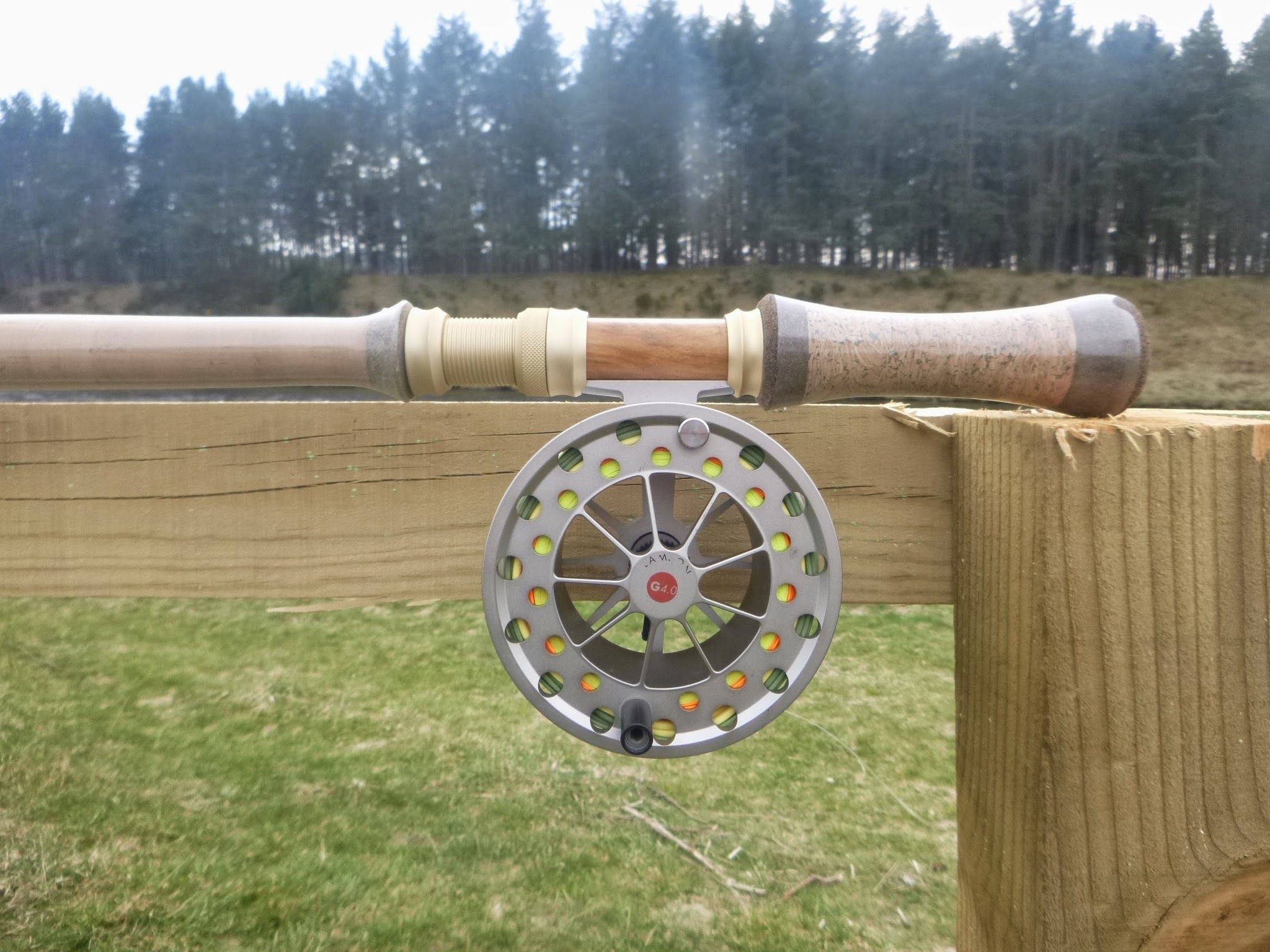


The understatement does not, however, extend to the reel seat.  The good news is that it's down-locking.  Although there's only one nut, it never came loose at any time during the trials with a variety of reels in hard usage.  The gold finish and natty wood seat are not to my taste: I'd much sooner have grey or black.  Taste apart it's a great improvement on the Cult in every functional respect.  With the down-locking the MAG balances nicely with a range of reels, including my Guru and Rulla.


The slim handle is a striking feature, which suits me admirably as I have small hands (Size 8 glove).  It follows roughly the same profile as the Cult but with a reduced diameter that you really do notice when switching between them.  Vision have also tried something different with the MAG: the cork rings in the primary top hand grip zone are arranged with the grain laterally, rather than longitudinally aligned.  I don't know why they've done this, and the net effect isn't an improvement in my view.


Vision MAG 10' #3/4 Trout

Frustratingly there are no alignment marks.   Which raises the obvious question: if Vision put them on the MAG trout range, why not on the salmon rods?


On the Water

Posing on Upper Kirk
By an accident of timing the MAG's first outing was on the Dee in April.  Although this was 14 footer water, the lack of fish led me to set up the MAG for a bit of a diversion.  I put on (what I thought was) an #8/9 AFS with a slow sink polyleader, a 3 foot tippet and medium-sized double fly.  After a few tentative rolls to extend the line downstream I launched into my first proper cast.  Contrary to my expectations I felt everything that happened, right the way down into the butt.  A respectable loop (by my standards) set off across the river to deliver the fly exactly where it had previously landed with a 14 footer.  After 20 minutes of this fun my preconceptions had gone.  This rod had both communication and muscle.  It wasn't as forgiving and communicative as the Cult, especially if you overdid the right hand and overshot the stop, but when I got it right, the line flew.  From the left bank I went through my full repertoire of right handed Single and C Spey; and left handed Double and Snake Roll (a sight for sore eyes), to find it worked equally well for me in all modes.  The MAG certainly met the highly desirable 'power on demand' criterion, but its short range capabilities remained untested.  I later discovered that I had mistaken the line: it was actually a #9/10 37g, which probably explains why it loaded all the way through!

The next session was a long spring day on the Bolton Hall Water of the Ure.  This was the real test of the core roll cast and versatility requirements.  Needless to say the Cult excelled here, but I rapidly discovered that it didn't like being over-lined.  It says 29-34g on the rod and unusually, that's the fact.  In contrast the MAG, also marked as 29-34g gets into its stride at 34g and handles a 37g AFS with ease.  Its roll cast performance was excellent across the spectrum and improved up to the 37g point.  It lacked the Cult's responsiveness at very short range and when under-loaded, but by no definition could the MAG be described as 'very fast' or synonymously 'stiff'.

The final stage was the week on the Deveron.  This started as an exercise in 'far and fine' in very low water, which played to the Cult's strengths.  Then the rain came and I spent the next 5 days roll casting off steep banks with medium and fast sinking leaders and weighted conehead tubes in winds of up to 30 mph.  In my view the Cult was working at its limits in my hands; or more likely, the deficiencies in my technique had curtailed its limits.  In particular its flexibility in the back-cast didn't give me confidence in my ability to control the process and place the anchor reliably.  In contrast the MAG excelled in the challenging conditions.  With the 34g Scandi head it told me what I needed to know during the cast: not as loudly and clearly as the Cult, but perfectly audible even with my imperfect casting ear.   Its steely core inspired confidence both backwards and forwards.  I was delighted with the distance it sent the line across the wind with a little extra bottom hand. With minimum effort it increased my expectations of the water I could cover from the bank.  The search was over: I had found my 13 foot rod.


Bottom Line

In my opinion the MAG 13' a very impressive rod that combines pleasant flexibility and a genuinely through action to deliver excellent feel and power on demand with Scandi-style heads.  Its very wide line weight window gives added options, especially for short range fishing.  Whether it's right for you is another matter.  But if you've gained some casting experience and are looking for a 13 footer to cope with a wide range of fishing conditions similar to mine, then I unreservedly recommend that you include the MAG in your 'must try' category before you buy anything else.  If on the other hand you're just starting, do try a Cult first.


Afternote

I've now used this rod for 5 years on rivers large and small in Britain and Norway; in high water and low; with floating and sinking lines; and with every combination of tip and fly you can imagine, and some you can't.  During that time it has been my go-to rod for everything except the smallest waters.  Even in my imperfect hands its casting performance is extraordinary.  I tested it, and myself, to my limits in Norway on the Gaula in high water, with thousands of Spey casts of every type, right and left handed.  On that evidence I am in no doubt that this wonderful rod is exactly the right one for me.

It is possible that if you spend twice the money on a Hardy, Loomis, Sage or Loop Cross you might achieve the same level of performance, provided the rod suited you. But at the £500 price point, nothing else came close.

Sadly the MAG is no longe sin production, but if you ever get the chance of a used 13 footer, go for it.  However, please do bear in mind that the excellence of the 13' doesn't guarantee the same characteristics at 12, 14 or 15 feet.

Monday, 14 September 2015

Deveron 2015 - Delightful but Dirty

Netherdale Beat 2
Looking upstream, water at + 20"
A rare photo taken in sunshine!

This year Just One Week migrated to the Deveron from its long term residence on the Findhorn. I'd never fished the Deveron, but its reputation, John's report from last year's reconnaissance and the enthusiastic following on the Salmon Fishing Forum combined to lift my anticipation to its usual August - September level.  This year, however, a wonderful family holiday in Italy in mid August diverted me from ranting about the weather or being completely obsessive.  My wife thought my covert looks at the SEPA water levels amidst the glories of Tuscany were acceptable, especially when judged against the standard of the past 15 years' seasonal daftness as evidenced in The Countdown and  Divine Madness.

As always my big worry was whether we would have any water.  The Deveron had a small rise in mid August but the forecast wasn't promising.  It was time for all good folk to come to the aid of the party, so I issued an appeal to friends and contacts for prayers, rain dances and magic.  The effects were variable: Steve, working in Italy, achieved only local effect, putting Pisa Airport under a foot of water on the morning we flew back to England, delaying the flight by 4 hours.  History subsequently showed that the range of his powers increased with practice and the incentive of fishing the same beats the week after me.  The locals, already in a state of grave concern at the lack of fishing, donned full regalia and took to the mountain tops.  No matter who was most effective, it worked!  Indeed, as you will see shortly, in some respects it worked rather too well.

Line cleaning
Warm, not hot, soapy water
Followed by drying and polishing
Once I got home the well practiced routine got underway: checking and stowing kit; servicing reels; cleaning and polishing lines; and finally loading the car.  For once there was no excuse or reason to stop at John Norris: I'd done so little fishing since my last visit in April on the way up to the Dee that nothing was needed.  This year stowing the car presented a greater challenge than normal: the change from a medium sized estate to a compact 4x4 reduced the available volume by 30%, while the dog's box hasn't changed in size and the number of rods seems to have crept upwards.  The smaller car did, however, prompt an unexpected degree of wifely space economy without any prompting on my part.


Following the established meteorological tradition, the rain forecast for the Cairngorms drifted inexorably to the north whilst the Deveron's level drifted southwards.  We just don't seem to get the traditional solid 200 mile wide frontal systems at the moment - just random large scattered showers.  If one hits the catchment area of the river you're going to fish then you may be in luck for a short period, but if not, it just passes by leaving you with ankle deep water.  This phenomenon affects the Deveron more than its neighbours, the Spey and Findhorn, because its catchment is on the north eastern shoulder of the mountains, rather than others on the west side facing the prevailing direction of weather arrival.  For that reason the Spey and Findhorn fished very well throughout August, whereas the Deveron, a mere 15 miles east, was devoid of water.  As I explained in The Vital (Missing) Ingredient, in most salmon rivers, no rain equals no water equals no fish.


Upper Carnousie
We arrived to find the river as expected, very low and clear, with only short stretches of fishable flow.  At normal fishing height the water on the Carnousie beat is up in the grass on the left side.  With only one small lift since the spring there were very few fish in the river, and they would be virtually uncatchable.

On a more positive note, the river was stuffed with trout of all sizes,feisty sea trout and legions of salmon parr.  It's always heartening to see a river full of life with a good supply of invertebrates.


Netherdale 2
The Loggs
The Carnousie and Netherdale beats are very attractive water.  The Deveron is, however, very different from both the popular image and my previous experience of Scottish salmon rivers, in that it isn't set in a glen surrounded by purple mountains.   For much of its length the Deveron runs through prime agricultural land that is intensively farmed with barley and seed potatoes on a good friable loam soil.  The consequences of this geography became apparent as soon as the rain came.


Netherdale 2 starting to rise
Tuesday 10 am
We'd been praying for this to happen and the rain arrived on cue.  It wasn't especially hard but it was persistent and falling throughout the catchment area. After about 6-8 hours the river started to rise slowly but steadily.


The first 4" of the rise
At first it rose whilst running clear, but before long the character of the water changed completely, from this to.....


The product of the next 4"

Aberdeenshire drinking chocolate!  Even without hard rain and rapid run off, enough of the 'friable loam' made its way into the river to make it unfishable.


Early stage of the rise
Depth 20cm horizontal view in shallow water
Windows 1, 2 & 3 visible
Actually, underwater it wasn't quite as bad as it appeared, but still bad enough to reduce one's chances to near zero.  The pink tinge is characteristic of the soil type (the Devonshire Exe is similar).  On the occasions the sun emerged through the clouds the back-scatter of light from the suspended particles was dazzling, and would have been extremely trying for the fish.  The green component at the bottom arises from the tremendous growth of vegetable matter during the long months of low water during the summer, which then detaches as the river rises.


Putting on a brave face
MCX in the rain
The rain kept coming and the river continued to rise.  To be brutally frank the conditions were pretty unpleasant for both salmon and people.  They couldn't see the flies that we were having great difficulty in casting off the raised banks in the gusty 20 knot downstream wind.  Undeterred I kept on trying - what else would you expect - whilst consoling myself that it would be ungracious to complain about the success of our prayers for rain, except that it was never enough to bring the sustained 4 foot spate the river so desperately needed.


Stable level +20"/50cm, Thursday 5pm
Depth 3' 6"/ 1.1m
Horizontal view Window 1 & 2

On the fourth day the rain abated somewhat and the river level stabilised at around +20-24". The mud dropped out and the Deveron re-assumed its more normal high water colour, which had been described to me as "inky".  This picture taken at fish depth suggests that 'Madeira' might be more accurate.  In this zone even a salmon would be hard pressed to detect and react to anything much except at point blank range.  However, the shot below was taken 60 seconds later in the same place but at a different angle.


Stable level +20"/50cm, Thursday 5 pm
Depth 3' 6"/ 1.1m
45 degree upward view of Windows 2 & 3
Elevating the sight line to the salmon's optimum detection angle of 45 degrees changes the tint and contrast, and provides a detection range of about 1-1.5 metres for dark flies. This underlines the key point that the correct depth for presenting your fly is at 45 degrees elevation above and ahead of the salmon, and not at its eye level.  So, while the natural impulse in dirty water may be to reach for the sinking line and go deep, this will be the wrong response because you could be concealing your fly in the gloom of Window 1.  Plus 20" isn't very deep, so a slow sink tip and a Conehead tube will put the fly where it can be seen and reached.


Netherdale 2
Looking down to Burn End
We now started to fish with more purpose and optimism.  There weren't yet many fish in the beats but more were coming off each high tide, especially some lovely pods of silver grilse.  The strong downstream wind was still awkward, especially as the great majority of casts had to be made from the bank.  However, as most of the grilse takes were occurring close to the dangle in the bank margins, there were no extra prizes for forcing long square casts.  You just had to be content with 45 degrees and covering 2/3 rds of the water.  It was nonetheless slow dour work, especially during the squalls.


Netherdale 1
The Doctor's Run
Dour work in a squall

Some of the pools and lies were unfishable with a fly owing to the wind and uncleared bankside vegetation, most notably the otherwise productive Burn End.  Once you got onto the promontory in the shot above, a machete was more useful than a fly rod.


I wasn't even trying to cast square!
A most unusual snag of the D loop
Dead sheep on the croy at the bottom of Netherdale 1 Upper

I don't think that my sticking with the fly made much difference, not least because the spinners weren't catching anything either


Heavy water, raised bank and downstream wind

This shot underlines the point about not striving to cast too far.  You can't fish the lie in the foreground effectively by casting out beyond it.  At this level the running line splits either side of the obstacle, which also provides some good short-halt 'breather' lies.  You have to come at it from a narrower angle with a shorter line. Casting like an automaton to a fixed angle and your maximum achievable distance will win the effort prize and little else besides.


Deveron Silver
Sea-fresh grilse ca 5.5 lbs
1" Cascade conehead on slow sink polyleader
Finally the effort prize turned up before breakfast on the Saturday morning. However, I cannot claim that skill or theory had anything to do with its capture.  This was an outrageous fluke in accordance the finest traditions of salmon fishing.  I had just entered the water on a shallow wading line that gave me room for a left handed Double Spey in the downstream wind, and rolled the shooting head downstream at a shallow angle.  Whilst I was stripping the running line off the reel in preparation for my first full length cast of the day, bang! and there it was, perfect in its silver livery.


Naturally I went into breakfast in high spirits and with optimism that was rising inversely with the river's fall.  Sadly our hopes for a great day were dashed by a further rising and colouring of the water - up 4" during breakfast.  Patrick managed to land a fine 14 pounder mid-morning, but that was all.  I got a nice solid 2 lbs sea trout at lunchtime as a minor consolation at the end of a long hard week's fishing with precious little reward - one salmon and 2 grilse between 5 rods is thin pickings for the first week of September - but that's salmon fishing.

So what did I take away from the week?


  • The Deveron's a lovely river, and given respectable water levels over a fortnight or more would undoubtedly hold a lot of good fish.  But you can't expect much dividend from the first 20 inch rise since the spring.
  • In low clear water the weapon of choice is a small double hander (mine's a 12 footer) or strong single (10' #7), fished with very small flies (#14 & 16) on a fine leader at longer range.  With the raised banks good fieldcraft is essential because the fish can see you over long distances.
  • With the water at +20" a 13 footer is the weapon of choice.  I was using the new Vision MAG for most of the week: my impressions will comprise the next post.
  • You have to put the fly where the fish can reach it, but always present it above the sight line to increase the chance of detection, especially in dirty water.
  • If you've prayed for rain, don't complain when it happens!  Nature isn't fair, it's just natural.
  • When the conditions are marginal you have 2 choices: retire to the lodge; or stick at it and wait for the outrageous fluke.
  • The generosity of advice and kindness from my SFF colleagues was outstanding: thank you Craig and Steve.
  • Gilly and John remain champion hosts and organisers: thank you.


Forlorn hope 2015


A more optimistic view
Netherdale 2
Looking back to the hut


Friday, 7 August 2015

Thank You

As a rule I don't write unless I have something useful to say.  The exception is my ranting about the weather and lack of rain.  Even then I try to include some substance.  Although we had some rain in July, it only put the Ure up for a couple of days.  This wasn't enough to pull fresh fish into the system, so I've got nothing new to tell.  What's worse, barring a miraculous coincidence of rain and family holiday timing presenting me with the right conditions on the Ure, I won't have anything to write about until I return from spending the first week of September on the Deveron.  So please don't expect anything from me for the next 5-6 weeks, but rest assured that despite my age I'm still alive.

This interlude has, however, given me some sympathy for the professional fishing journalists who have to turn out copy to demanding editors month after month.  It must be hard to be original and certainly not much fun.  At least I have the liberty of writing what I want, when I want, subject of course to your approval.  On this occasion, although I haven't anything useful to say about fishing, there's something I wish to say to you.

Thank You

When I started this blog almost 3 years ago it was as much about self-reflection as conveying information.  I wished to record my thoughts: the notion of writing 50 articles never entered my head. I'm not an expert and I'm certainly not a good caster, but if a few people who fished for just one week each year found my thoughts useful, so much the better. However, last Thursday, just before meeting my daughter for dinner in London (she was treating me as a birthday present), the counter passed the milestone of 50,000 page reads. Thank you for your amazing interest, support and encouragement.

It's not just the numbers of readers that amaze me, it's also your world-wide spread.  The combination of cheap communications and the internet has trumped geography and distance.  Google's Analytics tell me that at one time or another J1W has been read in over half the countries in the world.  I now have mental pictures of expatriates around the Gulf and other oil rich places pining for the cool waters of Scotland (including a singleton reader in Venezuela); tourists in South East Asia taking a quick read before the sundown cocktail; active fishing enthusiasts in Scandinavia, Russia, Patagonia, New Zealand, Canada, Alaska, Ireland and the whole of Europe; and like minded people in places I would never have connected with salmon fishing like Ukraine, Namibia, Taiwan, Georgia and Brazil. Thank you everyone.

The scale and spread of interest in Just One Week is not about me or what I write, but the sublime pleasure of our sport; the wonder of the magnificent fish we try to catch; the beauty of the surroundings in which fulfill our enthusiasm; and the people with whom we share that pleasure and who thereby lift is to an even higher plane.  It's a wonderful world: thank you for the miracle.

Monday, 29 June 2015

The Vital (Missing) Ingredient

Picture perfect
a fat 2 lbs Rye wild brown trout
June 2015
It's an unusual year when I don't have at least one rant at the weather.  Sometimes I wrap the rant in a bit of science (see How Long Can This Go On?), but more often it's just a straightforward rant born of frustration at not being able to fish.  Of course it's June, so I don't normally expect to be out on the Ure after salmon, but rather on the Rye bothering the trout.  Yes, it's summer, but for most of the past two months it's been hard to detect.  We've been locked in a cool northerly airstream that's endured from the early spring.  But whatever the upper levels of the atmosphere have been doing, down here on Planet Yorkshire it's been cold, windy and very dry.


Rainfall in the Vale of York 2015
As you can see from the graph, it's been exceptionally dry.  Only May was anywhere near the long term average, but this amount of water wasn't enough to bring many fish up into Wensleydale.  The head of this year's cohort of springers appears to have got just beyond Ripon. Perhaps the efflux from Theakston's Brewery in Masham proved an irresistible attraction.  It makes sense: Theakstons support the Ure Salmon Trust; and in return the salmon endorse my opinion that Theakston's XB is one of the finest ales on the planet.


Environment Agency gauge at Kilgram

The effect is obvious.  This is what salmon fishing depression looks like - a straight and level line telling me that the Ure, in common with all the rivers in North East England is down on its bones.  It's been like that for a month and looks set to stay that way.  All we can hope for is an earlier onset of rain than last year, when the river didn't rise until 17th October.


River Findhorn at Tomatin
3rd week September, 2002-2011
Average height and variation
For all salmon anglers water is the vital ingredient.  The graph showing our experience over a decade at Tomatin underlines the simple point: if there's no water, you're pressed; if there is, then you can catch plenty of salmon.  The stellar years of 2004, 10 and 11 are highlighted. The party took around 40 fish in 2004, compared to 4-5 in the drought years of 2002, 3 and 9.  In contrast, 2006 and didn't quite make the level or the grade, whereas 2007 came good, but only with a rise later in the week.  In the case of Tomatin, the data shows that pleasure starts at +12".


All that said, we have to accept the variability of the natural world.  In childhood my father impressed upon me that there was no point worrying about the things you can't change. However, for all the compensations of the trout and the garden (it's really beautiful this year) I miss the odd day out after salmon.  I had a dream recently, almost certainly prompted by booking a week's fishing in Norway in 2016, in which I could actually sense the flexing of the butt of the Vision MAG in a perfect Single Spey cast on a crystal river.  That must be the definition of salmon fixation, but perhaps that's what you expect from me.  In any event the only perfect Single Spey I ever achieve is in my dreams!

But in all things there are reasons for optimism.  Throughout history, from Nostrodamus via Malthus to the Club of Rome ("all the world's oil will run out on 17th February 1984") and today's gloomsters, the pessimists have all and always been wrong.  It's easy to paint a rich and convincing picture of disaster and gloom, which through its vivid colour gains credibility and convinces people of its likelihood.  The trouble is that the human fear of the downside far exceeds the attraction of the upside, so except when hysteria takes over - like in economic bubbles involving black tulips, South Sea spices, Victorian railway shares and post 1970 residential property - we tend to believe the prophets of doom.  But for my part, I'm an optimist: it's hard to be a salmon fisherman without optimism.


Sunday, 24 May 2015

Top of the Water - Upper Bolton Hall

It's been a while since I last wrote.  When I returned from the Dee in early April, Yorkshire went into a cool, windy and exceptionally dry spring - 14mm of rain when you're meant to get an April average of 60mm is unhelpful for salmon and anglers alike.  There were plenty of fish stacked up in the Ouse around York waiting to run up the system, but without rain they were going nowhere very slowly.  We needed a good two weeks' rain to generate a 2 metre spate and then keep the river well up for at least 10 days.  In early May my prayers were answered, at precisely the time I had to go to Qatar on business.  As my wife says, "it's never right for you and fishing", but there again she's not a student of Murphy's Laws.  If she was, multi-tasking would be right off the agenda.  By the time I'd got home, adjusted to the 40 degree temperature change, spent 2 days in London and sorted myself out, the Ure at Kilgram had fallen to +55cm, viable but certainly not optimal for spring fishing.  That note of pessimism merits explanation.  Springers are rare at the best of times, and to have a chance of connecting you need them to be alert and mobile: your best chance of catching them is at at short halts between moving.  Once they 'drop anchor', go deep and switch off they become extremely hard to catch except during a few short periods of activity during the day and early evening.  Nevertheless my waders had been dry for far too long: I was desperate to put a fly onto the water and the 20 mph wind meant that bothering trout would be pretty miserable, so it was time to load up the salmon boxes and head off to Wensleydale.


The latest improvement at Bolton Hall is a smart new hut facing onto the Lord's Pool, complete with an enclosure to protect your wing mirrors and paint from amorous cattle with an itch to scratch.  It's warm, dry and a most welcome addition.  It was a real boon when changing with the temperature gauge showing 8.5C and a 20 mph wind: this is Yorkshire, where summer remains an elusive concept.


In the event the level of the Lord's Pool was too low, so I went upstream to work some of my favourite spots.  The ash tree on the right is a hardy perennial marker where I hooked and lost a springer last season.  With the air at 9C and water at 11C; a moderate flow; medium clarity and dull conditions this was a solid 6 on the MCX scale.  As this stretch isn't deep there was no need for sink tips, just a medium sized Cascade double on 12 feet of fluorocarbon.


The lack of water was more apparent at the bend below: another 12-15 cm would have been much better.  In this pool the fish hold just upstream from the large rock in the centre of the picture on the far bank, but it's not much more than a 20 yard cast to cover the lies.  Sadly there was nothing happening that morning, so I fished down to the head of Park before breaking for lunch, which I'd obtained at the West Witton village stores.  They have a good selection of locally baked pies and pasties, and excellent scotch eggs, which are all ideal high-energy foods that fit easily into the back pocket of the wading jacket.  Just don't panic about the cardiac issues - you'll only worry yourself into an early grave!


After lunch I set out for the top of the Bolton Hall water.  Until now my ability to explore the full length had been constrained by my conventional estate car and unreadiness to march long distances through the bushes.  To the amazement of many I could get it to places few others ventured - even down to the river at Thoresby on one occasion - but on Bolton Hall the end of West Wood was my limit.  With the onset of partial retirement I've changed to something with 4 wheel drive and 9" of ground clearance - there's no point having leisure time and limited mobility.  It's not a serious mud-plugger in the Land Rover mode, but it certainly crosses fields and banks much better than a Mercedes estate.


Top of the beat looking upstream
Reaching the top of the Bolton Water just below Redmine was a revelation, a joy to behold.  It evoked happy memories of the Alness and the upper Carron with more trees added: characterful, lively and full of interesting runs, deep pots and holding pools.  There are several faults in the limestone that produce falls or channels, depending on which way the river is flowing.

This is shorter rod territory: at this level 12' was ample; or 13' when the river's up and you need a heavier front end.


And downstream
It's stunningly pretty at this time of year.  Sadly the photographs taken in very dull light don't do the scenes justice.  The greens are spectacular. The only drawback was that the pool shown was heaving with small sea trout: you could barely get a salmon fly into the water without an all-out assault.  The first cast yielded a very pretty fresh peal of around a pound with a beautiful blue sheen.  By the time I reached the bottom I'd landed 2 and missed about half a dozen. it will be interesting to return for an evening in July with a single handed rod to meet their elder brothers.


200 metres of heaven
The runs and pools follow in steady procession, with views to excite any angler.  This isn't big water, but you have to be flexible and inventive with your casting to fish it well.  There's a full 2 metres depth of water on the centre-line here, and enough flow in the water to work the fly all the way down to the neck at the bottom.  There were fewer sea trout in this pool, but one solid brownie of over 2 pounds decided that a #8 Cascade comprised a late lunch.


This picture will spark happy thoughts in anyone who's fished the Alness.  The difference here is that it leads into...


...a proper pool.  Come September I wish to be on this spot, grinning from ear to ear.  The old Lord Bolton remarked in his fishing diary that he'd never caught a fish in this pool, but judged that  "it could hold every fish in the river".  I concur with his judgement but aspire to doing better.


Around the right angle bend the limestone fault runs parallel to the flow and thus drives the river into a narrow defile with a series of deep pots and runs (like the Carron beside Amat House, but with more water).  There are so many possible lies that you have to fish every inch to be sure that you've exploited all your chances.  Some of it is at point-blank range with only a few metres of line outside the tip; in other places you're standing back 15-20 metres to fish at the narrowest possible angle in order to keep the fly in play as long as possible.


It then opens out into the long Neild's Dub, where your wading line down the right side is on a continuous flat limestone ledge.  You have to be wary of stepping off the drop into deep water, whilst also being aware that fish could be lying within a metre of your toes.


West Wood 1
After by-passing the small runs above Batt Island I reached the familiar West Wood 1.  Sadly it was too low for good fishing, so after a brief session with some different set-ups I called it a day, finishing almost 2 hours early without touching a salmon.  But I wasn't in the least disappointed.  Fishing this beautiful stretch of water was uplifting and stimulating.  The odds of catching a springer in most places are poor, but I felt they were as good here as anywhere, which kept me completely focused for a whole afternoon.  At £40 for the day ticket this is the best value delight around.  Bring on the water!