Tuesday, 4 October 2016

Meet the MCX Family

Don't be deceived by the title.  This post isn't about my wife, children, their spouses and our grandsons.  It's about the MCX Shrimp Family, which for the first time has been tied in its entirety.  I should love to be able to report that I had tied them myself, but I cannot.  I've never learned how and as I have a hand tremor caused by Focal Dystonia, exacerbated by injury, that gets worse when doing fine work under pressure, I lack the confidence to start.  I can do the science, the analysis and the conception, but not the execution.  Accordingly I sought the help of others: Darragh Digney who tied the Version 1 prototype; Martyn Roberts who developed V2; and now Peter Nightingale of Classic Flies who has tied the full family of V3.


The Design Process


Followers of my ramblings will be aware of the amount of time I have devoted to the study of light, contrast and colour in water of differing colours and brightness.  In Eye of the Beholder I demonstrated that once in the water it was almost impossible for us to differentiate between the most popular shrimp patterns, and I very much doubt that the salmon can either.  Indeed, if they're minded to take there's a fair chance they'll take whatever half way sensible fly you put in front of them.  My grandfather always opined that most salmon flies were tied to catch fisherman and not fish, and to be frank there's an awful lot of lily-gilding goes on amongst fly tying that isn't to my taste.  You give someone a brief for a simple design and the prototype comes back with a jungle cock 'eye' on each side and a load of sparkly floss stuck to its backside.  After a bit of deft scissor work I get back to what I wanted, although I do have a small pang of regret about vandalizing someone else's art.

All of my research, Yorkshire genes and inclination lead me towards simplicity that verges on austerity.  I carry very few fly patterns - see Inside the Box for the evidence - and only change my fly when there's clear reasons for doing so.  After all, there are more reasons for a salmon not to take than just the choice of fly.  The proof of that statement is simple: for 99% of the time they take nothing at all.  If you do change the fly and then catch a fish, you have no means of knowing whether the previous pattern would not have delivered the same result.  Of course, the blindingly obvious conclusion from this line of reasoning is that I shall be unable to prove that anything I come up with is demonstrably more effective than anything else.

By the end of the research, design and analysis phase I had a clear mental picture of a simple fly in two variants: for higher water, a predominantly dark design to achieve strong contrast to enhance detectability, with enough orange (remember that's grey underwater) to break up the details to achieve the desired "impressionist" effect; and for lower clearer water, a light design in which its pale grey anonymity prevents the salmon getting "too good a look".


Version 1


MCX Dark Shrimp V1
(Darragh Digney)

The sparsely dressed V1 had a brief but useful career before being snatched by a hard bit of Yorkshire rock.  It proved utterly lethal on Ure sea trout, even in broad summer daylight.  The austerity of the design and the modest aesthetics appealed to me and it inspired confidence.  However, the abject lack of salmon in the Ure precluded gathering any evidence.  Of course the downside of austere dressing is fast sinking, which is what caused its loss.


Version 2 
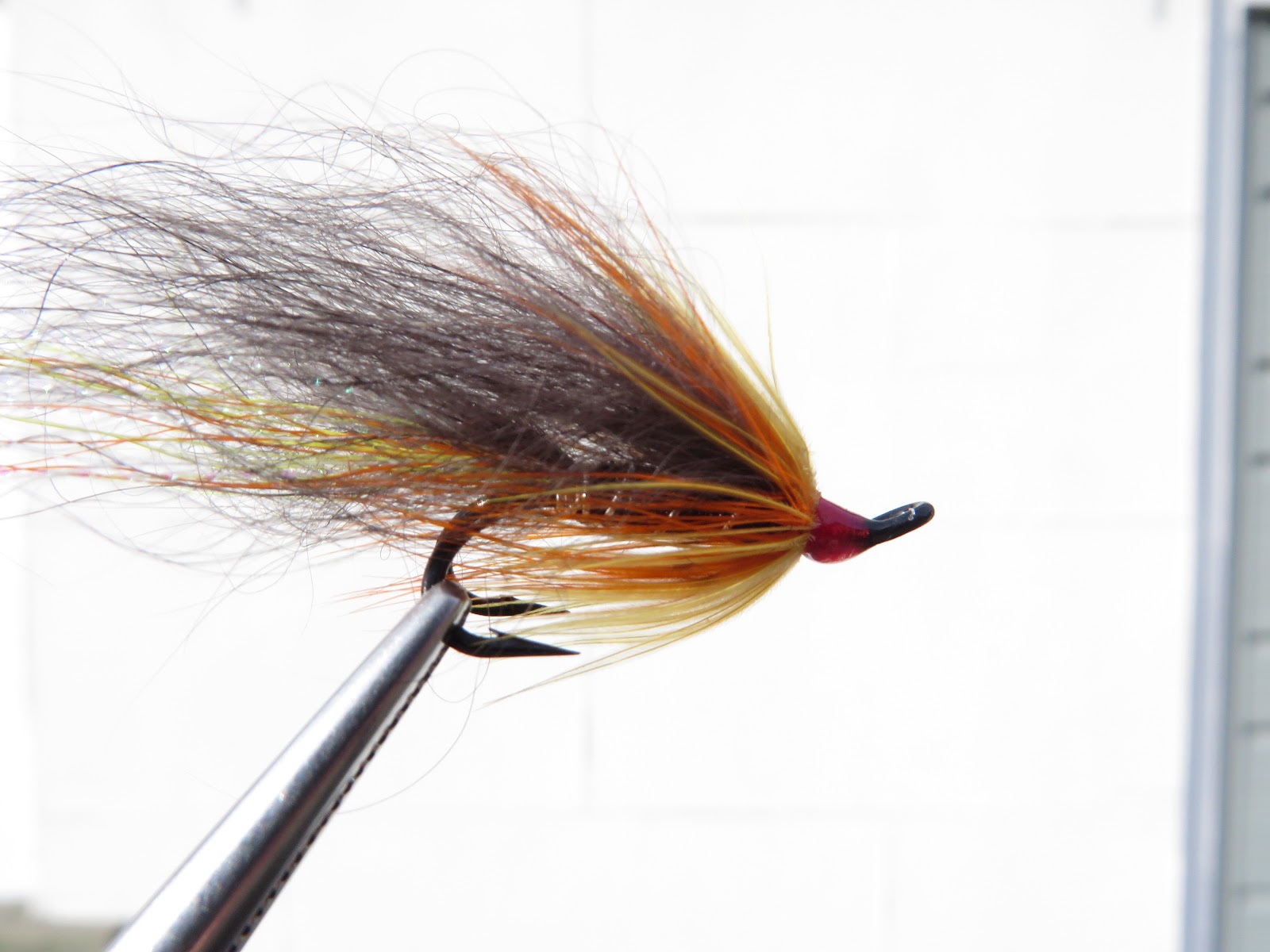

MCX Dark Shrimp V2
(Martyn Roberts)

The more heavily dressed V2 proved to be a highly effective fly against a small number of fishing outings and salmon caught.  It looks pretty bushy here, but after a bit of light pruning and use it becomes somewhat more conservative in appearance, as shown below.


MCX Dark Shrimp V2
Pruned, swum and salmon-chewed

In fact this fly caught a salmon on every day that it was used, but the sample was too small to count as evidence.  However, on two days it was the only fly to catch fish on the Ure, one of which was the Beast of Wensleydale, which was good for morale if not for statistical discipline.

Sadly, when Martyn had to close his business All Water Fly Fishing - another expert small tackle shop throttled by the web heavies - he was unable to tie further examples and recommended that I approach Peter Nightingale.


Version 3


MCX Dark Shrimp V3
Pre-production prototype
(Peter Nightingale)
The development of V3 involved lengthy consultation and discussion as Peter is a perfectionist who wished to be absolutely clear as to exactly what I wanted.  The pre-production model arrived in time for Norway, but had its first UK outing on the Ure in mid-September in almost unfishable conditions - near 30 degree heat, ultra low water and finally a violent lightning storm.  As the fish came awake towards last light I had one good take and loss as the lightning arrived before I fled the scene.  A week later in better conditions but turbid water (+8") I had 3 takes and landed one fish.  Overall I was happy with the design and had the confidence to ask Peter to tie me 4 examples of every member of the family.


Here they are in serried order, working away from the camera:

  • Light double #14, 12, 10
  • Dark double #10, 8, 6
  • Light 0.5" Conehead & 0.5" ultra-light
  • Dark 1" conehead plastic, 1" conehead brass, 1.5" conehead copper
Of course opening the envelope was a matter of much excitement - even my art historian wife was aesthetically impressed.  Beyond the art they are beautifully tied and look suitably rugged and durable.  I'm delighted, so for your delectation here are some of the individual family portraits.  


Light #12


Dark #8


Light alloy mini-conehead


Dark 1" conehead


Out of the envelope - the whole family

Bring on the next outing, even though there will be no water, following a September with less than 1/3rd of average rainfall, and a cold dry east wind to boot.  I probably won't catch anything, but I shall have the great pleasure of sharing 2 days on the Ure with young HMCX, staying in the outstanding Bolton Arms at Redmire, enjoying good beer and eating too much, and all the best bits of father and son bonding in a balanced life.

Saturday, 3 September 2016

River Ure - Swinton Beat

After a week away on business in the Middle East I took a day off to fish the Swinton beat of the Ure, which is located directly downstream from Masham.  I'd not fished it before, so a reading of +60cm on the Kilgram gauge - equivalent to +30cm/12" above summer low - and the river falling and clearing from a 1.8 metre spate over the weekend provided ample incentive.  Booking via FishPal took a couple of minutes and the total cost, including a donation to the Atlantic Salmon Trust, was £32.

Swinton Beat River Ure
Scale 1:25,000
Copyright Ordnance Survey 2016

I checked in with the receptionist at the Swinton Park Hotel (off map to the west) who gave me printed directions to the fishery and a simplified sketch map, which was entirely adequate for the purpose.  The pool boundaries shown above are approximations transferred from the sketch and not therefore wholly accurate.  The beat comprises some 1.5 miles/2.2 km of single bank fishing on the west side of the river.

You access the fishing via the track to Nutwith Cote Farm off Thorpe Road, parking on the verge at the right angle bend, and then walking down the hedge line which bisects pools 1 and 2.  As you can see there is a public footpath that runs almost the full length of the beat, but during the day I saw only 6-8 people walking.

The challenge on Pools 1, 2 and 3 is access to the water.  The bank is very steep, heavily treed and vegetated and there are no prepared entries.  The photos below give a flavour of the machete work required, but in simple terms, the further up you go, the worse it gets.

Looking down into Pool 1

At this point I was about 20 feet vertically above the surface of the water.  The mixture of debris and brambles was a significant deterrent to attempting the descent in breathable waders.  Fortunately I had decided to wear my 10 year old Vision Ikon Zips, so damage would not be the end of the world.  I went further up the path to find a way in, but the prospects got progressively worse.


 I duly retraced my steps, gritted my teeth and launched myself down into the jungle.  Having arrived at the bottom unscathed I then gingerly tackled the entry into the pool down a 2' bank into totally opaque water.  Needless to say the bottom was covered in the Ure's traditional egg-shaped boulders standing 10-12" tall, liberally covered with slippery stuff.


Pool 1 looking upstream to the head
Fishing width about 25m
Note the overhanging trees


 Once I'd sorted myself out, the view before me was very attractive from a salmon perspective.  Pool 1 comprises a 200 metre long straight run over a rocky bottom.  In the upper section I estimated the depth to be about 3' - 4' 6"(1-1.5m). When you take into account a further 1' fall to summer low that isn't enough to hold long term residents, but it's ample to give running fish secure halts and resting lies.  There were a few more prominent rocks to create lies near the centre line, but not a profusion.


Duly primed and enthused I set off on the 100 metre wade up to the head of the pool, which was slow hard work.  In the event I gave up the struggle about 20 metres short of my objective and did the MCX Calculation.  I'd normally fish this size of water with my 12 footer, but I'd lent it to Rob for his Deveron week, so I was somewhat over-gunned with the 13' MAG and a Scandi head.  With the water at +50, somewhat below medium height and falling (2), clearer than the photo above suggests but still somewhat opaque (2), medium paced (2) and a temperature of 16C (1), the total score of 6-7 indicated a double fly on the smaller side of medium.  Normally I would add a 5' slow sinking polyleader to get the fly down in the quicker water and to steady its motion.  However, with strong late August sunlight coming straight upstream and consequently a high level of backscatter from particles in the water, it was essential to present the fly above the fish to get the best chance of detection.  On that basis I selected a #8 MCX Dark Shrimp on a plain fluorocarbon leader. 


Pool 1 - downstream to the tail


 Pool 1 was relatively simple to fish, subject to the restrictions created by overhanging trees.  In some cases wading around them posed the risks of either standing on fish or finding yourself in unpleasantly deep water.  In either case, once you'd got downstream, they intruded on your back cast room.  Well, that's life and fishing, and you just have to make the best of it.  However, more seriously, if the Kilgram gauge is reading +70 or more, this pool would be a difficult proposition, despite the attractions of its head and tail.


Pool 2 - middle to tail
Pool 2 is another attractive pool, very similar to 1 in most respects, with perhaps better fish holding capacity, although a big clump of overhanging trees makes fishing the head a mite challenging.  You also need to exercise caution whilst wading, especially if you decide to go round rather than under the trees.  Again, this could be very difficult to fish thoroughly if the gauge is above +70.


Pool 3 - head

When you reach Pool 3 you have passed the tree intrusions and wading challenges.  It's a very good looking pool with the fast water on the far side and some interesting inlets and eddies.  I wouldn't have been surprised to catch a sea trout in here if I'd stayed towards dusk.  It will fish well at all heights and certainly should hold salmon.  At this level there was almost 100m of good fishing length, which I enjoyed so much I did it twice.


Pool 4 - head


Pool 4 is another attractive curved pool with the fast water on the far side.  It's significantly shorter than 3, and there's an array of troublesome rocks in the middle that are infallible fly grabbers.  Again it smells strongly of sea trout.  Pool 4 would be an even better prospect for salmon with an extra 8-12" of water (75-85 on the Kilgram gauge).


Pool 5 - head
The greatest interest in Pool 5 is the head, which is a straight fast run with depth in the middle and a clear capacity to hold running fish at the short halt.  It's the one place where I was tempted to try a larger and heavier fly.  At this level it's quite short, about 60m of good fishing, but even quite a modest rise would increase its length and holding capacity substantially.


Pool 6 - head downstream to 7
8 is around the bend


At Pool 6 the bend turns the other way, bringing the mail flow and depth to your side.  As a result of erosion there is a steep high earth bank all the way down its length. To add to the entertainment there was barbed wire to limit your exit and lots of giant balsam to catch your cast.  At this point elderly discretion trumped enthusiasm: I didn't fancy finding myself wading in water of unknown and increasing depth with an unscalable bank exit.  Moreover, getting enough back cast space would put me right on top of any fish present.


Looking at the map, with the next right hand bend in the river half a mile's tramp in wading boots away and the access to Pool 8 an open question, I decided that I'd come far enough and that my time would be better employed re-fishing 3, 4 and 5.  The exploration of Nutwith Cote Wood could wait for another day dedicated to reconnaissance in walking books with lower and clearer water.  No doubt some pundit will tell me that I missed the best of the fishing.

It was too bright and warm for high expectations.  I had one possible take near the head of Pool 1 - a tap and steady draw that certainly wasn't a trout - but it came to nothing.  If I'd stayed until the sun was off the water I would have been confident of getting at least a sea trout, starting with the one slashing at flies on the surface in the eddy on the far side of Pool 3.  I certainly wouldn't have ruled out the chance of a salmon, despite not seeing any during the day, as I've caught most of my August Ure fish in the evening.  In any event I'd had an interesting and enjoyable day out, and more than my money's worth in pleasure.

So what are my conclusions?
  •  Swinton is an attractive beat that is capable of holding salmon in the right water conditions and offers good value for money.  By any standards £30 is a fair price for a small salmon beat that is less than 25 minutes away from the M1 (Junction 50).
  • Pools 1 and 2 are awkward to access and fish, but presented realistic prospects at water levels in the range +50 - 70.  At +80 and above on the Kilgram gauge they would become seriously difficult.
  • Pools 3, 4 and 5 are attractive and could hold good numbers of moving fish at higher water levels, and sea trout under all conditions.  These pools alone make the Swinton beat a realistic proposition, and at lower water levels (+45-65) a better bet than Bolton Hall.
  • Pools 6-8 are an unknown quantity.
  • At the level I fished a switch rod or a 12 footer is ample.  Higher water and the use of sink tips and tubes would commend a 13 footer.  This is entirely short head line water. 
  •  If you wish to get the best out of your day and you're not an experienced reader of water, then I would recommend hiring Philip or Brian as your ghillie for half a day.  Brian is also a fully qualified Spey casting instructor.
  • With a small amount of low-cost work the Swinton Estate could improve the beat substantially, grow its catches and enhance its value without increasing the ticket price.  The Estate also needs to do something about vehicle access to Pools 7 & 8 as a mile march in waders isn't a sensible proposition for most anglers.
  • Owing to the entry issues on Pools 1 and 2, and the challenges of 7 and 8, this isn't a 4 rod beat for salmon, and FishPal might usefully reduce the figure to 3 on the website.


Wednesday, 24 August 2016

Rod Choice

Recently a friend sought my advice on the purchase of a new salmon rod.  R has fished for salmon for 1 or sometimes 2 weeks per year for the past 16 years or so, using the same 15 footer that was the tackle dealer's default option around the time he began.  He runs his own business, splitting his time between London and Yorkshire, with correspondingly little slack in his diary.  On the other hand his children have flown the nest and he is looking forward to increasing his fishing.  Thus R neatly fits the model I had in mind when I started writing Just One Week.

On those grounds it might be useful to describe the process we went through to find the right rod.  It's based on the decision model I laid out in the Springtime post of April 2013, modified to suit the difficulty of getting our diaries to match and the demands of communicating by email.  Unsurprisingly it displays my hallmarks of boring pedantry (well, I call them thoroughness and systematic thought).  In an ideal world I should have preferred to hand him over to an experienced casting instructor devoid of any specific brand loyalties and with far greater technical knowledge than my own. That ideal would, however, have taken months to achieve, if at all, so I judged it better to press on with what was feasible.

Please note that there are no photos in this post in order to preserve R's anonymity.

Step 1 - Framing the Requirement


The first step was to frame the requirement and factors within the simple email question and answer template shown below:

Question
Answer
What size of river covers 80% of your fishing?  Select from
Allness, Brora, Deveron, Findhorn, Ure, Tyne, Dee, Spey, Tay.
Have fished all of those but the 80% bracket covers the Deveron/Findhorn/Ure range.
Wading preference & confidence?
A serious historic heel injury following a fall generally limits my wading to knee depth in most water conditions
How do you rate your casting?
Adequate for the rivers I fish
Are you equally confident with both hands?
No: right hand predominant
What are your preferred types of casts?
Waterborne anchor
Do you use heavy tube flies, fast sinking tips and/or sinking lines?
Yes, on occasion
What type of line do you use on your current rod?
Rio Windcutter 2 (47’ head)
Have you tried any other rod/line combinations recently that you liked?
Loop Classic Spey 14’ #9 with Rio AFS
Budget?
£400


The responses provide the basis for a series of deductions covering the full system of rod and line:
  • The river size points towards rods in the 13-14 foot range, probably matched to lines with shorter head lengths.
  • The wading limitation also impacts the choice of rod length.  In the first instance, if you do a lot of deep wading a longer rod is helpful.  More importantly in this case it determines the desirable head length of the line.  This is because shallow wading reduces the back-cast space and room for forming the D-loop, especially in a downstream wind, which is the prevailing direction on much of the Findhorn and Ure. If you wish to keep a 50' head Spey line clear of the bankside vegetation in a Double Spey or Snake Roll cast, you need to be about 30' offshore, probably in deep water or standing on fish.  With a 35' Scandi head it would be no more than 15'
  • The modest statement of "adequate" suggests that a rod with an easy through action that communicates effectively will boost his confidence and performance. The requirement to cover the bigger pools on the Ure running at +18" with sink tips and tube flies suggests that a 14 footer would be a better option than a 13, even if this leads to some 'over-gunning' on the Deveron. The easy action inference is reinforced by the responses to hand balance and cast type.  First, the greater flexibility of the easy action rod absorbs some of the excess right hand effort.  Second, if you're not a competent and confident caster, working left hand up with a stiff and uncommunicative rod is no fun whatsoever (I've tried).
  • The sinking lines and tips question is all about the rod's versatility, and in particular its ability to extract and pick up the sunk portion of the line, whilst allowing for limitations in the user's technique.  I've tried some rods that perform quite well with floating lines, but for whatever reason, make really heavy weather of getting a sunken line up, out and into the D-loop.  In my inexpert hands, genuinely through action rods seem to do this best, because they bring the progression of the entire blank into play.
  • As its name implies, the 2005 Loop Classic Spey was the epitome of a through actioned rod.  It would cast virtually any line well, and with the AFS comprised one of the easiest casting combinations available. Sadly the Classic went out of production in 2010 and 14 footers rarely appear in the used market. Loop brought a through action back into its model range in 2016 with the Evotec Cast, but even with a major discount at John Norris the price is above R's target.
  • The £400 budget is more than adequate to get a really nice rod to suit the individual. The best rod in the world is the one that best suits you, not the most expensive or prestigious.  There are some excellent new rods available in this price range, including the Shakespeare Oracle Spey, which I recently recommended for another friend. However, in this case it was easier to meet the 'try before you buy' rule for a busy man with a week on the Deveron looming with a readily available selection of used high quality 14' rods rather than driving hundreds of miles hunting around retailers for examples of new budget models.
By the end of this phase I had a good idea of what might cover the requirement and spent the next week selecting and acquiring a suitable selection of rods for testing.

Step 2 - Acquiring Sample Rods and Lines


Step 1 allowed me to reduce the field of possible solutions to a manageable level and to focus on a specific type of action.  In the event I obtained six 14' rods, but was unable to get hold of either a Mackenzie G2 or an LTS in the time available.  After further thought I removed the 2 stiffest contenders, leaving 4 that spanned the requirement in descending order of flexibility:
  • Guideline LPXe (so popular that it's almost a de facto standard)
  • Vision MAG
  • Hardy Marksman 2T
  • Vision Cult (the most forgiving rod on the market)
For reference the Loop Classic would have fitted somewhere between the Cult and the Marksman.

The line selection was easier as I have a range of Rio #9 lines in my box, with head lengths down from the 55' Unispey, through the 45' Short Spey to the AFS and Scandi at 38'.  For the reasons described above I didn't bother deploying the Unispey.

We were ready to start testing, but then hit a problem.  The demands of R's business meant that we couldn't arrange the 4 hours needed to get to a river to test on water.  The fallback option was to use the meadow beside his house, with some 'grass leaders' tied to simulate and provide the essential anchor.  As a result I spent a couple of happy hours making up a couple of grass leaders using 40lbs nylon.  It was time consuming but simple to make up a 14' leader with a double blood or uni-knot every 8-10 inches with the tag ends sticking out to catch the grass.  I discovered that the uni-knot was much quicker: as this leader was never going to fight a fish you could cheat and just do 2 turns. Even with that 30% saving, tying 20 double uni-knots became a little boring towards the end.  Putting a simple loop top and bottom was light relief. The last step is to trim the tags to match the length of grass in the test area, which takes a bit of trial and error, so start long and reduce progressively until you get the feel and effect you want.  The 40lbs nylon gives you nice stiff tags that stick out and provide the anchor resistance.  It's not perfect but it's good enough and does give a consistent result.

Step 3 - Try before You Buy (on grass)


The test routine involved starting with the outer markers (LPXe & Cult) and working inwards, with a combination of roll and change of direction jump roll casts.  Initially all rods were rigged with appropriate Rio Scandi heads.  The impressions, comments and decisions recorded below are R's, not mine. Most importantly, R had no preconceptions as to rod choice and approached the trial with a totally open mind (which of course makes him a rarity amongst salmon anglers).

LPXe  From the outset this felt uncommunicative and very unforgiving of deficiencies in technique.  Re-rigging with a heavier AFS head didn't change things much, which led to the Guideline's first round elimination.

Cult  The difference in feel and communication after the LPXe was immediately apparent in an enjoyable session, so the Cult went through to the second round.

Marksman  The 2T was an instant hit on the basis of feel and reassuring firmness where needed (especially in overhead casts), which took it straight through.

MAG  When the technique was right there was a great feel and the line flew, but the MAG was rather unforgiving with a very narrow margin of error, which reduced confidence and caused its elimination.

The final was a simple head-to-head between the Cult and the Marksman.  After 15 minutes there was no doubt that R preferred the Marksman: the smile on his face said it all and sealed the decision.  I was slightly surprised because my assessment of his technique suggested that he might like the Cult best.  However, the magic ingredient of 'feel' which is specific to an individual and a rod is an intensely personal thing, so I was delighted to have a happy user.

To be absolutely certain I suggested that he should take it up to the Deveron, which at Carnousie demands a wide range of techniques, use it for the week and on return let me know if he was still happy with his choice.  Unfortunately it looks like the water will be so low that I shall need to lend him a 12 footer as well.

Final Thoughts


This practical example underlines the importance of 'try before you buy', even if the 'try' is limited to casting on grass.  It is very dangerous to make assumptions about salmon rods: the maker's marketing verbiage is designed to sell them rather than impart accurate information to the customer; the words have no consistent definitions; the biggest variable is you; and the critical issues of feel and communication are highly individual.  All 4 of the rods tested are 'good' in absolute terms - liked by lots of anglers, well engineered and functional.  A good caster could work well with any or all of them.  If you canvassed a random sample of 100 salmon anglers, a majority would probably state that the LPXe is a good rod, and also that you wouldn't go wrong buying one, largely on the basis of anecdote and accumulated reputation.  But in this case it was absolutely the wrong rod for the user: it just didn't suit him.  Testing always trumps opinion and reputation.

The second point is "the danger of the deal".  The retailers sell rods and cash flow is king.  The last thing they need is money tied up in slow or non-moving stock.  Superseded stock is the slowest moving of all, especially when it's one of the less popular models in a range (the Hardy Marksman 2S is an example).  The harder it is to shift, the lower its price will be, but some rods aren't a good buy at any money because they don't suit you or your needs.  EBay and the classified sections of on line forums are littered with barely used rods being sold by disappointed punters who fell into the deal trap. Being boring and methodical is much cheaper and happier in the long run. Trust me: I'm from Yorkshire.

Sunday, 31 July 2016

You want to go to Norway?

The purpose of this post is to assist anyone thinking of going to Norway to fish for the first time.  It embodies the key pieces of advice that I received and the things I noted from this year's trip to the Gaula, along the way from inception, through planning and preparation, deployment and arrival, to the eventual return.  Very few of them have anything to do with fishing, not least because the lack of fish prevented my learning many lessons in that department.  Most of them are pretty basic, but in my experience it's often the basic things that get overlooked in great endeavours.  They are certainly not novel or revelatory, but if this post spares somebody one cock-up then it's succeeded in its aim.

Motive

 What led me to the Gaula was, at heart, the realistic prospect of catching a specimen salmon.  The statistics speak for themselves: in an average season, anglers on this single river land more 40 pounders than all the rivers in the UK added together.  One was caught 3 days before we arrived and another lost near the net early on the Saturday.  The fish are silver and feisty, with an average weight in 2016 that was above 15lbs.  All this takes place in beautiful surroundings in crystal water.  There are very good reasons for going to Norway.

The lesson I re-learned was that in salmon fishing there are no guarantees.  You can have low water in Norway, and if you do, the results are just the same as in UK - a blank week.


Cost

 Inevitably going somewhere that requires air travel and a hire car will be more expensive than a trip to a local UK river.  However, the difference may be much less than you expect if you compare like quality with like; allow for the fact that you will fish a full 7 days rather than 6 in Scotland, and for many more hours daily; and if you don't live in Scotland, you account for UK motoring costs at full economic rate.  If you go to one of the big-name fishing travel companies offering packages in Norway they will ask a cardiac price for a week on premium water.  But if you go about it the right way you can get a DIY week on the Gaula or other good rivers for about £1,800 all inclusive.  Here are some tips:
  • Start your planning early: I started 17 months ahead and it worked.  Time saves money across the board.
  • The local members of SFF are incredibly helpful and readily offer invaluable advice.  Listen to what they say; remember your manners; and be generous in your thanks.
  • That advice makes it much easier to build your own solution, dealing directly with the fishery operator (company, club or association in UK parlance).   
  • It is essential to grasp that in Norway the fishing rights are indivisibly attached to the land.  The operator usually rents the rights from farmers via a three-yearly competitive tendering process.  As a result of this process and the fact that many of the farms are small, the operator manages multiple,  non-contiguous beats spread over significant distances (perhaps 6-10 miles).  A hire car is therefore indispensable for moving from beat to beat.  Remember to take your rod clamps (we took 2 sets for 3 people to carry 6 rods).
  • The cost of living in Norway is astronomic by UK standards and the BREXIT vote fall in the value of Sterling has added a further 12%: a pound of streaky bacon was £12.50.   
  • Everything except petrol and car hire costs far more, and Norwegian salaries are proportionately higher.  As a result steering clear of anything that involves a labour input - e.g. catered accommodation, pre-prepared food - will save you a lot of money.  First class self catered accommodation can be had for under £30 per person per night.
  • Buy your duty free spirits at the UK departure airport (half the Norwegian duty free price - litre of good Speyside malt = £70) but your wine at the arrival airport (allowance 4 bottles per person).  Beer is available in supermarkets at sensible prices.   
  • If you smoke don't even think of buying tobacco products in Norway without first talking to your bank manager.
  • Whatever the temptation to save a few pounds by stuffing your kit with bacon and sausages it's not worth running the risk of having your rods and reels impounded until the airport food inspector turns up for work on the Monday.  The Norwegians take food safety and standards and animal disease control very seriously.

Travel

 This was perhaps the easiest thing to get right.
  • If you pay your car hire in advance you get the best price and the pick up process is incredibly quick.  There is none of the southern European bureaucracy and paperwork.  From arriving at the Avis desk to departing with the keys took 2 minutes 40 seconds.  Everyone in your party needs to be registered as a driver: remember to take all the DVLA check-codes.
  • This is not Italy: you don't need the supplementary hire car insurance, which saves you £150, or the SATNAV, because there aren't many road to confuse you.
  • Do not underestimate the volume of kit that you will have when selecting your hire car.  For a party of 3 rods the Skoda Superb or VW Passat Estate was the right size.

Fully loaded with 3 people's kit
The centre section of the seat folds down to take the rods

  • Norway is the land of the 50mph/80kph speed limit on rural roads.  Most inhabited areas, however sparsely populated, are 60 or 50kph.  It takes a fair time to cover long distances and despite the joys of the views for the passengers, it can be seriously dull for the driver.  Consequently, following the advice I got from an SFF member, I strongly recommend flying into Trondheim Vaernes (1 hour) rather than Oslo (6+ hours) despite the extra cost.
  • Beware: driving under the influence of alcohol is a very serious offence in Norway, and the threshold is far lower than in England (and lower even than in Scotland).  In the event of an accident it's zero.  Bearing in mind that you'll be driving between beats during the night and early hours, the 'duty driver' cannot afford to indulge at supper time or celebrate his PB fish too enthusiastically.
  • We flew from Leeds Bradford with KLM via Amsterdam to Trondheim, which was easy and efficient.  We bought the tickets 8 months ahead at an excellent price.  The significant extra costs were the checked in bags - 3 suitcases and 2 rod carriers, each with a 23kg limit.
  • The rod carriers were a brilliant success.  Actually they are golf club transit containers that we hired from the local driving range for £18.  The internal length is 48".  They cost no more to transport than a standard checked bag or specialist rod carrier, and swallowed a mountain of kit, including 3-4 rods (13-15 footers) in tubes, 2 sets of chest waders and boots, plus other items.  For 2 anglers, one carrier would suffice.
 
Shown part loaded for illustration


Lockable, secure and very robust
Trundle wheels at right end


Fishing and Tackle

  • The river conditions can change markedly and quickly so you need to cover the most likely options.  In our party the choice, guided by local advice, was one large rod (14 or 15); one light (13); and either a switch or 10' single hander.  This proved to be sound.
  • You will fish off both banks and often in swirling wind.  It therefore pays to be well practised in a range of casts with both right and left hand.
  • With the variability of the conditions you need the full range of lines, tips and polyleaders.   
  • Bankside vegetation is rarely an issue so there's ample scope for full Spey lines.  However, you won't want to wade deep in the lumpy pools (look at the photo below) and the boulders at the water's edge are ever-ready to catch your D loop, which makes shooting heads a good answer in many situations.   
  • Running lines with brightly coloured thicker head sections are a real boon in darkness.
  • In my previous post J1W in Norway - The Preparations I explained the background to the advice to use ultra-strong leader materials: 40lbs for the short header; and 30lbs for the main body.  It's all to do with abrasion on rocks rather than the size of the fish.  Just in case you have doubts, this is what the bottom of some pools looks like.

In this pool the 'standard' boulder is 2'/75cm in diameter
which makes it easy for fish to get between them


  • During our week Patrick got a bit carried away and hooked the far bank.  The effort required to detach was immense: eventually the hook gave way.  If your running line is 30lbs BS there is a 50% chance that it will break before the leader, especially if you've previously stressed it with some heavy rock salmon.  In response to Patrick's experience I inserted a 3"/7cm breakable link of 23lbs between the header and main body of the leader.  An alternative would be to tie the upper loop in the 30lbs with only a single turn in the Surgeon's knot, thereby reducing the knot strength to 23-25lbs, without compromising the abrasion resistance.
  • As an aside, don't dingle at the dangle in Norway: the rocks are aggressive takers. 
  • Only take reels that will hold 200 metres or more of backing.  Remember that the capacity of many reels is grossly over-stated.  Moving over the large pebbles, let alone the boulders, is seriously difficult, even without the distraction of a 25lbs salmon going downstream with 100 tons/second of water behind it.

Run? It's an assault course.
Avoiding a broken ankle is your highest priority

  • I covered fly selection in The Preparations.   A novelty I tried on the Gaula was a hitched Sunray, which rose the only fish that came to my flies in the week.  I'd hitched small tubes before in UK with intermittent success, but this was a big step up and in the half-light, an extremely exciting style of fishing.

Attached with a short length of Seaguar to a floating leader
Rapala knot secures a light but very strong Partridge Patriot single hook
The knot creates the separation from the back of the tube
Two half hitches round the body provide the offset
(with thanks to Sean Clark)


General

 Some observations:
  • All the Norwegians we met were kind, cheerful and very helpful.  Most people speak a fair amount of English, but being able to say please and thank you in their language is a matter of politeness.
  • There is a strong sense of community based on trust.  People have no fears and leave their houses and cars unlocked.
  • The staff at the Natursenter in Storen where you can buy your licence (I saw no advantage in buying on line as you drive right past the place) and get your gear disinfected were enthusiastically helpful.  Your reels and lines also have to be dunked.  As the liquid is rather sticky and full of the debris from wading boots, I strongly recommend rinsing them in clean water at the earliest oportunity (the river serves well). 
  • Fishing is a major activity in the Gaula valley: everywhere you see cars with rods mounted.  The comradeship and banter between the anglers of many nationalities adds to the fun (even if BREXIT gave them lots of opportunities for teasing).  You can  learn much from their different experiences and tactics.
  • At weekends all the locals go out to fish on their friends' land.  You will therefore often have people on the opposite bank spinning, worming, pirking and much else besides.  You just have to live with it.
  • Mobile phone coverage is comprehensive throughout the valley.
  • The Norwegian weather forecasting service is incredibly precise, updated hourly and mobile friendly.
  • There are no pubs or restaurants along the 60 miles of road up the Gaula valley between Storen and Alen, so don't plan on eating out.
  • If you need to top up your wine stock you have to go to the government operated Vimonopolet in Storen (it's in the same complex as the big Coop supermarket).  It has a good selection: the prices are 40% higher than UK but not crazy if you stick to Chile and Australia.
  • If you're fishing further up the river there is a small but quite well stocked Coop supermarket at Singsas, 20 miles from Storen.
  • When the water's low and the weather bright the best of the fishing is between 11pm and 5am.  You need to pace yourself to last the week, taking power naps whenever the opportunity or inclination arises.  The fanatics sleep beside the river.
  • Having one good solid meal each day helps to keep you going, but be in no doubt that you'll be tired by the end of the week.

 I'll be going back next year.