Saturday, 25 July 2020

Frustration

We truly are living in extraordinary times.  When I wrote my last post on 4th March from a hotel room in Abu Dhabi, we still had freedom of movement and association.  We could go where we wanted, when we wanted, and associate with whomsoever we wanted.  It was normal and we took it for granted.  Then the world changed and our perceptions of normality evaporated within days.  I flew back into Manchester in mid-March through a succession of deserted airports that echoed the slamming of doors all over the world.  With no idea of how long the pandemic might persist, the situation brought to mind Lord Grey's comment as Foreign Secretary August 1914 that "the lamps are going out all over Europe and we shall not see them re-lit in our lifetime".  Let us hope the second clause is as incorrect now as it was then.

The joys of the garden
Rose Felicite Perpetue
Since then we've lived through lockdown and its partial relaxation.  I must confess that lockdown was much easier for me than most others.  The wags might say that social distancing comes easy to a Yorkshireman: perhaps they're right on that score.  Living in a village with a shop and Post Office surrounded by beautiful countryside laced with delightful walks and deserted lanes for cycling is a rare privilege and advantage.  So is having a large garden, which is now repaying the 3 months' effort expended in lockdown.  And at my advanced age I'm not in a tearing hurry to get out to do things, except insofar that I'm increasingly aware of the diminishing number of fishing seasons that may be left to me.  Like everyone else I've missed my family and friends most of all.  Now I'm finding reunions with our children and grandchildren very emotional, especially when they have to go home.


Rye Trout


The reopening came too late to save a friend's invitation to the Tweed and the better part of the Mayfly period on the Rye.  I did, nevertheless enjoy some success, albeit without ever coinciding with either a Mayfly hatch or an evening spinner fall.

5lbs 3oz - Pheasant Tail Nymph
3lbs 9oz - BWO Spinner


The larger fish presented real challenges with fighting under an overhanging tree, which precluded having the rod upright, and keeping it out of the bushes on the opposite bank only 12-14 feet away.  It gave me some really nervous moments, culminating in its inability to fit into my little landing net, which is why you see it some way up the bank!  The smaller fish - itself no dwarf - actually gave me much more satisfaction.  First, I love the thrill of the one-to-one combat of close quarter dry fly fishing for wary wild trout: nymphing doesn't compare unless you can see a fish taking rising nymphs near the surface.  And second, for my birthday my wife gave me an utterly wonderful little Vision Sisu 8' #3 brook rod, a tiny delicate little wand weighing less than 2 ounces, and this was its baptism as darkness fell on an evening rise.  This fish was tucked under the bank of one of the few open pools on the Rye in an awkward current seam, which required a slow and careful stalk to get into the best position for ideal fly presentation.  The size of the pool gave the trout ample opportunity to show off its strength and aerobatic urges.  Fighting a wild trout of this size on a tiny rod is one of the greatest rushes that fishing can give.  It was a truly perfect evening.

Ure Salmon


Amidst all this I wasn't too concerned on the salmon front because after 3 months of near-drought with barely 8% of average rainfall between March and May there certainly wasn't any kind of spring run in the Ure.  I hadn't missed anything and could look forward to when the rain arrived, which it did in excess in June, triggering a summer surge of salmon from the North Sea into the Ure.  My hopes of intercepting them at Sleningford came to naught owing to Covid precautions at the caravan site, so I had to wait a little longer for the best possible conditions up at Thoresby.

Everything aligned perfectly in early July, with the river falling from +1.3m at Kilgram and clearing nicely.  I was doubly excited because this was the first July opportunity on the Ure since the (non) summer of 2012.  Arriving on the water at 9.30 it looked absolutely perfect and my anticipation and morale were both sky high: who wouldn't be inspired by a view like this, especially after 4 months' lockdown?


The Perfect Summer View
Frodle Dub tail 10th July 2020


I put the Brigadier on Frodle Dub and went upstream to fish the Hut pool and the junction with Bishopdale Beck.  It needs plenty of water to fish well and the height couldn't be bettered even if it was running slightly brown.  Applying the 'Walking to the Water' formula a 1" MCX Conehead tube and a slow sinking polyleader would give the right presentation.


Hut Pool
Bishopdale Beck joins on the right

It's essential in this pool not to wade too far out from the bank - 3-4 yards is plenty.  It doesn't give you any advantage and certainly isn't necessary for casting distance as you can cover the water with only a partial D-loop.  More importantly, some of the best lies are on the near side, including one within 6-8 yards downstream of where you enter the water, so the old adages apply: clear the water nearest you before extending to casting distance; and fish the dangle positively.


After a couple of minutes removing some cobwebs from my casting I set off down the pool.  About 10 yards below the point at which I took the photo I had a good strong take - probably a grilse - close in to the bank.  It didn't stay on; nor did the one 3 casts later.  Missing fish is sad, but getting a couple of good takes within 10 minutes of starting is definitely good for morale.  As my fly was fishing about level with the end of the fallen tree on the left, between there and the well known lie in the middle, I had another much more forceful take and turn, which took my rod right over.  Without being too firm I leaned back to set the hook - and failed.  I was frustrated but unworried: there were clearly plenty of fish present and active.

Flesh Dub
After finishing off in Hut I progressed through Frodle and on to Flesh Dub, which was looking lovely and very fishy in the sporadic sunshine.  In the circumstances I was 
surprised not to get a take in the large lie at the head of the pool, usually one of the most reliable spots in the whole river.  However, as I progressed I became aware that the river was rising quite quickly and changing colour.  This was unexpected as the main rain front had passed through the previous night, and up until then the river had been falling quickly and clearing.


I wasn't too worried about the lift as there was no reason for it to be large or sustained, but the discolouration was a greater cause for concern owing to the effects of back-scatter of the sunlight underwater, which becomes much more pronounced in bright conditions and when the sun is high in the sky.  There's a fuller description of back-scatter (and other phenomena of light behaviour underwater) in 'Sparkling Water'.  There was a serious risk that my fly would shortly become invisible to the salmon, no matter where or how it was presented.


Backscatter
The effects of clay and
bright sunlight in water


If you're uncertain what is really happening under the water in terms of visibility and light level, the simple solution is to put your waterproof fishing camera to use and have a look.  This was the result.  In the space of 10 minutes the river had gone from falling and clearing nicely to total obscuration.  Even a salmon would be unable to detect a fly in the murk, even if you fished it closer to the surface.  The colour is the give-away: this was particulate grey clay, which because it is so fine would hang in the water for as long as this flush persisted, probably at least 12 hours, possibly longer.  At a stroke my perfect day (and my ambition to put the Brigadier into a fresh silver salmon) had come to naught.

My frustration was exacerbated by knowing whence the clay had come.  This was not a new occurrence.  Some years ago a large block of forestry on the flank of the hills beyond Hawes had been clear-felled.  The ridge ploughing to prepare the ground for new trees had breached the surface layer, exposing and disrupting an extensive layer of pale grey clay, which runs off into the adjacent beck.  If the rain is heavy enough it will displace sufficient clay to affect the main river, and the effects can persist for days.  In this case it brought the streak of July catches on the Ure to a shuddering halt, disappointing and frustrating many others with equally high hopes.

I fished on to the end of the day in hope but without expectation.  Lunch with the Brigadier was as pleasant as ever - we've been friends for 50 years and are totally relaxed in each other's company.  The disappointment would have been far, far worse if I'd been fishing alone.

Learning Points

So amidst my frustration, what learning points did I gather from the day?

  • Grilse are less tied to specific lies than larger fish.  They range all over the width of the river and can take anywhere, including the most unlikely places and in shallow water.  Don't be surprised when it happens.
  • Grilse are much less powerful and efficient swimmers than larger salmon, and when the river is up will usually run in the easier water close to the banks.  Don't wade unnecessarily deep.  Expect takes at the dangle and fish it positively.  Most of the hookings will be near the front of their soft mouths, so resign yourself to losing lots of them, but don't despair.
  • There are as many fish on your side of the river as the other.
  • Don't rush.  Always clear the water closest to you with a short line before extending to full casting distance and heading off down the pool.
  • Buy a waterproof camera and put it to good use to help you understand the conditions.  They're not unduly expensive and spare you all the worries of dropping your phone or smart camera in the water.

Looking Ahead

Given the clear evidence of plenty of salmon in the Ure we can only hope for a bit of rain and water in August (but not too much - no more clay please).  In 2011 and 2012 I caught some wonderful fish in August, large and in prime condition, so it would be lovely to repeat the achievement.  In September, lockdown permitting, we're back to Tomatin for Just One Week, somewhat earlier than in the past, but it will be a wonderful week with friends to savour.  HMCX is also coming up for a couple of days with his family to share my rod, which will be an added treat.  Let's hope for some water there too!

Unless I get some fishing on the Ure in August I won't have anything useful to write about until October.  For those of you lucky enough to be fishing, tight lines.


Wednesday, 4 March 2020

Estimating the Weight of Salmon

How heavy?
Dalnahoyn Pool
Tomatin House
River Findhorn 2017

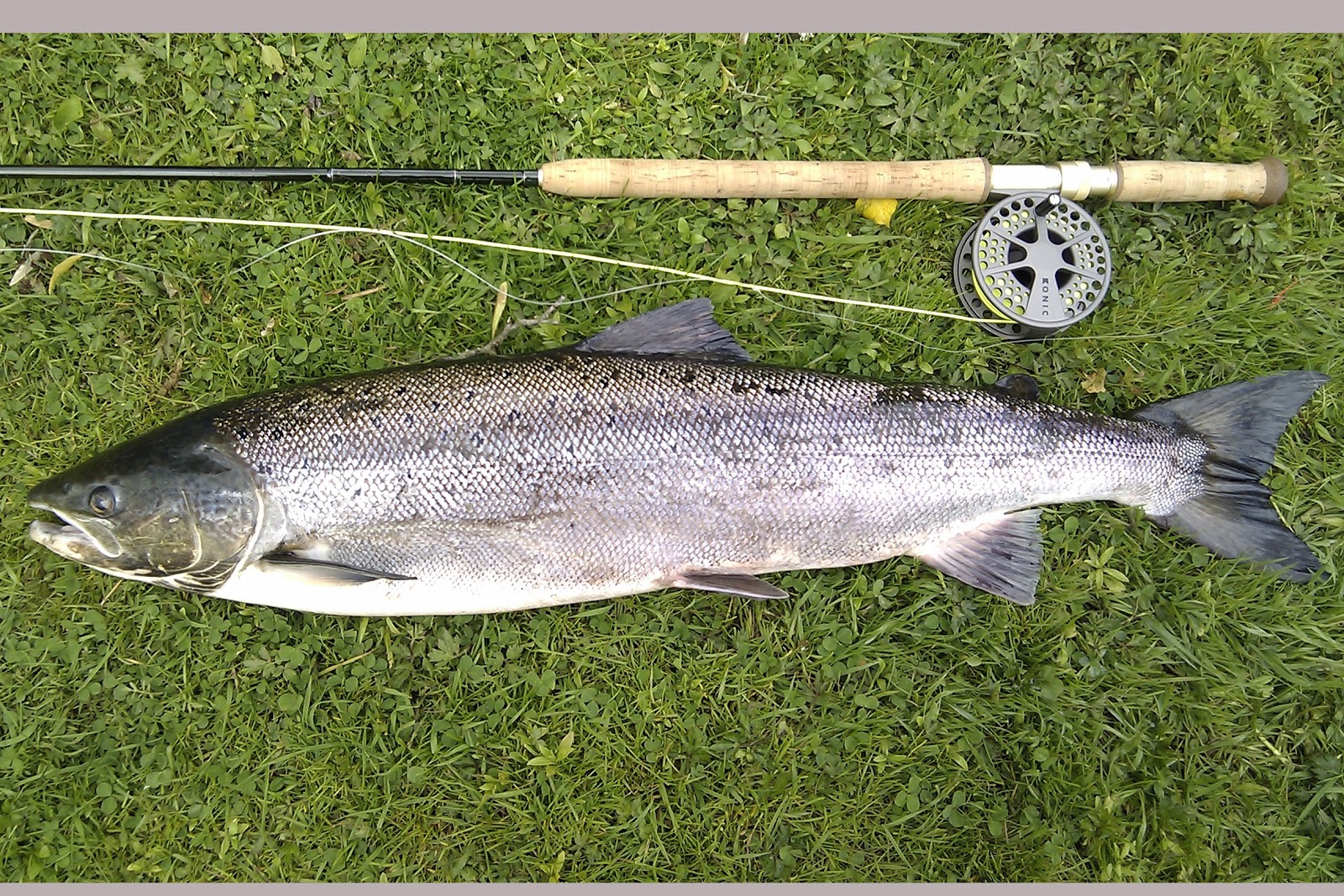
Yes, Rory's fish was big, but just how heavy?  Please make your estimate now and then review it at the end of this article.

In this era of near 100% catch and release the whole question of weight has become a vexed issue.  In the old days you knocked it on the head and put it on the kitchen scales (or bathroom if it was truly huge).  It's simple if you've invested £100 in a Maclean weigh net, but that's not an economic proposition for those who only fish one week each year.  I'm fortunate: one of the advantages of having grown up children is that they can afford to be generous and give you a weight net as a birthday present.  Most salmon anglers face the challenge of coming up with a good estimate of the weight of a large fish.  Length alone doesn't cut it: there's no real substitute for pounds and ounces, as AA Milne might have put it, because "Tigger always seemed bigger on account of his bounces". Estimating the weight of salmon is difficult for the inexperienced, especially when they're tiggerly excited and bouncing about on the river bank with post-landing euphoria.


Teviot Silver 2008
Of course ghillies have an experienced and sceptical eye.  Most tend to be very accurate with early season fresh fish. Eoin Faigrieve was within 4 ounces with this chap who'd only been in the river a couple of weeks in early May 2008.  However, from June onwards it starts to become more difficult, especially for the less experienced angler.  


Length to weight estimating scales


The usual recourse is to use one of the scales that you can find either via Google or in various publications.  However, this is where the more vigorous (and sometimes vicious) debates on salmon weight begin in earnest.


Sturdy


Edward Sturdy, who gave his name to the scale, fished in Norway on the Vosso system, where large salmon are commonplace.  His scale is based on a formula, with the input in inches and the output in pounds.


(Length x 1.33) x Girth x Girth
                 800


The drawback with Sturdy's scale is that on the Vosso he was dealing with fish built like South Devon bullocks - big and massively broad and deep.  Those Norwegian characteristics are what made the genetic strain so popular with the salmon farmers when choosing their brood stock.  Traditionally Dee fish were viewed as being heavily built.  The squaring of the girth places more emphasis on that feature than the length.  That is appropriate for very big fish, when every extra inch of length sees a disproportionate increase in girth and weight.


Sparkling fresh
Helmsdale in April
The Sturdy Scale seems to work quite well for hefty fresh-run spring fish up until early June.

You can see the high girth to length proportion of this lovely example of an average 2SW spring fish from the Helmsdale.


Same river, same week, different shape
But even on the same river you get variations in shape and hence weight to length ratios.

Sturdy does allow for this in spring fish at least.  However, I suggest that his scale starts to run into problems later in the season and thus must be allied to judgement.


River Ure
Early October 2015

If you apply Sturdy to the dimensions of the Beast of Wensleydale - 42" long, 24" girth - you arrive at a highly improbable weight of 40 lbs.  Clearly something's wrong: I shall explain why shortly.

It was the biggest salmon of my life, but I'd be the first to say it was nowhere near that heavy.


General Scale

What I call the 'General' scale on account of its very wide circulation is probably probably based on blending Sturdy's formula with empirical experience of British fish.  I've seen it reproduced in T&S, on blogs and in fishery board leaflets.  You will find a nice clear reproduction on Richard Donkin's website.  The copy on the desk beside me as I type is printed on water-resistant paper and appears to have been cut out of a fishery board pamphlet.


Like Sturdy it's pretty good on normally shaped fresh run fish until early June.  From that point onwards things start to go awry.  Look at the changing profile of fresh fish as the months advance.  The August fish is much the biggest of the sample, but it may have been hanging around in the North Sea for a few months before running the river, and it came 130 miles to the point of capture, which might explain its reduced profile.


May
 Scale about right
July

Scale overestimates by 1 lb


August

Scale overestimates by 2.5 lbs


So what's the problem with length to weight scales?


Actually there are 5 problems:
  • From the moment they convert to fresh water salmon start to lose weight because they are living on stored energy.  The rate of loss accelerates as the months pass.
  • Grilse and smaller salmon are less efficient swimmers than big fish and so burn off a higher percentage of their stored energy during migration.  They are also more mobile and erratic while running.
  • Hen fish are better at energy conservation than their testosterone-laden brothers, especially in the later summer and autumn.  They do, however, convert a great deal of flesh protein into eggs and the process is not a straight exchange of mass.
  • Very large fish are the most efficient swimmers and once in the river display extreme levels of energy conservation.  In a secure lie they seem able to go into a state of limbo, with all their body systems just ticking over.
  • And cock fish grow their kypes, which serve to exaggerate their length.  This is a major source of error in estimating their weight unless the extra length is discounted.

How much weight do they lose?

Ure Kelt 2011


The simple answer is an awful lot.  The mended kelt in the picture died during the fight and I couldn't revive it.  It was just over 36 inches in length, so it's reasonable to suggest that when it had entered the Humber a year earlier it was some 20 lbs in weight.  At death it weighed less than 12 lbs.

About 70% of a salmon's weight is flesh.  The other 30% comprises head, bones, skin and internal organs.  So during the last year of its life, this specimen lost more than 50% of its flesh mass and 40% of its original overall weight.  Those figures provide an objective anchor for the bottom of any weight loss graph.


Mr Angry
a colourful shadow of a former 14-15 pounder
September


As I said earlier, most cock fish lose weight faster.  This chap is a good example of the effects of the testosterone-driven territorial behaviour that is prevalent in the autumn.  He was the 'Pool Boss' of the tail of Flesh Dub: every time another male fish ran through his patch he would launch into an energy-sapping aggressive display.  Indeed, he was so punchy that he came after a small Ally Shrimp being stripped quickly from a range of 15 or more feet: the visual spectacle and tension was like something out of Jaws.  He was 35" long including his kype, but you can see how much body mass has already gone.  By spawning time he would have been knackered and down to a weight of 9-10 lbs.  That's why many fewer cocks than hens survive the spawning process.  it's quite possible that Mr Angry didn't make it to the spawning start-line.


Compare his body profile and mass with a hen fish caught a fortnight earlier 400 yards upstream.


Compare him also to this much bigger chap caught at exactly the same point of the season and place.  It's not a good photo, but make no mistake this was a very good fish.

He's a 37" 3SW who clearly hasn't wasted his energy on pointless behaviour.  But he most certainly isn't the 22 lbs that the scale might suggest on first inspection.  Not only has he lost 2-3 lbs in mass wastage, but also he's grown by 1.5" with the development of his kype.  He's actually somewhere around 15 lbs.


Definitely not a pretty fish
Tomatin 2005
Smaller fish also lose a larger proportion of their flesh mass.  Most grilse are male, so they are caught by the double trap of inefficiency and hyper-activity.  This especially ugly exemplar was my second-ever Findhorn fish on the fly, taken in very low warm water.

I was very much a novice then and delighted to have caught the fish after blank years in 2002 and 2003.  The sharp-eyed tackle geeks will spot an Aircel double-taper line and the Fibatube 13 footer I inherited from my father.  Those were indeed the early days.


This graph, based on an estimate for two identical 15 pound fish that entered the Ure in May, attempts to show with the blue line how the cocks' weight loss accelerates as the testosterone rises.  The main weight loss for the hen in Nov/Dec is the loss of egg mass at spawning: the milt mass in cock fish is significantly less.


Large Ure hen
3rd week of October

The visible effects of flesh mass loss in hen fish is often concealed by the 'plumping' effect of egg development.  You can see the well-stuffed appeared of this very large early October hen fish.  The sharp-eyed readers will spot the figure on the tape measure - 38" - which suggests that in May she was around 24 lbs.  Unfortunately, with flesh loss she was probably nearer 19 lbs by this time.

Note also the very short distance from the from the front edge of her eyeball to her nose - just 2.5" - which is germane to the next heading.


I got into a complete mess landing this fish, which explains why she's covered in sand.  Someone else had my landing net; just as I got hold of her tail in shallow water she went berserk; I fell over; and in the melee between us we broke the top section of my rod.  What a shambles!


How much does the kype extend?

Kype growth is one of the most important factors that lead to the overestimation of the weight of late summer and autumn cock salmon.  It is essential to grasp that the kype is not an integral part of the salmon's skeleton.  The hormone-driven growth of the cartilaginous extension is a temporary addition to the fish's body.  And of course, both estimating scales are based on skeletal length, not overall length.

The easy answer to this question is that it all depends.  Not all kypes are equal, nor do they grow at the same rate.  The first variable is whether the fish has run a river before (note the 'a river' - it could be a strayer).  If the fish survives spawning, its hormones subside and the kype shrinks as the kelt mends, but the nose doesn't return to its start state.  There's always an extra bit of bone and cartilaginous material that remains.  That gives it a head start on the next occasion.  Thus you can have 2 fish of the same birth age, one a 3SW first-timer and the other a former grilse, similar in most respects apart from the rate and extent of kype growth.  You can of course then play all the various permutations, but it won't necessarily give you a consistent explanation.  Then the equation is further complicated by latitude and when the salmon start spawning: as a general rule Findhorn and other northern Scottish cock fish are 4-5 weeks ahead of their Yorkshire cousins in testosterone levels and kype growth.


Here's a pair of fairly typical late season 2SW cock fish taken on the Ure in early October.  The were probably around 8-9 lbs on entry and by then were down to 7 lbs or so.  I apologise for the poor focus on the top one caused by haste to get a good profile of the kype.  They've both got just over an inch of kype growth.  The one to the right is more interesting, especially if you examine his upper jaw in close-up.


What a fine manly jaw
River Ure
October 2019
Here you can see the mark on the upper jaw showing the underlying bone profile from which it has extended by about 1.25".  It looks more, especially if you focus on the lower jaw, but that's fairly typical.  It will, however, extend further towards 2" before spawning in late November - early December.

But it does suggest that with a 2SW cock fish at this point in the season, or in September at the Findhorn's latitude, you need to knock about 1.5" off the length as well as applying mass depreciation in arriving at an adjusted weight.  But to be frank, we're not much concerned with exact weights at this size.


Mid-September
Let's now look at some bigger fish where the estimates of weight take on a whole new meaning.  We'll start with the 37 inch 3SW you saw above.  He probably turned Spurn Point at a spanking 18-19 lbs, but then he was only 35.5" long, not 37".  He hasn't been in fresh water as long as Mr Angry, so I reckon he's lost about 2-3 lbs of body mass.  So looking at the General Scale at 35" (18.5 lbs) and knocking off 3 lbs leads to my estimate of 15 lbs.


No, he's not one of my sons
Here's Rory's first large salmon, taken at Tomatin in early September 2011 and he's rightly proud of this warrior who was led astray by testosterone and chasing a rapidly stripped fly in the early morning.  See the post 'Morning Glory - Sex and Flies" for an explanation.  The latitude effect is evident.  The kype is much more developed than the bigger fish above.  There's close to 3" of upper jaw extension beyond the growth line.  Leaving aside the effect of the well-advised pose, once you deduct 3" of kype and apply appropriate mass depreciation its much-reduced real weight is exposed.  By such means does a 36" fish shrink from 20 to 12 lbs (it was killed and weighed).


And then you get the exceptions.  This brute was caught on the Deveron the week after I caught the Beast by an acquaintance who has a well-established reputation for catching very big late season fish and the prize rods to prove it.  It measured 41.5" in length and had a girth of 21.5".  This fish was therefore slightly shorter and 2.5" slimmer than the Beast and had a similar upper jaw extension of around 2.5 - 3".  With a net length of 38.5" and adjusted at the rate of mass depreciation you see in mid-teen fish, you'd be thinking of 24 lbs.


In fact it was weighed in front of a reliable witness at 31 lbs 4oz, earning the captor the prize for the biggest Deveron fish of the year.  Incidentally, as his prize he chose a Vision MAG 13', which goes to prove that I'm a better judge of rods than I am of the weight of very large cock salmon.  In any event there's little doubt that very big fish are different: they're highly efficient swimmers; they don't waste energy being stupid; and they're a very different shape.  This means that hypotheses that work for fish in the 14- 20 lbs zone aren't reliable for 30 pounders.


So what?

To get a better estimate of the weight of your salmon apply the following adjustments:

  • Until June use the General scale and apply only minor adjustments for mass loss, based on what you see.  Moderate or increase the mass loss to allow for size above or below 15 lbs/33".
  • After June continue to use the General scale but apply the following adjustments
    • Hen Fish  Measure from the nose to the fork in the tail and correct for mass loss using the orange line in the graph above and a degree of judgement.  Don't be fooled or flattered by the 'plumping' effect.
    • Cock Fish  Measure from the bone line in the upper jaw to tail fork.  Correct for mass loss using the blue line and common sense.  To guide that judgement remember that the girth may still be roughly the same as it was in the spring, but by by September the stomach cavity walls have already lost much of their mass.  And invisibly, most of the heavy high-energy fats interleaved in its flesh have gone.
    • Very big fish are where you can go badly wrong: I certainly did in my early years and even now in the post-fight euphoria my judgement gets seriously frayed.  Measure the length and girth; take a good photo side on; and pick it up with both hands to feel the weight (30 lbs is your wife's checked-in bag for holidays).  Please don't commit to an estimate until you've calmed down.  But do embrace the adrenalin, euphoria and accolades; enjoy the moment and the years of pleasurable glow to come; congratulations!  No matter what the exact weight it was very big and you caught it.

What was your estimate of the weight of Rory's fish at the top of the post?

The correct answer, courtesy of Mr Maclean, is 16.5 lbs.


Looking Ahead

After the wettest February on record - albeit strangely in Swaledale but not Wensleydale - at the end of a wet autumn and winter, there's water everywhere.  Let's hope the river levels are still good on 6th April when the Yorkshire season opens, because this year I really hope to catch Yorkshire silver.  On the other hand I say that every year, don't I?

Come March it will be time to launch into my spring routine.  The anticipation is already climbing.  For you lucky folk who have started the new season, tight lines.


Thursday, 14 November 2019

MCX's Christmas Stocking 2019

It's that time of year again.  As I get older it seems to come round with ever-increasing speed.  I suppose it's the fault of all those little monsters who "can't wait for Christmas" causing clocks to accelerate.  On the other hand, I need to be a bit more charitable about little people after the grandchild count reached 5 earlier this year.  They're still too young to start fishing but I'm looking forward to the 2022 season when they will enter the frame.  From the moment I caught my first trout I was totally hooked: the magic of the take; the excitement of the fight; its beautiful red spots; and the pride of success.  It's still crystal clear in my mind, yet so, so long ago - Winston Churchill was then the Prime Minister.  I desperately hope that they in their turn will enjoy the same thrill as the foundation of a lifetime's pleasure.

I wrote the first Christmas Stocking in 2013 and with the exception of 2017 it's been an annual event, in the belief that you may find it useful in advising Father Christmas (or in my case Mrs Christmas).  The items described:
  • Work well and add value on the river
  • Are cheap enough to consider putting in a Christmas stocking
  • Offer good quality and value for money
  • Can be purchased without technical knowledge by internet or phone
  • Fit in a large sock


Followers of this blog will of course note that there are hardy perennials.  It's not that I lack originality: if something's good and worth having, it wouldn't make sense to displace it purely for the sake of doing so.  Anyway, I doubt that many readers will bother to go back through the back numbers, so I hope that repetition bothers you less than it does me.

Budget Nippers

Sportfish own-brand nippers
Year after year I've bemoaned the price charged by some brands for nippers.  Abel's £159.99 effort is an especially egregious example.  I suppose someone must buy them, but I can't for the life of me think why.  The search for good budget nippers has thus become something of a personal crusade, during which I have sampled 4-5 different designs across the price range £3.99 - £14.75.  The cheapest ones rapidly disintegrated, and the more expensive Fishpond is still going strong, albeit after 4 seasons it's showing signs of going blunt.  Last summer I needed a new pair for trout fishing, which led me to Sportfish's own brand.  They're described as de-luxe, but are absolutely austere and fuss-free.  More importantly, they're very sharp and do exactly what's required.  It may be that they'll go blunt after a couple of seasons, but on that basis you should get 50 years' fishing before you equal the outlay on the Abels, and you'll never worry about losing these.

Gloves

The Snowbee gloves are the ultimate perennial, featuring in every edition of the Christmas stocking since 2013.  At a mere £12.99 they're unbeatable value.  On average they last 2-3 seasons and work well in all but the lowest temperatures.  As the years go by, the blood thins and my resistance to cold declines, I need the gloves more often than before.  I wouldn't be without them.


Mitten Clamps

Every time I come to unhook a salmon I give thanks for my clamps, which are so much easier to use and far more powerful than conventional forceps.  My trusty William Josephs are now longer in production, but these Loons at £21.99 from John Norris are first class.  The advantages of having a full-hand grip on a nice rubbery handle are huge, especially when you're dealing with a lively fish in the water.


Digital Thermometer

My little device continues to be an object of remark everywhere I go to fish.  All you have to do is walk to the water, point, press and read the result on the screen, all in less time than it takes to read this sentence.  It weighs about an ounce and the batteries last for years.

Specialised digital fishing thermometers are about £40-50, but this device from Labfacility in Sheffield costs £13.20 inc VAT.  They do charge you a whopping £9 for P&P, but even so you are still saving a full £20 and more against examples sold by angling retailers.


Wader Repair

For many years Aquasure was a hardy perennial.  However, I've generally found that you buy a 60 gm tube, use 3-4 grams and then throw away the other 55 grams that have gone solid.  To answer the requirement for quick, easy repairs to waders and jackets on the riverbank, without the need for curing time or hairdryers, McNett have come up with self-adhesive, instantly curing Goretex patches, 2 in a pack for £6.99.  That's the same price as a tube of Aquasure and there's no waste.  As an alternative you could also consider the Aquasure quick kit at £7.99, in which the tube only contains 6 grams, for more deliberate repairs.


Basic Fly Box


The Wheatley Comp Lite fly box I recommended last year has given a good season's service.  Its price is now £12.99 for the 6 inch version.  It's simple, functional and does just what I need.  I don't carry a lot of flies and have just 2 boxes for doubles - one marked 'High' and the other 'Low' reflecting the prevailing water level.


Small Tube Fly Box

I continue to miss the baby Snowbee box - they've gone all flashy, plastic and big now.  The neatest design around at the moment is the C&F Small Case, which is suitably compact and works well.  The clear plastic internal lid that keeps the tubes safe has a cunning magnetic latch.  I bought one of these 4 years ago and it's thoroughly satisfactory.  It's a bit more than an average stocking price at £27.99 from John Norris (£2 cheaper than Sportfish), but I haven't found anything as good at a lower price.


Seat Covers

I discovered these handy things 5-6 years ago and keep a pair in the car.  If you need to drive between beats (or to the pub for lunch) in wet waders, they are a very cheap and convenient way of protecting your car upholstery at £8.99 from John Norris.  They're very quick and easy to fit and pack away into a pouch no larger than a pair of socks.


Cranky Kit

When I change lines and shooting heads I meticulously coil them to fit in an old cardboard reel box.  This is all very fine but it's time consuming, especially if the head in question is 55 feet long, and it also puts a slight twist in the line.  This year Rio have come up with this clever device to allow you to wind the head straight onto a line holder that you then detach and stow.  Unusually for Rio it's sensibly priced at £7.99 from John Norris and other suppliers.  Purist coilers will probably say it's unnecessary but I'm going to drop the hint to Mrs CX.  It will certainly work much better than the C&F shooting head winder that I tried and discarded 7 years ago.


Stocking Fillers

Here's a selection of low-cost but useful items to fill any gaps in your stocking.

Airflo polyleaders are a hardy perennial that I request every year.  They're currently discounted by £2 to £4.99 for the 10' salmon version at John Norris.


Leader rings are a very convenient way of joining elements of your built-up leader and of providing a durable junction at the bottom of a polyleader.  When you need to replace the tip section it's much easier and quicker to tie a single Blood knot to a ring than fiddle about doing a full double.  £1.99 for 10.


Knot Sense is another hardy perennial.  I like the ease with which you can form a smooth shape over a knot, which renders it less vulnerable to abrasion.  There's also a degree of flexibility with Knot Sense that you don't get with cheaper super-glues.  I've never had a knot fail while using this.


Father Christmas Goes Bonkers


As in 2018, the retailers seem to be holding their nerves and breath in the run-up to Christmas.  There's very little discounting of kit in the 'bonkers' zone.  I have, however, found one superb offer.  John Norris is selling Lamson Guru reels with 30% off.  This brings the 4.0 model - a perfect #8/9 to match most 13' and 13' 6" double handed rods - down from £290 to £202, which is below the price of die cast models from some other makers.  I've used this reel for years on the MAG and Charles Burns, and as a result I'm a great fan of the elegant simplicity of the Guru's design, manufacture and utility.  It's a delight to behold and use, and requires minimal maintenance.  I suspect that this model is about to be superseded, but I can't see that they can improve its function.  The changes are likely to be purely cosmetic.  At £202 it's a great bargain and will probably sell out quickly.  The smaller 3.5 at £188 is a #7/8 and would work nicely on a switch rod.


So I wish you a very Happy Christmas, a great New Year and hopefully a nice average season's weather in 2020.  Tight lines!